
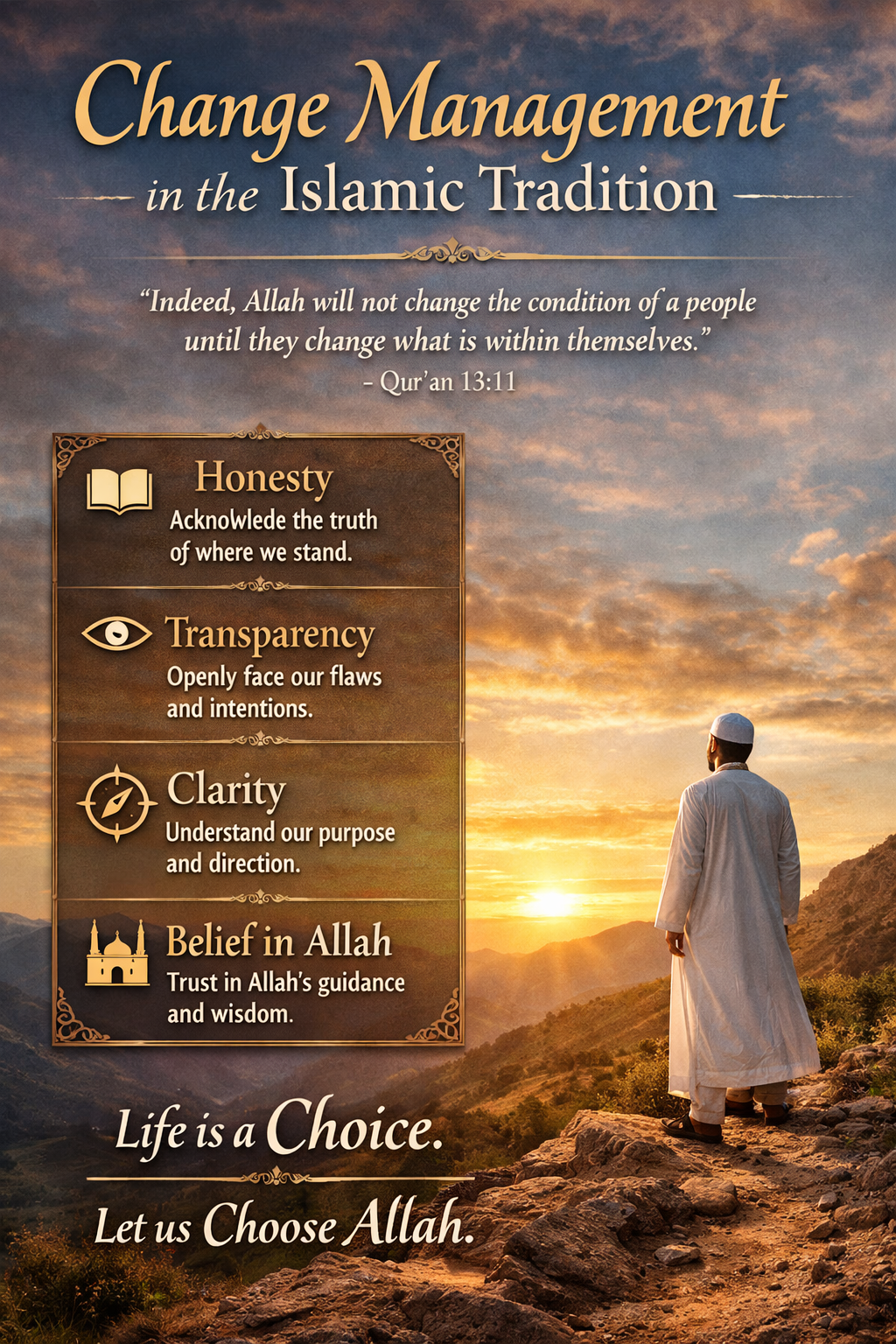
Change Management in the Islamic Tradition: A Theological and Transformational Framework
Change is a fundamental aspect of human life and social development. In modern management literature, change management is frequently discussed within corporate, organizational, and psychological frameworks. However, long before contemporary theories emerged, Islam presented a profound and comprehensive framework for understanding and managing change at both the individual and societal levels. This article explores the Islamic conception of change by examining theological principles, Qur’anic guidance, and the transformative methodology of the Prophet Muhammad (peace and blessings be upon him) during his twenty-three years of prophethood. The study argues that change in Islam begins with a conscious decision rooted in faith, followed by a disciplined process grounded in honesty, transparency, clarity, and unwavering belief in Allah. Through the lens of Islamic teachings, change is reframed not as a burden but as a liberating and rewarding journey toward spiritual freedom and moral responsibility. Ultimately, Islam presents change as a choice—a deliberate return to divine guidance and alignment with the purpose of human existence.
Introduction
Change is often perceived as one of the most difficult challenges facing individuals and societies. Within contemporary discourse, change is associated with uncertainty, discomfort, and resistance. Psychological research frequently identifies fear of the unknown, attachment to familiar habits, and perceived loss of control as major barriers to transformation. As a result, many individuals conclude that meaningful change is nearly impossible.
Yet from an Islamic perspective, this perception warrants critical examination. The assumption that change must be inherently difficult is not a theological inevitability but rather a psychological construct shaped by human perception. Islam proposes an alternative understanding: change can become manageable, purposeful, and even spiritually uplifting when grounded in faith and correct conceptual framing.
In Islamic thought, transformation is not merely a social or behavioral phenomenon. It is fundamentally spiritual and existential. The Qur’an repeatedly calls humanity to reflect, reform, and return to the path of righteousness. Change is therefore embedded within the core mission of Islam.
The Prophet Muhammad (peace and blessings be upon him) exemplified this transformation during his twenty-three-year mission. Through revelation, moral leadership, and strategic wisdom, he transformed a fragmented society into a morally conscious and spiritually unified community. This transformation was not accidental; it was the result of a systematic process rooted in divine guidance.
This article aims to explore the Islamic framework for change management by addressing several key questions:
How does Islam conceptualize change and transformation?
What principles guide individual and societal change within Islamic teachings?
How did the Prophet Muhammad demonstrate effective change management during his prophethood?
What role do intention, faith, and mindset play in facilitating transformation?
Through theological analysis and historical reflection, this study presents Islam as a comprehensive model for sustainable and meaningful change.
Conceptualizing Change in Islam
The Arabic language offers several terms associated with transformation and reform, each highlighting different dimensions of change. Among these are taghyīr (change), islāḥ (reform), and tawbah (repentance and return).
Each concept reflects an important element of the Islamic worldview.
Taghyīr (Change)
The Qur’an explicitly addresses change through the concept of taghyīr. One of the most frequently cited verses states:
“Indeed, Allah does not change the condition of a people until they change what is within themselves.” (Qur’an 13:11)
This verse establishes a foundational principle: societal change begins with internal transformation. Islam therefore emphasizes personal accountability as the starting point for broader social reform.Islāḥ (Reform)
Islāḥ refers to improvement, reconciliation, and restoration. It is often used in the Qur’an to describe efforts aimed at correcting injustice and restoring moral balance. Unlike superficial change, islâh involves intentional improvement guided by ethical principles.Tawbah (Return)
Tawbah represents a deeper dimension of change. It signifies a conscious return to Allah after recognizing deviation from the path of righteousness. Tawbah reflects the Islamic understanding that transformation is always possible regardless of past mistakes.
Together, these concepts illustrate that change in Islam is not merely behavioral modification. It is a comprehensive process involving the mind, heart, and actions.
Reframing the Perception of Change
In contemporary culture, change is often framed as an inherently stressful process. This framing influences how individuals approach transformation. If change is perceived as painful or threatening, resistance becomes natural.
Islam encourages believers to challenge such assumptions.
When change is directed toward Allah and motivated by sincere intention, it becomes a source of comfort rather than distress. The Qur’an frequently associates faith with tranquility:
“Verily, in the remembrance of Allah do hearts find rest.” (Qur’an 13:28)
This verse highlights a critical psychological insight: peace is not achieved by resisting change but by aligning oneself with divine guidance.
Therefore, the difficulty associated with transformation often arises not from the change itself but from the definitions and assumptions individuals attach to it. When believers reframe change as a path toward spiritual liberation rather than loss, the emotional experience shifts significantly.
This reframing aligns with modern cognitive psychology, which emphasizes the role of mindset in shaping behavior and emotional responses.
The Moment of Decision
An important principle within Islamic teachings is that transformation begins with intention (niyyah). The Prophet Muhammad stated:
“Actions are judged by intentions, and every person will have what they intended.” (Sahih al-Bukhari)
From this perspective, change begins with a single decision of the heart. This moment of decision may occur instantly, even if the subsequent process unfolds gradually.
Thus, one may argue that change itself takes only a moment—the moment when the individual resolves to pursue a new direction for the sake of Allah.
However, the journey that follows requires commitment, patience, and discipline. Islam does not demand instant perfection but encourages continuous improvement.
The Prophet (peace and blessings be upon him) emphasized consistency in this regard:
“The most beloved deeds to Allah are those that are consistent, even if they are small.” This principle reflects a sustainable model of transformation where gradual progress is valued over dramatic but short-lived efforts.
The Prophetic Model of Transformational Change
Perhaps the most profound example of change management in history can be found in the life of Prophet Muhammad (peace and blessings be upon him).
Over the course of twenty-three years, the Prophet (peace and blessings be upon him) guided a society characterized by tribal conflict, economic inequality, and widespread injustice toward a unified moral framework rooted in monotheism and ethical responsibility.
This transformation occurred through several stages.
Stage One: Intellectual and Spiritual Awakening
The first phase of the Prophet’s mission focused on establishing the foundation of belief in one God. The central message of Islam—La ilaha illa Allah—represented a radical shift in worldview.
It challenged entrenched systems of power and demanded moral accountability. By emphasizing monotheism, the Prophet reoriented individuals away from tribal loyalty and toward universal ethical principles.
Stage Two: Character Development
The Prophet (peace and blessings be upon him) placed significant emphasis on moral refinement. His teachings addressed honesty, compassion, justice, humility, and generosity.
Before establishing political structures, the Prophet (peace and blessings be upon him) prioritized character transformation. This approach highlights a key lesson for change management: sustainable systems must be built upon ethical foundations.
Stage Three: Community Formation
After years of persecution in Mecca, the migration to Medina marked the beginning of a new stage in Islamic history. The Prophet (peace and blessings be upon him) established a community based on cooperation, mutual support, and justice.
The Constitution of Medina, often regarded as one of the earliest written social contracts, demonstrated remarkable foresight in managing diverse communities.
Stage Four: Institutional Transformation
As the Muslim community grew stronger, institutions reflecting Islamic values were gradually established. Economic reforms, social welfare mechanisms, and legal frameworks were introduced.
This phased approach ensured that change occurred organically and sustainably rather than through abrupt imposition.
Psychological Foundations of Change in Islam
Islam recognizes the complexity of human psychology and provides guidance for managing internal resistance to transformation.
Several psychological principles can be identified within Islamic teachings.
Self-Reflection (Muhasabah)
Islam encourages believers to engage in regular self-evaluation. Umar ibn al-Khattab famously advised:
“Hold yourselves accountable before you are held accountable.”
Self-reflection allows individuals to recognize areas requiring improvement and take proactive steps toward reform.
Hope and Mercy
One of the greatest barriers to change is despair. Individuals who believe they are beyond redemption may lose motivation to improve.
Islam counters this mindset by emphasizing divine mercy:
“Do not despair of the mercy of Allah.” (Qur’an 39:53)
This message reassures believers that transformation remains possible regardless of past failures.
Patience (Sabr)
Transformation requires perseverance. The Qur’an repeatedly praises patience as a virtue necessary for overcoming challenges.
Patience enables individuals to maintain commitment even when progress appears slow.
Honesty, Transparency, and Clarity
Islamic change management begins with intellectual and moral honesty.
Honesty requires acknowledging one’s shortcomings without denial. Transparency involves openness about intentions and motivations. Clarity ensures that individuals understand their purpose and direction.
These qualities were evident in the leadership of the Prophet Muhammad (peace and blessings be upon him). His reputation for integrity—earning him the title Al-Amin (the trustworthy)—played a crucial role in establishing credibility.
In modern leadership theory, trust is widely recognized as a cornerstone of effective change management. Islamic teachings anticipated this principle centuries earlier.
Belief in Allah as the Foundation of Transformation
At the heart of Islamic change lies unwavering belief in Allah. Faith provides both motivation and guidance for personal transformation.
Belief in divine accountability encourages ethical conduct, while trust in divine wisdom provides reassurance during difficult moments.
Faith also redefines success. Rather than measuring achievement solely through material outcomes, Islam emphasizes spiritual growth and moral integrity.
Change as Liberation
One of the most profound insights within Islamic teachings is that change directed toward Allah represents a form of liberation.
Human beings often become enslaved by social expectations, desires, and ego-driven ambitions. Islam calls individuals to free themselves from these constraints by submitting to divine guidance.
Paradoxically, submission to Allah leads to true freedom. By aligning with a higher moral framework, individuals gain clarity of purpose and independence from worldly pressures.
Life as a Series of Choices
Islam consistently emphasizes human agency. While divine guidance is available, individuals must ultimately choose their path.
The Qur’an frequently presents belief and disbelief as choices:
“Whoever wills—let him believe; and whoever wills—let him disbelieve.” (Qur’an 18:29)
This verse underscores the importance of personal responsibility. Every action reflects a decision regarding one’s relationship with Allah.
Choosing Allah
In conclusion, the Islamic framework for change management presents transformation as a deliberate and spiritually meaningful process. Change begins with a moment of decision but unfolds through consistent effort, patience, and faith.
The Prophet Muhammad (peace and blessings be upon him) demonstrated the effectiveness of this model through his leadership and moral example. His twenty-three-year mission transformed individuals and societies by emphasizing belief, character development, and community building.
Ultimately, Islam teaches that life itself is a choice. Every moment offers an opportunity to move closer to or further away from divine guidance.
To choose Allah is to choose purpose, clarity, and moral responsibility. It is to embrace transformation not as a burden but as a path toward spiritual freedom.
Change therefore becomes not merely possible but inevitable for those who sincerely seek the pleasure of Allah.
Yours sister,
Dr. Thamina Anwar
CEO and Founder
Global Halal Shura Hub
please Join the Global Halal Shura Hub Community
📱 WhatsApp Community
👉 https://chat.whatsapp.com/CZJshg7AycWFJd3CyhSWj3
🌐 Website
https://globalhalalshurahub.com
📧 Email
thaminaanwar11@gmail.com; globalhalalshurahubsocialmedia@gmail.com
📘 Facebook
https://www.facebook.com/profile.php?id=61588247732733
https://www.facebook.com/profile.php?id=61588077462429
📷 Instagram
https://www.instagram.com/globalhalalshurahub/
🔗 LinkedIn
https://www.linkedin.com/in/dr-thamina-anwar-806124145/
https://www.linkedin.com/in/global-halal-shura-hub-dr-thamina-samina-anwar-05418b398/
📺 YouTube Channel
https://www.youtube.com/@GlobalHalalShuraHub
#globalhalalshurahub