
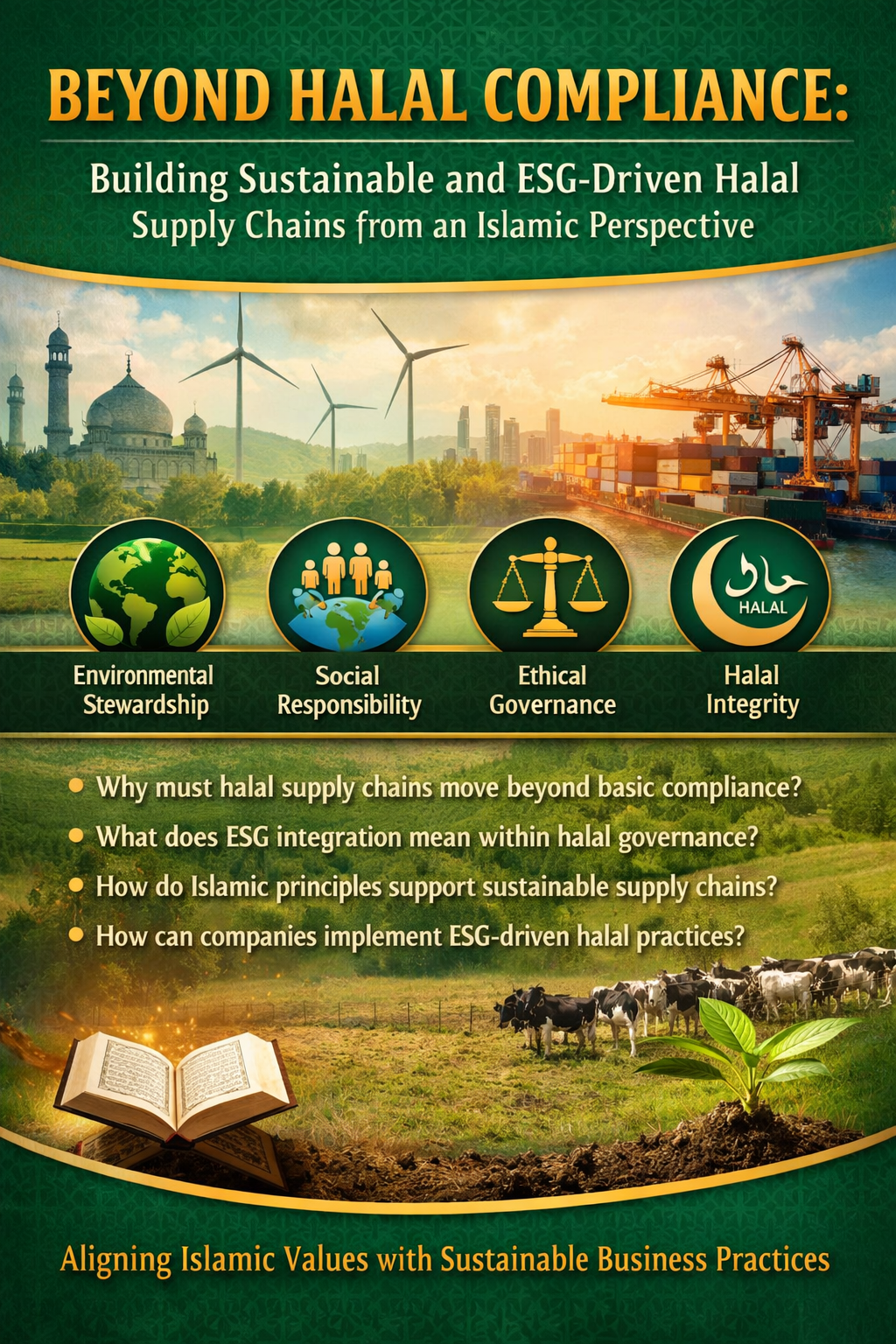
Building Sustainable and ESG-Driven Halal Supply Chains from an Islamic Perspective
Over the past two decades, the global halal economy has experienced remarkable expansion, transforming from a niche religious market into one of the fastest-growing sectors of the global economy. The halal industry now encompasses a wide range of sectors including food, pharmaceuticals, cosmetics, logistics, tourism, fashion, and financial services. Halal certification has traditionally served as the primary mechanism for ensuring compliance with Islamic dietary laws and maintaining consumer trust. However, as supply chains become increasingly complex and consumers demand greater ethical accountability, there is growing recognition that halal compliance alone may not be sufficient to ensure the long-term sustainability and credibility of the halal industry.
This article explores the convergence between Islamic ethical principles and Environmental, Social, and Governance (ESG) frameworks within the context of halal supply chain management. ESG frameworks have become a central component of modern corporate sustainability strategies, focusing on environmental stewardship, social responsibility, and ethical governance. The article argues that these principles are deeply aligned with core Islamic values such as stewardship (khilafah), justice (‘adl), trustworthiness (amanah), and public welfare (maslahah).
Using a conceptual “Why–What–How” framework, this study examines the necessity of integrating ESG principles into halal supply chains, identifies the key areas of integration, and proposes practical strategies for implementation. The analysis demonstrates that Islamic ethical teachings provide a strong moral and conceptual foundation for sustainable business practices that extend beyond basic halal compliance.
Ultimately, the article proposes that the future development of the halal industry lies in the creation of supply chains that combine halal integrity with environmental sustainability, ethical governance, and social responsibility. Such an approach not only strengthens the credibility of halal certification but also positions the halal industry as a global leader in ethical and sustainable commerce.
Introduction
The global halal economy is currently undergoing a significant transformation. Historically, the concept of halal was primarily associated with dietary regulations governing what Muslims are permitted to consume. These rules focused mainly on food preparation, slaughtering practices, and ingredient verification. For centuries, halal functioned primarily as a religious guideline for Muslim communities rather than as a global commercial system.
Over time, however, the scope of halal has expanded dramatically. Today, halal is no longer limited to food production but encompasses a wide array of economic activities. The halal market now includes pharmaceuticals, cosmetics, personal care products, tourism services, fashion, logistics, and financial services. This expansion reflects both demographic trends and broader changes in global consumer behavior.
With the global Muslim population approaching two billion people, the demand for halal products and services has increased significantly. Muslim consumers are increasingly seeking products that comply with Islamic principles, not only in terms of ingredients but also in terms of ethical production and supply chain integrity. At the same time, non-Muslim consumers are increasingly drawn to halal products because they are often perceived as cleaner, safer, and more ethically produced.
According to industry estimates, the halal food market alone exceeds USD 1.5 trillion annually. When combined with other halal sectors such as finance, tourism, and lifestyle industries, the global halal economy is projected to surpass USD 3 trillion within the next decade. As a result, companies across both Muslim-majority and non-Muslim-majority countries are increasingly seeking halal certification as a strategic gateway to global Muslim markets.
Despite this rapid expansion, the halal industry faces several structural challenges. Many existing halal supply chains continue to interpret halal primarily as a technical certification process focused on verifying ingredients and ensuring compliance with Islamic dietary laws. While these procedures remain essential, this narrow interpretation risks reducing halal to a regulatory label rather than recognizing it as a comprehensive ethical framework rooted in Islamic values.
In an era characterized by climate change, social inequality, and increasing demand for corporate accountability, halal supply chains must evolve beyond this limited interpretation. Halal compliance remains necessary, but it is no longer sufficient to ensure long-term credibility and sustainability.
Instead, halal supply chains must integrate broader sustainability frameworks that address environmental impact, social responsibility, and governance integrity. Environmental, Social, and Governance (ESG) frameworks have emerged as one of the most influential models for evaluating corporate sustainability in modern business environments.
From an Islamic perspective, integrating ESG principles into halal supply chains does not represent a departure from traditional halal values. Rather, it reflects a reaffirmation of the ethical foundations embedded within Islamic teachings. Islam emphasizes environmental stewardship, social justice, ethical governance, and accountability—principles that closely align with contemporary sustainability frameworks.
This article explores the intersection between Islamic ethical teachings and ESG principles within halal supply chains. It addresses four central questions:
Why must halal supply chains move beyond basic compliance frameworks?
What does ESG integration mean within the context of halal governance?
How do Islamic ethical principles support sustainable supply chain management?
How can organizations practically implement ESG-driven halal supply chains?
Through this analysis, the article argues that halal integrity provides the moral and operational foundation upon which sustainable and responsible supply chains can be built.
Halal as a Comprehensive Ethical System
In Islamic jurisprudence, the concept of halal extends far beyond the simple classification of permissible and impermissible foods. The Arabic term halal refers to that which is lawful and permissible according to divine guidance, while its opposite, haram, refers to that which is forbidden.
However, the Qur’an frequently pairs halal with another important concept: tayyib. The term tayyib conveys meanings such as wholesome, pure, ethical, and beneficial. This pairing indicates that halal consumption must satisfy both legal and ethical dimensions.
The Qur’an states:
“O mankind, eat from whatever is on earth that is lawful and good (halalan tayyiban).”
(Qur’an 2:168)
This verse illustrates that halal is not merely about permissibility but also about quality, purity, and ethical production. A product may technically satisfy halal requirements yet still violate broader ethical principles if it is produced through exploitative labor practices, environmental destruction, or dishonest trade.
Islamic economic thought emphasizes that commercial activities must promote justice, transparency, and social welfare. Trade is not merely an economic activity but also a moral responsibility.
The Prophet Muhammad (peace be upon him) emphasized ethical conduct in commerce when he said:
“The truthful and trustworthy merchant will be with the prophets, the truthful, and the martyrs.”
(Tirmidhi)
This hadith underscores the importance of honesty and integrity in business practices. Halal supply chains must therefore ensure not only lawful ingredients but also ethical practices throughout production, processing, distribution, and governance structures.
In this broader sense, halal can be understood as a holistic ethical system that encompasses environmental responsibility, social justice, economic fairness, and moral accountability.
The Rise of ESG in Global Business
In recent years, Environmental, Social, and Governance (ESG) frameworks have emerged as a central pillar of corporate sustainability strategies. ESG metrics provide a comprehensive system for evaluating corporate performance based on three interconnected dimensions: environmental responsibility, social impact, and governance practices.
The environmental dimension focuses on issues such as climate change, carbon emissions, resource management, waste reduction, and biodiversity protection. Companies are increasingly expected to minimize their environmental footprint and adopt sustainable production methods.
The social dimension examines how companies interact with employees, suppliers, consumers, and communities. This includes labor rights, workplace safety, diversity, consumer protection, and community engagement.
The governance dimension focuses on leadership ethics, transparency, accountability, anti-corruption practices, and corporate decision-making structures.
Global investors increasingly rely on ESG metrics to assess the long-term sustainability and risk profile of companies. Businesses that demonstrate strong ESG performance are often perceived as more resilient, responsible, and trustworthy.
For the halal industry, ESG frameworks offer an opportunity to expand halal beyond a narrow compliance-based model toward a more comprehensive ethical system that aligns with both Islamic principles and global sustainability standards.
Islamic Foundations for ESG Principles
Many of the principles embedded within ESG frameworks are deeply rooted in Islamic ethical teachings. Several key Islamic concepts provide a strong foundation for sustainable supply chain governance.
Stewardship (Khilafah)
Islam teaches that human beings are stewards of the earth. The Qur’an states:
“Indeed, I will place upon the earth a steward.”
(Qur’an 2:30)
This concept of khilafah establishes a moral obligation to protect natural resources and maintain environmental balance. Environmental sustainability therefore becomes a religious responsibility rather than merely a corporate objective.
Justice (‘Adl)
Justice occupies a central place in Islamic ethics. The Qur’an commands believers:
“Indeed, Allah commands justice and excellence.”
(Qur’an 16:90)
Within supply chains, justice requires fair wages, ethical sourcing practices, and equitable treatment of workers and suppliers.
Trust (Amanah)
Trustworthiness is a fundamental principle in Islamic commerce. Business actors are expected to uphold honesty, transparency, and accountability in all transactions.
Halal certification itself represents a form of amanah between producers and consumers. When consumers purchase halal products, they trust that producers and certifiers have fulfilled their ethical responsibilities.
Public Welfare (Maslahah)
Islamic jurisprudence emphasizes the promotion of societal welfare and the prevention of harm. Sustainable business practices that protect communities and ecosystems align closely with this principle.
Why Halal Compliance Alone Is No Longer Sufficient
Traditional halal certification focuses primarily on verifying ingredients, production processes, and contamination risks. While these procedures remain essential, they address only a limited dimension of ethical responsibility.
Modern global supply chains involve complex environmental and social consequences. Agricultural practices may contribute to deforestation, manufacturing facilities may involve exploitative labor conditions, and governance failures may undermine consumer trust.
If halal certification ignores these issues, the credibility of halal itself may be questioned.
Furthermore, contemporary consumers increasingly demand products that are not only halal but also ethically produced, environmentally sustainable, and socially responsible. Younger Muslim consumers in particular demonstrate growing awareness of climate change and ethical consumption.
Integrating ESG principles into halal supply chains therefore strengthens both ethical legitimacy and market competitiveness.
The Why–What–How Framework for ESG Integration
To effectively integrate ESG principles into halal supply chains, organizations must consider three key questions: Why integrate ESG, What should be integrated, and How can integration be implemented.
Why Integrate ESG?
Several factors explain the growing importance of ESG integration:
• rising consumer awareness of sustainability issues
• increasing regulatory pressure related to environmental standards
• investor demand for responsible corporate governance
• alignment between ESG values and Islamic ethical teachings
What Should Be Integrated?
Environmental initiatives may include sustainable agriculture, renewable energy adoption, and waste reduction strategies.
Social initiatives include fair labor practices, worker safety protections, and community development programs.
Governance initiatives involve transparent auditing systems, ethical leadership practices, and traceability mechanisms.
How Can ESG Be Implemented?
Implementation requires structural integration across supply chain operations through sustainability standards, digital traceability systems, ESG audits, and collaboration with halal certification bodies.
Sustainable Halal Supply Chains
Sustainable supply chains aim to minimize environmental harm while maximizing social and economic value.
Within halal supply chains, sustainability can be integrated at multiple stages including sustainable farming practices, responsible packaging, energy-efficient transportation, and transparent monitoring systems.
These practices align closely with Islamic teachings on environmental stewardship and responsible resource management.
Governance and Halal Integrity
Strong governance mechanisms are essential for maintaining halal integrity across complex global supply chains.
Effective governance includes independent certification bodies, internationally recognized accreditation frameworks, transparent auditing procedures, and emerging digital traceability technologies such as blockchain.
Social Responsibility in Halal Supply Chains
Islamic ethics emphasize compassion, fairness, and protection of vulnerable populations.
Businesses must ensure fair wages, safe working conditions, and respect for human dignity throughout supply chains. Community engagement and social welfare initiatives further reinforce the ethical foundations of halal commerce.
The Future of Halal and ESG Integration
As global markets evolve, halal supply chains must adapt to new expectations regarding sustainability, transparency, and ethical governance.
Companies that integrate ESG principles into halal operations are likely to gain competitive advantages through stronger reputation, improved compliance, and enhanced consumer loyalty.
Conclusion
The halal industry stands at a critical moment of transformation. While halal certification remains essential, the future of halal governance lies in broader ethical integration.
By aligning halal supply chains with ESG frameworks, businesses can develop systems that are not only compliant but also sustainable, ethical, and socially responsible.
The future of halal therefore lies beyond compliance—it lies in building supply chains that reflect the full ethical vision of Islam, where halal integrity and sustainability work together to serve both humanity and the planet.
Yours sister,
Dr. Thamina Anwar
CEO and Founder
Global Halal Shura Hub
please Join the Global Halal Shura Hub Community
📱 WhatsApp Community
👉 https://chat.whatsapp.com/CZJshg7AycWFJd3CyhSWj3
🌐 Website
https://globalhalalshurahub.com
📧 Email
thaminaanwar11@gmail.com; globalhalalshurahubsocialmedia@gmail.com
📘 Facebook
https://www.facebook.com/profile.php?id=61588247732733
https://www.facebook.com/profile.php?id=61588077462429
📷 Instagram
https://www.instagram.com/globalhalalshurahub/
🔗 LinkedIn
https://www.linkedin.com/in/dr-thamina-anwar-806124145/
https://www.linkedin.com/in/global-halal-shura-hub-dr-thamina-samina-anwar-05418b398/
📺 YouTube Channel
https://www.youtube.com/@GlobalHalalShuraHub
#globalhalalshurahub