
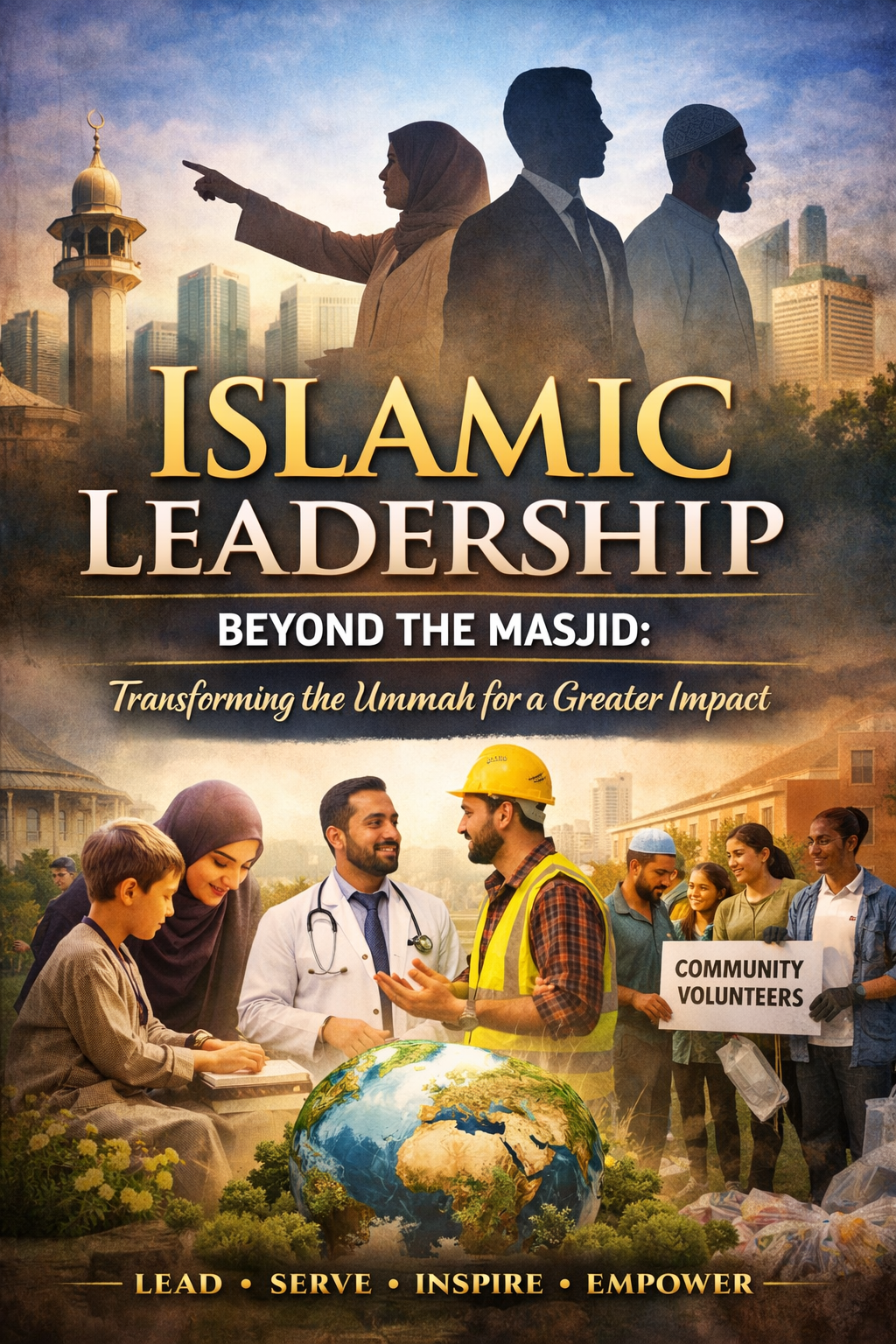
Islamic Leadership Beyond the Masjid: Transforming the Ummah for a Greater Impact
In an increasingly complex and interconnected world, the role of Islamic leadership must evolve beyond its traditional confines within the masjid to address broader societal, economic, and global challenges. This paper explores the concept of “Islamic Leadership Beyond the Masjid” as a transformative framework for empowering the Ummah and creating meaningful impact across multiple domains. It examines how leadership rooted in Islamic principles can extend into non-religious spaces such as business, governance, education, and social activism while maintaining a balance between deen (faith) and dunya (worldly engagement).
The study further highlights the importance of building a robust halal economy through ethical entrepreneurship, Shariah-compliant financial systems, and collaborative economic initiatives that promote equity and sustainability. Emphasis is placed on the role of Muslim leaders in driving economic empowerment, particularly within underserved communities, while upholding Islamic values of justice, transparency, and accountability.
Introduction
For centuries, Islamic leadership has been closely associated with the masjid—embodied by imams, scholars, and teachers of sacred knowledge. These figures have played an indispensable role in preserving the deen, guiding communities spiritually, and maintaining religious continuity. However, the modern world presents a vastly different landscape. Globalization, rapid technological advancement, economic disparities, political instability, and shifting cultural dynamics have created complex challenges that extend far beyond the walls of the mosque.
Today, the Ummah stands at a crossroads. The question is no longer whether Islamic leadership is important, but rather how it must evolve to remain relevant, impactful, and transformative. Leadership in Islam must now extend into every sphere of life—business, education, governance, media, and social activism. It must address not only spiritual development but also socio-economic empowerment, ethical governance, and community resilience.
This article explores how Islamic leadership can move beyond traditional confines to create meaningful, sustainable impact. It examines three key dimensions: redefining leadership in the modern world, building a robust halal economy, and translating faith into tangible community transformation.
1. Redefining Islamic Leadership in the Modern World
Beyond Traditional Roles
Islamic leadership has historically centered around scholars (ulama) and imams, whose primary roles were teaching, issuing rulings, and leading worship. While these roles remain essential, limiting leadership to these functions risks narrowing Islam’s transformative potential.
The Prophet Muhammad ﷺ himself was not only a spiritual guide but also a statesman, entrepreneur, community organizer, and social reformer. His leadership extended into every aspect of life—demonstrating that Islam is not confined to ritual practice but is a comprehensive way of living.
In today’s world, Islamic leadership must similarly expand. Leaders must address issues such as poverty, education, mental health, climate change, and economic inequality. This requires interdisciplinary thinking and the ability to engage with contemporary systems while remaining grounded in Islamic principles.
Leadership in Non-Religious Spaces
Modern Islamic leadership must be visible and effective in spaces often considered “secular”—business, politics, academia, and civil society.
In business, Muslim leaders can demonstrate ethical practices rooted in honesty (
sidq), trust (amanah), and fairness (adl).In politics, they can advocate for justice, equity, and the protection of human dignity.
In education, they can shape curricula that integrate moral development with intellectual excellence.
In social activism, they can address systemic injustices and uplift marginalized communities.
This shift requires a mindset change: leadership is not defined by title or position but by influence and impact.
Balancing Deen and Dunya
One of the greatest challenges for modern Muslim leaders is maintaining a strong connection to their faith while navigating dunya-driven environments.
Islam does not call for withdrawal from the world; rather, it encourages engagement with purpose. The Qur’an reminds us:
“Seek the Hereafter through what Allah has given you, but do not forget your share of this world.”
Balancing deen and dunya requires:
Regular spiritual grounding (prayer, Qur’an, reflection)
Clear ethical boundaries
Intentionality in actions (niyyah)
A leader who loses spiritual grounding risks compromising values, while one who disengages from the world risks irrelevance. True Islamic leadership lies in harmonizing both.
Empowering Everyday Muslims
Leadership is not exclusive to scholars or public figures. Every Muslim has the potential to lead within their sphere of influence—family, workplace, or community.
The Prophet ﷺ said:
“Each of you is a shepherd, and each of you is responsible for his flock.”
This concept democratizes leadership. It encourages:
Professionals to lead ethically in their industries
Youth to initiate change within their communities
Women to take active roles in social and economic development
Families to cultivate strong moral foundations
By empowering individuals, the Ummah becomes a network of leaders rather than a hierarchy dependent on a few.
Engaging the Youth
Young Muslims face unique challenges—identity struggles, digital overload, cultural tensions, and economic pressures. For Islamic leadership to remain relevant, it must resonate with their realities.
This means:
Speaking their language
Addressing their concerns
Providing platforms for their voices
Mentoring rather than dictating
Youth are not just the future—they are the present. Ignoring them is not an option.
2. Building the Halal Economy: Leadership in Trade, Finance & Business
Economic Empowerment of the Ummah
Economic strength is a critical pillar of community resilience. Without it, social and spiritual initiatives struggle to sustain themselves.
Historically, Muslim civilizations thrived economically through trade, innovation, and ethical business practices. Today, however, many Muslim communities face economic marginalization.
Leaders must prioritize:
Job creation
Financial literacy
Access to capital
Support for small businesses
Economic empowerment is not merely about wealth—it is about dignity, independence, and the ability to contribute meaningfully to society.
Balancing Profit and Ethics
Islam does not oppose profit; rather, it regulates it through ethical guidelines. Business in Islam is an act of worship when conducted with integrity.
Key principles include:
Avoiding exploitation
Ensuring transparency
Upholding contracts
Prohibiting interest (
riba) and fraud
Muslim leaders in business must resist the temptation to adopt unethical shortcuts in pursuit of profit. Long-term success lies in trust and reputation.
Ethical Entrepreneurship
Entrepreneurship in Islam is not just about innovation—it is about impact.
A truly ethical Muslim entrepreneur:
Creates value for society
Treats employees with fairness and respect
Considers environmental sustainability
Prioritizes community benefit over personal gain
This model challenges the profit-maximization mindset prevalent in many modern economies.
Developing Shariah-Compliant Systems
Islamic finance has grown significantly, yet challenges remain in scalability, standardization, and public trust.
To build sustainable systems, leaders must:
Innovate financial products that are both compliant and competitive
Strengthen governance and transparency
Invest in education and awareness
Foster global collaboration
The goal is not to replicate conventional systems with Islamic labels but to create genuinely distinct and ethical alternatives.
Collaboration and Unity
Fragmentation weakens the halal economy. Collaboration, on the other hand, amplifies impact.
Muslim businesses and institutions must:
Share knowledge and resources
Build networks and partnerships
Support each other’s growth
Unity transforms isolated efforts into a collective force capable of influencing global markets.
3. From Imaan to Impact: Transforming Communities Through Action
Translating Values into Action
Islamic teachings emphasize justice, compassion, and service. However, these values must move beyond theory into practice.
This means:
Feeding the hungry
Educating the underserved
Supporting mental health initiatives
Addressing domestic violence and social issues
Faith without action is incomplete. The Qur’an repeatedly pairs belief (imaan) with righteous deeds (amal).
Youth and Grassroots Movements
Some of the most impactful initiatives today are driven by youth and grassroots efforts. These movements are often:
Agile
Innovative
Community-centered
Young leaders bring fresh perspectives and energy. Supporting them requires:
Mentorship
Funding
Trust
Top-down approaches alone are insufficient. Change must also come from the ground up.
Addressing Social Challenges
The Ummah faces numerous challenges, including:
Poverty and inequality
Lack of education
Identity crises among youth
Islamophobia
Mental health struggles
Effective leadership requires understanding these issues deeply and responding with practical solutions.
For example:
Establishing community support centers
Providing scholarships and training programs
Creating safe spaces for youth dialogue
Reimagining the Role of the Masjid
The masjid must evolve from being solely a place of worship to a hub of community development.
Historically, the Prophet’s mosque in Madinah served multiple functions:
Education center
Courtroom
Social welfare hub
Modern masjids can:
Offer career counseling
Host workshops and training
Provide social services
This transformation requires vision and proactive leadership.
Ensuring Sustainability
Many initiatives fail not due to lack of passion but due to lack of sustainability.
To ensure long-term impact, leaders must focus on:
Strategic planning
Financial stability
Leadership development
Measurable outcomes
Sustainable change requires systems, not just inspiration.
Conclusion
Islamic leadership is at a pivotal moment. The challenges facing the Ummah are complex, but so are the opportunities.
Moving beyond the masjid does not mean abandoning tradition—it means expanding its application. It means taking the timeless principles of Islam and applying them to modern realities.
True Islamic leadership today is:
Spiritually grounded
Socially engaged
Economically empowered
Youth-driven
Action-oriented
It is leadership that transforms not only individuals but entire communities.
The question is no longer whether we need leaders—it is whether we are willing to become them.
Each Muslim has a role to play. Each action counts. And together, the Ummah has the potential to create a greater, more impactful future—rooted in faith, driven by purpose, and guided by the principles of Islam.
Yours sister,
Dr. Thamina Anwar
CEO and Founder
Global Halal Shura Hub
please Join the Global Halal Shura Hub Community
📱 WhatsApp Community
👉 https://chat.whatsapp.com/CZJshg7AycWFJd3CyhSWj3
🌐 Website
https://globalhalalshurahub.com
📧 Email
thaminaanwar11@gmail.com; globalhalalshurahubsocialmedia@gmail.com
📘 Facebook
https://www.facebook.com/profile.php?id=61588247732733
https://www.facebook.com/profile.php?id=61588077462429
📷 Instagram
https://www.instagram.com/globalhalalshurahub/
🔗 LinkedIn
https://www.linkedin.com/in/dr-thamina-anwar-806124145/
https://www.linkedin.com/in/global-halal-shura-hub-dr-thamina-samina-anwar-05418b398/
📺 YouTube Channel
https://www.youtube.com/@GlobalHalalShuraHub
#globalhalalshurahub