
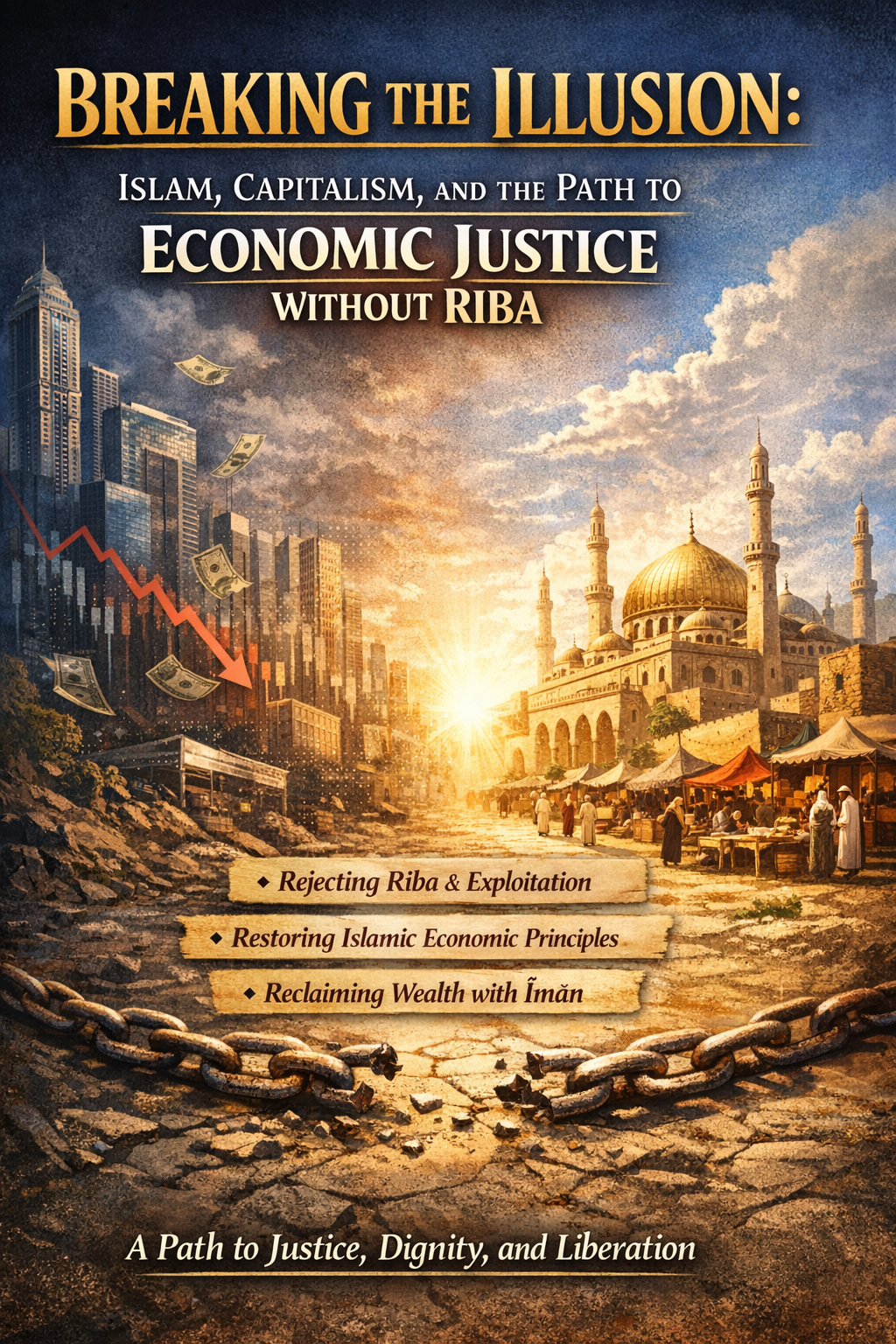
Breaking the Illusion: Islam, Capitalism, and the Path to Economic Justice and Liberation Without Riba
This article explores the intersection between īmān (faith) and economic life, arguing that contemporary capitalist systems have not only shaped markets, but also subtly reshaped the moral and intellectual framework of Muslims. It examines how the normalisation of riba (interest), debt-based finance, and profit-driven values has influenced Muslim thought—often leading to the justification or rebranding of prohibited practices under the guise of “halal” compliance.
Moving beyond critique, the article presents the Prophetic economic model as a lived and viable alternative—highlighting key institutions such as the suq (ethical free market), waqf (endowment-based social welfare), asset-backed currency, and risk-sharing finance. These elements collectively demonstrate that Islam offers a comprehensive economic vision rooted in justice (ʿadl), trust (amānah), and collective wellbeing.
The discussion calls for a shift from survival within dominant systems to a civilisational mindset of rebuilding. It emphasises the need to move from technical legality to ethical integrity, from passive consumption to active institution-building, and from individualism to an Ummah-centred approach. While acknowledging the scale of transformation required, it underscores that meaningful change begins with awareness, sincere intention, and localised action.
Ultimately, the article argues that economic liberation in Islam is not merely structural, but spiritual—beginning with a critical realisation: existing systems are not inevitable, and Muslims are not bound to them. Instead, through faith-driven effort and adherence to divine guidance, a just and balanced economic order can be reimagined and restored.
From Īmān to Economic Liberation
This is not merely a discussion about economics. It is a reflection on belief, values, and the boundaries of what we have come to accept as “normal.” Every economic system is built not only on policies and institutions, but on assumptions—assumptions about human nature, wealth, success, and power. Over time, these assumptions become so deeply embedded that they are no longer questioned.
Yet Islam calls the believer to a higher standard: not passive acceptance, but conscious alignment with divine guidance.
Allah ﷻ reminds us:
“But you prefer the worldly life, while the Hereafter is better and more enduring.” (Qur’an 87:16–17)
In a world where financial systems are dominated by interest (riba), debt, and profit maximisation at any cost, the line between necessity and compromise often becomes blurred. Riba is frequently presented as unavoidable—an essential pillar of modern life. But when something prohibited by Allah is treated as inevitable, we risk more than economic entanglement—we risk moral desensitisation.
Allah ﷻ declares unequivocally:
“Allah has permitted trade and forbidden riba.” (Qur’an 2:275)
And more sternly:
“O you who believe, fear Allah and give up what remains of riba, if you are truly believers. And if you do not, then be informed of a war from Allah and His Messenger.” (Qur’an 2:278–279)
These are not merely legal prohibitions—they are moral boundaries meant to preserve justice, dignity, and balance in society. When ignored, the consequences extend beyond finance into inequality, exploitation, and spiritual erosion.
But Islam does not only prohibit—it offers a vision.
It calls for a transformation in how we understand and engage with the economy:
Trade becomes an act of worship, grounded in honesty and accountability. The Prophet ﷺ said:
“The truthful and trustworthy merchant will be with the Prophets, the truthful, and the martyrs.” (Tirmidhī)
Wealth becomes a trust (amānah), not an end in itself. Allah ﷻ says:
“Believe in Allah and His Messenger and spend out of that in which He has made you trustees.” (Qur’an 57:7)
Markets become spaces of justice, not exploitation. The Prophet ﷺ warned:
“Whoever cheats is not one of us.” (Muslim)
Leadership becomes service, not control. The Prophet ﷺ said:
“Each of you is a shepherd, and each of you is responsible for his flock.” (Bukhārī & Muslim)
This is the journey from īmān to impact—from belief confined to the heart to belief expressed through systems, institutions, and daily transactions.
The goal is not merely to critique capitalism or condemn its excesses. Critique alone does not liberate. Islam calls for something more profound: to transcend flawed systems and rebuild an economic order rooted in ʿadl (justice), ihsān (excellence), and taqwā (God-consciousness).
Allah ﷻ says:
“Indeed, Allah commands justice, excellence, and giving to relatives, and forbids immorality, wrongdoing, and oppression.” (Qur’an 16:90)
This transformation does not begin with governments or global institutions—it begins with a shift in perception. It begins when we recognise that the systems we live within are not natural or inevitable. They are constructed by human choices—and therefore can be reshaped by human conviction guided by divine truth.
And so we arrive at a powerful realisation:
The system is not natural.
It is constructed.
And what is constructed can be challenged.
How Capitalism Quietly Reshapes the Muslim Mind
Perhaps the greatest danger is not the system itself—but how deeply it shapes the way we think.
A system does not need to announce its influence to be powerful. Its greatest strength lies in subtlety. When you live within a structure long enough, you stop seeing it as a structure at all. It becomes the background of life—unquestioned, unexamined, and eventually, unquestionable.
What was once constructed begins to feel natural. What was once imposed begins to feel inevitable.
And this is where the real transformation occurs—not in markets, but in minds.
The assumptions of capitalism begin to settle quietly into our worldview, presenting themselves as simple “common sense”:
Debt becomes normal—even necessary for survival.
Interest (riba) becomes reframed as “just business.”
Wealth becomes the primary measure of success and worth.
Time is no longer a blessing to be used wisely, but a commodity to be monetised.
Risk is something to be avoided individually, rather than shared collectively.
Accumulation becomes the ultimate goal, rather than accountability before Allah.
Yet Islam offers a fundamentally different lens.
Allah ﷻ reminds us:
“And you love wealth with immense love.” (Qur’an 89:20)
Not as praise—but as a warning about the human tendency to become consumed by accumulation.
The Prophet ﷺ further clarified the danger:
“If the son of Adam had a valley of gold, he would love to have two…” (Bukhārī & Muslim)
Capitalism does not create this desire—but it amplifies it, legitimises it, and builds entire systems around it.
Over time, this influence begins to extend beyond our behaviour into our religious thinking itself.
The shift is subtle—but deeply transformative.
Instead of asking:
“What does Islam require of us?”
We begin asking:
“How can we fit Islam into this system?”
This reversal changes everything.
Islam is no longer the standard by which systems are judged. Instead, the system becomes the framework within which Islam must operate. Divine guidance is no longer leading—it is being adjusted, interpreted, and sometimes diluted to fit prevailing economic realities.
Yet Allah ﷻ cautions us clearly:
“Then is it the judgement of ignorance they seek? But who is better than Allah in judgement for a people who are certain?” (Qur’an 5:50)
And He warns:
“Do not mix truth with falsehood or conceal the truth while you know [it].” (Qur’an 2:42)
When the framework shifts in this way, the consequences begin to appear:
Interest-based systems are justified under the guise of necessity.
Structurally flawed financial models are repackaged as “halal alternatives,” without addressing their underlying principles.
Convenience is prioritised over conviction, and ease over obedience.
Even the language we use begins to reflect this compromise. Instead of questioning whether a system aligns with ʿadl (justice), we ask whether it can be made “acceptable enough.”
But Islam does not call us to partial alignment.
Allah ﷻ says:
“O you who believe, enter into Islam completely (kāffah)…” (Qur’an 2:208)
Not selectively. Not conditionally. Not conveniently.
Completely.
This means that Islam is not meant to be squeezed into existing systems—it is meant to shape them, challenge them, and when necessary, replace them.
The Prophet ﷺ did not reform Makkah’s unjust economic practices by accommodating them. He transformed them by establishing a new moral and economic order rooted in revelation.
This is the path that lies before us.
To recognise that the real struggle is not only external—but internal. It is a struggle to reclaim clarity, to resist subtle compromises, and to realign our thinking with divine guidance.
Because before systems change, minds must awaken.
And before markets are reformed, hearts must be reoriented back to Allah.
The Illusion of Halal: When Riba Is Rebranded – Halal Loopholes or Spiritual Compromise?
One of the most pressing challenges facing the Muslim Ummah today is not always open disobedience—but subtle distortion. It is the emergence of what can be described as “halal loophole thinking”: an approach that does not sincerely seek what is halal, but instead attempts to reshape what is clearly prohibited into forms that appear acceptable.
This is not the pursuit of obedience—it is the pursuit of justification.
At its core, it reflects a deeper spiritual tension: the desire to participate fully in a system built on riba, while still maintaining the comfort of religious compliance.
Yet Allah ﷻ has already set the boundary with clarity:
“Allah has permitted trade and forbidden riba.” (Qur’an 2:275)
The distinction is not vague. It is not open to manipulation. It is a line drawn between what is just and what is exploitative, between what is earned through effort and what is extracted through imbalance.
And yet, instead of removing riba entirely, some contemporary financial models attempt to preserve its function while altering its form:
Riba is reconstructed through layered and complex contracts.
It is renamed using permissible terminology to avoid direct identification.
It is replicated through technical structures that produce the same economic outcomes.
The language changes. The structure becomes more sophisticated. But the essence often remains untouched.
This creates a dangerous illusion:
A system that appears Islamic in its terminology.
But operates on the same underlying principles as what it claims to replace.
This is not purification—it is camouflage.
And camouflage, over time, is far more dangerous than clear wrongdoing. Because when something is visibly haram, the believer remains cautious. But when it is disguised as halal, the heart becomes at ease with what it should resist.
The Prophet ﷺ warned against such distortions:
“There will certainly come a time upon the people when they will consume riba and call it by another name.” (Ahmad)
This hadith is not merely predictive—it is diagnostic. It exposes a mindset where renaming becomes a substitute for reform, and technical compliance replaces moral integrity.
But Islam does not prohibit riba merely as a label.
It prohibits it in its essence, outcome, and impact.
Riba is not just a contract—it is a system of imbalance:
Where wealth is generated without shared risk.
Where gain is guaranteed regardless of outcome.
Where one party benefits at the expense of another.
Where money becomes detached from real economic activity.
Allah ﷻ warns of the deeper consequences:
“So that wealth does not merely circulate among the rich from among you.” (Qur’an 59:7)
A truly Islamic economic system is not concerned only with formal compliance—it is concerned with justice, circulation, and fairness.
So if a financial model:
Guarantees profit without exposure to risk,
Extracts wealth without contributing real value,
Or replicates the same inequities under a different name,
then the problem has not been solved—it has been disguised.
This is why true halal cannot be achieved through legal engineering alone.
It cannot be reduced to technical structures, contractual layering, or semantic shifts.
True halal is a matter of alignment—alignment with the spirit (maqāṣid) and the substance of the Sharīʿah, not just its outward form.
Allah ﷻ reminds us:
“O you who believe, fear Allah and be with those who are truthful.” (Qur’an 9:119)
Truthfulness here is not only in speech—but in intention, in transactions, and in the systems we uphold.
The scholars of Islam have long warned against using legal forms to bypass moral realities. The goal of Sharīʿah is not to create loopholes—it is to establish justice, remove harm, and preserve balance.
Therefore, the question is not simply: “Is this contract technically valid?”
The deeper question is: “Does this truly reflect the justice that Allah has commanded?”
Because in the end, we are not accountable to structures—we are accountable to Allah.
And true halal is not achieved by reshaping the haram.
It is achieved by having the courage to leave it behind.
The Prophetic Economic Model: A Living Alternative
Islam does not merely critique unjust systems—it provides a complete and principled alternative.
Too often, Islamic economics is spoken about as an abstract ideal, something theoretical or impractical in the modern world. But this perception is historically inaccurate. The economic framework established by the Prophet ﷺ in Madinah was not a theory—it was a lived reality. It was implemented, refined, and sustained across generations, forming the backbone of one of the most enduring civilisations in history.
It was a system rooted not in profit maximisation, but in ʿadl (justice), barakah (blessing), and amanah (trust).
Allah ﷻ says:
“We have certainly sent Our messengers with clear proofs and revealed with them the Scripture and the balance so that people may uphold justice.” (Qur’an 57:25)
This “balance” (mīzān) was not only spiritual or moral—it was economic, social, and institutional.
The Prophetic model demonstrates that an economy aligned with revelation is not only possible—it is transformative.
1. The Suq: A Free Market Rooted in Justice
When the Prophet ﷺ migrated to Madinah, one of his earliest actions was not only to establish the masjid—but also the marketplace.
This was deliberate.
It signified that economic life is not separate from faith—it is an extension of it.
The Madinan suq (market) was radically different from the dominant models of its time. It was:
Open and accessible to all, without barriers to entry
Free from taxation that burdened traders unjustly
Free from monopolistic control or elite domination
When some attempted to allocate fixed spaces or impose control over market activity, the Prophet ﷺ refused, declaring:
“This is your market. Do not restrict it and do not impose taxes on it.” (Reported in early historical sources)
This was not deregulation in the modern capitalist sense—it was principled freedom, bounded by ethics.
The market was governed by moral accountability:
Fraud was prohibited
Hoarding (iḥtikār) was condemned
Artificial price manipulation was forbidden
The Prophet ﷺ said:
“Whoever hoards is a sinner.” (Muslim)
And when asked to fix prices, he declined, saying:
“Indeed, Allah is the One who sets prices…” (Abū Dāwūd)
This reflects a profound balance: the market was free—but not unjust. It was open—but not exploitative.
It was a space of real exchange, not financial domination.
2. Waqf: Building Civilisation Through Endowment
If the suq represented ethical commerce, the institution of waqf represented structured compassion.
Waqf is one of the most powerful yet underappreciated tools in Islamic civilisation. It transforms private wealth into perpetual public benefit.
The Prophet ﷺ laid its foundation when ʿUmar ibn al-Khaṭṭāb (رضي الله عنه) acquired land and asked how best to use it. The Prophet ﷺ advised:
“If you wish, you can keep the asset and give its produce in charity.” (Bukhārī & Muslim)
From this guidance emerged a system that would sustain societies for centuries.
Through waqf:
Schools, universities, and libraries were built
Hospitals and public services were funded
Roads, water systems, and infrastructure were maintained
The poor, travellers, and vulnerable were supported
And remarkably, all of this functioned independently of the state.
Waqf was rooted in ṣadaqah jāriyah—continuous charity that outlives the giver.
The Prophet ﷺ said:
“When a person dies, all their deeds end except three: ongoing charity, beneficial knowledge, or a righteous child who prays for them.” (Muslim)
Waqf institutionalised mercy. It ensured that wealth did not stagnate in private hands, but flowed continuously for the benefit of society.
Allah ﷻ commands:
“You will never attain righteousness until you spend from that which you love.” (Qur’an 3:92)
In this way, wealth became not a means of accumulation—but a pathway to legacy.
3. Dinar and Dirham: Honest Money
A just economic system requires not only ethical behaviour—but also sound foundations. Among the most critical of these is money itself.
The early Islamic economy operated on gold (dinar) and silver (dirham), currencies with intrinsic value.
This ensured:
Stability in exchange
Protection from arbitrary expansion
Preservation of purchasing power over time
Money was not created out of nothing. It represented real value, grounded in tangible assets.
In contrast, modern fiat currency systems:
Are often created through debt
Can be expanded without physical backing
Lose value over time through inflation
This has profound consequences.
When money can be created without limit, wealth can be redistributed silently—eroding the purchasing power of the poor while benefiting those closest to financial systems.
Islam seeks to prevent such hidden injustice.
The Prophet ﷺ emphasised fairness even in exchange:
“Gold for gold, silver for silver… equal for equal, hand to hand…” (Muslim)
This principle safeguards against manipulation and ensures that money remains a measure of value, not a tool of exploitation.
The goal is not merely stability—but justice.
4. Qirāḍ: Finance Based on Trust and Risk
Perhaps the most defining feature of the Prophetic economic model is its approach to finance.
Instead of lending money for guaranteed return (riba), Islam promotes partnership.
One of the earliest and most widely practiced models was qirāḍ (also known as muḍārabah), in which:
One party provides capital
The other provides labour and expertise
Profits are shared according to agreement
Losses are borne based on contribution
This creates a system built on:
Trust (amānah)
Shared responsibility
Real economic activity
The Prophet ﷺ himself engaged in such partnerships before prophethood, trading with the wealth of Khadījah (رضي الله عنها).
This model ensures that:
Profit is earned, not guaranteed
Risk is mutual, not shifted onto one party
Wealth is tied to real productivity, not speculation
Allah ﷻ says:
“And that there is not for man except that [good] for which he strives.” (Qur’an 53:39)
In contrast, riba-based systems allow profit without effort and gain without exposure—creating imbalance and injustice.
Qirāḍ restores alignment. It ensures that those who benefit also bear responsibility.
It replaces exploitation with cooperation.
A System Rooted in Revelation
These elements—the suq, waqf, sound money, and partnership-based finance—are not isolated mechanisms. They are interconnected components of a unified vision.
A vision where:
Wealth circulates rather than concentrates
Risk is shared rather than transferred
Trade is ethical rather than exploitative
Giving is institutionalised rather than occasional
Allah ﷻ summarises this principle:
“So that wealth does not merely circulate among the rich from among you.” (Qur’an 59:7)
This is the essence of the Prophetic economic model.
It is not anti-market. It is not anti-wealth.
It is anti-injustice.
And most importantly—it is not a relic of the past.
It is a living alternative.
A model that demonstrates that an economy guided by īmān is not only spiritually sound—but socially just, economically stable, and deeply human.
The challenge before us is not to invent something new.
It is to rediscover, revive, and reapply what has already been given.
Because the question is no longer whether such a system can exist.
It already did.
The question is whether we have the will to bring it back.
From Survival to Transformation: A Civilisational Shift
For too long, the mindset of the Muslim Ummah has been shaped by survival.
Survival within systems we did not design.
Survival within economies that do not reflect our values.
Survival within frameworks that often stand in tension with divine guidance.
This survival mindset, while understandable, is not sustainable.
Because Islam was never revealed to merely fit into the world—it was revealed to transform it.
Allah ﷻ declares:
“This day I have perfected for you your religion, completed My favour upon you, and chosen for you Islam as your way.” (Qur’an 5:3)
A perfected religion cannot be reduced to partial application. A complete way of life cannot remain confined within incomplete systems.
Yet over time, a subtle shift has taken place.
Instead of viewing Islam as the foundation upon which life is built, it has been repositioned as something to be accommodated within dominant global structures. Economic systems, political models, and social norms are often accepted as fixed realities—and Islam is then interpreted in ways that allow us to navigate them.
But this was never the role of Islam.
Islam is not meant to orbit around systems. Systems are meant to orbit around Islam.
Allah ﷻ reminds us:
“And We have not sent you, [O Muhammad], except as a mercy to all the worlds.” (Qur’an 21:107)
This mercy is not limited to rituals or personal spirituality—it extends to how societies are organised, how wealth is distributed, how justice is upheld, and how human dignity is preserved.
Islam is not a set of isolated rulings. It is a civilisation.
A civilisation with its own:
Moral foundations
Economic principles
Social structures
Legal frameworks
Vision of justice and human flourishing
The early Muslim community did not ask how to survive within Quraysh’s system—they built a new one. In Madinah, under the leadership of the Prophet ﷺ, a complete societal model emerged: spiritually anchored, economically just, and socially cohesive.
It was not reactive—it was generative.
This is the shift we must rediscover.
For generations, many Muslims have asked:
“How do we survive capitalism?”
How do we navigate interest-based systems?
How do we minimise harm while remaining compliant?
How do we find “halal options” within fundamentally flawed structures?
These questions come from a place of necessity—but they are not enough to carry a civilisation forward.
A new question must emerge:
“How do we move beyond it?”
This is not a call for withdrawal from the world, nor is it a denial of present realities. It is a call for a higher level of engagement—one rooted in vision, confidence, and īmān.
To move beyond is to:
Re-centre Islam as the معيار (standard), not the exception
Rebuild institutions that reflect divine guidance
Reimagine economic life beyond riba and exploitation
Revive systems of circulation, trust, and shared responsibility
Invest in long-term transformation rather than short-term accommodation
Allah ﷻ commands:
“Indeed, Allah will not change the condition of a people until they change what is within themselves.” (Qur’an 13:11)
This transformation begins internally—with mindset, intention, and conviction. But it does not end there. It must extend outward into structures, systems, and collective action.
It requires moving:
From dependency to استقلال (self-sufficiency)
From imitation to originality
From fragmentation to unity
From compromise to clarity
And above all, from survival to transformation.
The Prophet ﷺ did not merely teach individuals how to remain righteous in a corrupt system—he established a new order rooted in revelation. His mission was not adaptation—it was transformation.
This is the legacy we inherit.
Not a religion confined to the masjid, but a way of life that shapes markets, governance, education, and society as a whole.
The challenge before us is not whether Islam is capable of guiding civilisation.
It already has.
The real question is whether we are ready to think beyond limitation, to act beyond fear, and to trust fully in the guidance of Allah.
Because the future of the Ummah will not be defined by how well it survives within broken systems—
But by how courageously it rebuilds upon divine foundations.
The Failure of “Islamised Capitalism”
Attempts to “Islamise” capitalism without challenging its foundations often result in:
Replication of conventional banking
Superficial compliance
Structural compromise
Islam is not meant to be adjusted to fit systems.
Systems are meant to be reformed in light of Islam.
The Way Forward: Rebuilding with Purpose
Clarity is not the end of the journey—it is the beginning of responsibility.
Once the illusion is lifted, once the compromises are recognised, and once the gap between what is and what should be becomes clear, the believer is no longer at ease with passivity. True īmān does not allow comfort in contradiction. It calls for movement, for action, for rebuilding.
Allah ﷻ says:
“Say, ‘This is my way; I call to Allah upon clear insight—I and those who follow me.’” (Qur’an 12:108)
Clarity (baṣīrah) leads to دعوت (calling), and calling must lead to construction.
The question, then, is no longer simply what is wrong—but what must be built in its place.
1. From Technical Halal to Ethical Truth
For too long, much of the discourse has been reduced to a narrow question:
“Is it permissible?”
While this question is important, it is not sufficient.
Islam does not only seek formal compliance—it seeks moral alignment. It is not only concerned with legality, but with justice, sincerity, and the spirit of the Sharīʿah.
The deeper questions must return:
Is it just (ʿadl)?
Is it pure (ṭayyib)?
Does it reflect the Sunnah of the Prophet ﷺ?
Does it bring barakah—or merely profit?
Allah ﷻ commands:
“O you who believe, eat from the good (ṭayyib) things We have provided for you…” (Qur’an 2:172)
And He warns:
“Woe to those who give less [than due]—those who, when they take a measure from people, take in full. But when they give by measure or weight to them, they cause loss.” (Qur’an 83:1–3)
This is not just about technical compliance—it is about integrity in outcome.
The Prophet ﷺ said:
“Leave that which makes you doubt for that which does not make you doubt.” (Tirmidhī)
This is the معيار (standard) of a believer—not how close one can get to the boundary, but how sincerely one can remain within it.
The shift, therefore, is from legal minimalism to ethical excellence (ihsān).
2. From Consumers to Builders
A community that only consumes will always remain dependent.
For generations, many Muslims have been positioned primarily as participants in systems built by others—consumers of products, users of services, and followers of economic trends.
But Islam calls the believer to a higher role: to build, to contribute, and to lead.
The Prophet ﷺ said:
“The upper hand is better than the lower hand.” (Bukhārī & Muslim)
Not merely in charity—but in agency, in productivity, and in contribution.
Muslims must re-embrace their role as:
Institution builders — creating structures that reflect Islamic values
Market creators — establishing spaces for ethical trade and exchange
Economic contributors — producing real value, not merely consuming it
Allah ﷻ says:
“He has produced you from the earth and settled you in it…” (Qur’an 11:61)
This settlement (istiʿmār) implies responsibility—to cultivate, to develop, and to build civilisation.
The early Muslims did not inherit institutions—they created them. From markets to endowments, from trade networks to centres of learning, they built systems that carried their values into the world.
This is the mindset that must be revived.
3. From Individualism to Ummah
Modern economic systems often elevate the individual above the collective—prioritising personal gain over shared wellbeing.
But Islam builds something different.
It builds an Ummah.
An Ummah is not merely a group of individuals—it is a body bound by shared responsibility, mutual care, and collective purpose.
The Prophet ﷺ said:
“The believers, in their mutual love, mercy, and compassion, are like a single body…” (Bukhārī & Muslim)
This has economic implications.
It means:
Wealth is not hoarded—it circulates
Risk is not isolated—it is shared
Hardship is not ignored—it is alleviated
Allah ﷻ says:
“And cooperate in righteousness and piety…” (Qur’an 5:2)
And He reminds:
“The believers are but brothers…” (Qur’an 49:10)
An Islamic economic vision cannot be built on hyper-individualism. It must be rooted in:
Shared responsibility (takāful)
Collective prosperity
Social cohesion
This transforms the economy from a competitive arena into a cooperative ecosystem.
4. Reviving the Forgotten Tools
The path forward is not innovation disconnected from tradition—it is revival grounded in revelation.
Islam has already provided the tools.
What is required is not invention—but rediscovery and implementation.
Among these tools are:
• Suq-Based Economies
Markets that are open, ethical, and free from unjust control—spaces where trade is real, transparent, and accessible.
• Waqf Institutions
Endowments that transform private wealth into lasting public benefit—funding education, healthcare, and social welfare independent of unstable systems.
• Asset-Backed Currencies
Money rooted in real value, protecting against manipulation, inflation, and hidden injustice.
• Risk-Sharing Finance
Partnership-based models like muḍārabah and mushārakah—where profit is earned, loss is shared, and exploitation is removed.
These are not relics of the past.
They are blueprints for the future.
Allah ﷻ says:
“Indeed, Allah commands justice, excellence, and giving…” (Qur’an 16:90)
These tools operationalise that command.
Rebuilding with Intention and Trust
The way forward is not easy.
It requires patience, sacrifice, and long-term vision. It requires resisting convenience in favour of conviction. It requires moving from critique to construction.
But above all, it requires trust in Allah.
Allah ﷻ says:
“And whoever fears Allah—He will make for him a way out and provide for him from where he does not expect.” (Qur’an 65:2–3)
This promise is not abstract. It applies to individuals, communities, and entire systems.
When we align with divine guidance, provision follows—not only in wealth, but in barakah, stability, and dignity.
Reality Check: Change Begins Small
It is easy, when speaking about systems, civilisation, and transformation, to feel overwhelmed.
The scale of the problem appears vast. The structures seem deeply entrenched. The systems feel immovable.
But Islam does not begin with systems.
It begins with the heart.
And from the heart, it moves to action—small, sincere, consistent action.
Transformation, in the Islamic tradition, has never been instantaneous. It has always been gradual, intentional, and rooted in truth.
Allah ﷻ reminds us:
“Indeed, Allah will not change the condition of a people until they change what is within themselves.” (Qur’an 13:11)
This is the starting point of every meaningful shift.
Not institutions. Not policies.
But people.
1. Awareness: Seeing Clearly
Every transformation begins with awareness.
To recognise the system for what it is.
To distinguish between what is natural and what is constructed.
To see where compromise has replaced conviction.
Without awareness, there can be no change—only repetition.
The Qur’an repeatedly calls us to reflect:
“Do they not reflect?” (Qur’an 59:21)
And:
“So give good tidings to My servants who listen to speech and follow the best of it.” (Qur’an 39:17–18)
Awareness is not merely intellectual—it is spiritual. It is the awakening of the heart to truth, even when that truth is uncomfortable.
It is the moment when what was once normal begins to feel questionable.
And that moment matters.
2. Intention: Anchoring in Sincerity
Awareness alone is not enough.
It must be anchored in niyyah (intention).
Because in Islam, actions are not judged only by their outcomes—but by what drives them.
The Prophet ﷺ said:
“Actions are only by intentions, and every person will have only what they intended.” (Bukhārī & Muslim)
This means that even small actions—if rooted in sincerity—carry immense weight.
Choosing to avoid doubtful income.
Choosing to support ethical businesses.
Choosing to learn, to question, to seek what is pleasing to Allah.
These are not insignificant steps.
They are acts of worship.
And when intention is aligned with truth, Allah places barakah in even the smallest efforts.
3. Local Action: Building Where You Stand
Change does not begin at the global level.
It begins where you are.
In your معاملات (transactions).
In your business.
In your community.
In your مسجد (masjid).
The Prophet ﷺ did not transform the world overnight. He began with individuals, then families, then a community in Madinah—step by step, with patience and purpose.
Allah ﷻ says:
“So fear Allah as much as you are able…” (Qur’an 64:16)
This is not a call to perfection—it is a call to effort.
To do what is within your capacity.
To build what you can, where you are, with what you have.
A small ethical business
A local initiative rooted in fairness
A community effort to revive waqf
A network of trust-based partnerships
These may seem small.
But small actions, when rooted in truth, carry weight far beyond their size.
The Power of Sincere Beginnings
History does not change through sudden revolutions alone.
It changes through consistent, sincere beginnings.
The early Muslim community in Makkah was small, marginalised, and seemingly powerless. Yet their clarity, sincerity, and steadfastness laid the foundation for a civilisation that would transform the world.
The Prophet ﷺ said:
“The most beloved deeds to Allah are those that are consistent, even if they are small.” (Bukhārī & Muslim)
Consistency builds momentum.
Sincerity brings barakah.
Truth gives direction.
And over time, what begins as a small effort becomes a movement.
What begins as a local action becomes a model.
What begins as awareness becomes transformation.
A Final Reflection
We often wait for large-scale change before we act.
But Islam teaches the opposite:
Act—and Allah will open the way.
“And those who strive for Us—We will surely guide them to Our ways.” (Qur’an 29:69)
The path forward does not require perfection.
It requires sincerity.
It requires courage.
And it requires a willingness to begin—even if the beginning feels small.
Because in the sight of Allah, no sincere effort is ever small.
And through small, truthful steps, entire communities can be reshaped.
One heart.
One action.
One intention at a time.
From Īmān to Economic Liberation — Conclusion
This discussion was never only about economics.
It was about perception.
About what we have come to accept as “normal.”
And about what we are willing—despite difficulty, despite pressure—to challenge for the sake of Allah.
Because every system, no matter how dominant, ultimately rests on human acceptance. And when that acceptance goes unquestioned, even the most unjust structures begin to feel inevitable.
But the believer is not defined by what is common. The believer is defined by what is true.
Allah ﷻ says:
“And if you obey most of those upon the earth, they will mislead you from the way of Allah…” (Qur’an 6:116)
Truth is not measured by majority. It is measured by revelation.
And so, when riba becomes widespread—embedded in institutions, normalised in language, and justified through necessity—the danger is not only economic. It is spiritual.
Because to accept riba as inevitable is to risk normalising what Allah has clearly declared unlawful.
Allah ﷻ warns:
“O you who believe, fear Allah and give up what remains of riba, if you are truly believers.” (Qur’an 2:278)
This is not simply a prohibition—it is a test of īmān.
Will we align with divine command, even when the world moves in another direction?
Or will we reshape our understanding to fit what is convenient?
But Islam does not leave us with prohibition alone.
It calls us to something higher—to reclaim a vision of economic life rooted in worship, trust, justice, and service.
A vision where:
Trade becomes worship, carried out with honesty, sincerity, and consciousness of Allah.
The Prophet ﷺ said:“The truthful and trustworthy merchant will be with the Prophets, the truthful, and the martyrs.” (Tirmidhī)
Wealth becomes a trust (amānah), not a measure of superiority.
Allah ﷻ says:“And spend out of that in which He has made you trustees.” (Qur’an 57:7)
Markets become just, free from exploitation, deception, and imbalance.
The Prophet ﷺ said:“Whoever cheats is not one of us.” (Muslim)
Leadership becomes service, rooted in responsibility and accountability.
The Prophet ﷺ said:“Each of you is a shepherd, and each of you is responsible for his flock.” (Bukhārī & Muslim)
This is not an idealistic vision.
It is a Prophetic one.
It is the same vision that transformed a fragmented society into a civilisation defined by justice, trust, and balance.
This is the journey from īmān to impact.
From belief that resides in the heart
To belief that shapes markets, institutions, and systems.
From internal conviction
To external transformation.
And this journey requires more than critique.
It requires courage.
Because the goal is not merely to point out the flaws of capitalism, nor to endlessly navigate within it.
The goal is to transcend it.
To move beyond systems rooted in exploitation, imbalance, and artificial scarcity—and to begin rebuilding an economy grounded in:
ʿAdl (justice)
Ikhlāṣ (sincerity)
Barakah (blessing)
And Waḥy (divine guidance)
Allah ﷻ says:
“Indeed, Allah commands justice, excellence, and giving…” (Qur’an 16:90)
This is not a suggestion—it is a foundation.
And yet, despite the scale of this vision, it begins with something profoundly simple.
A realisation.
A shift in perspective.
A moment of clarity.
That:
The system is not natural.
It is constructed.
And what is constructed can be questioned.
It can be challenged.
It can be reshaped.
And, by the permission of Allah, it can be replaced.
Because we are not bound to systems.
We are bound to Allah.
And when īmān is firm, when intention is sincere, and when action follows truth—then even the most entrenched systems begin to lose their hold.
The path forward will not be easy.
But it is clear.
And it begins—with us.
Yours sincerely,
Dr. Thamina (Samina) Anwar
CEO & Founder
Global Halal Shura Hub
📱 WhatsApp Community: https://chat.whatsapp.com/ISSstU726tqBjVXlYYnHGN
🌐 Website: https://globalhalalshurahub.com
📧 Email: globalhalalshurahubsocialmedia@gmail.com
📘 Facebook:
https://www.facebook.com/profile.php?id=61588247732733
https://www.facebook.com/profile.php?id=61588077462429
📷 Instagram: https://www.instagram.com/globalhalalshurahub/
🔗 LinkedIn:
https://www.linkedin.com/in/dr-thamina-anwar-806124145/
https://www.linkedin.com/in/global-halal-shura-hub-dr-thamina-samina-anwar-05418b398/
📺 YouTube: https://www.youtube.com/@GlobalHalalShuraHub
May Allah (SWT) bless this effort and allow it to be a source of benefit for the Ummah.