
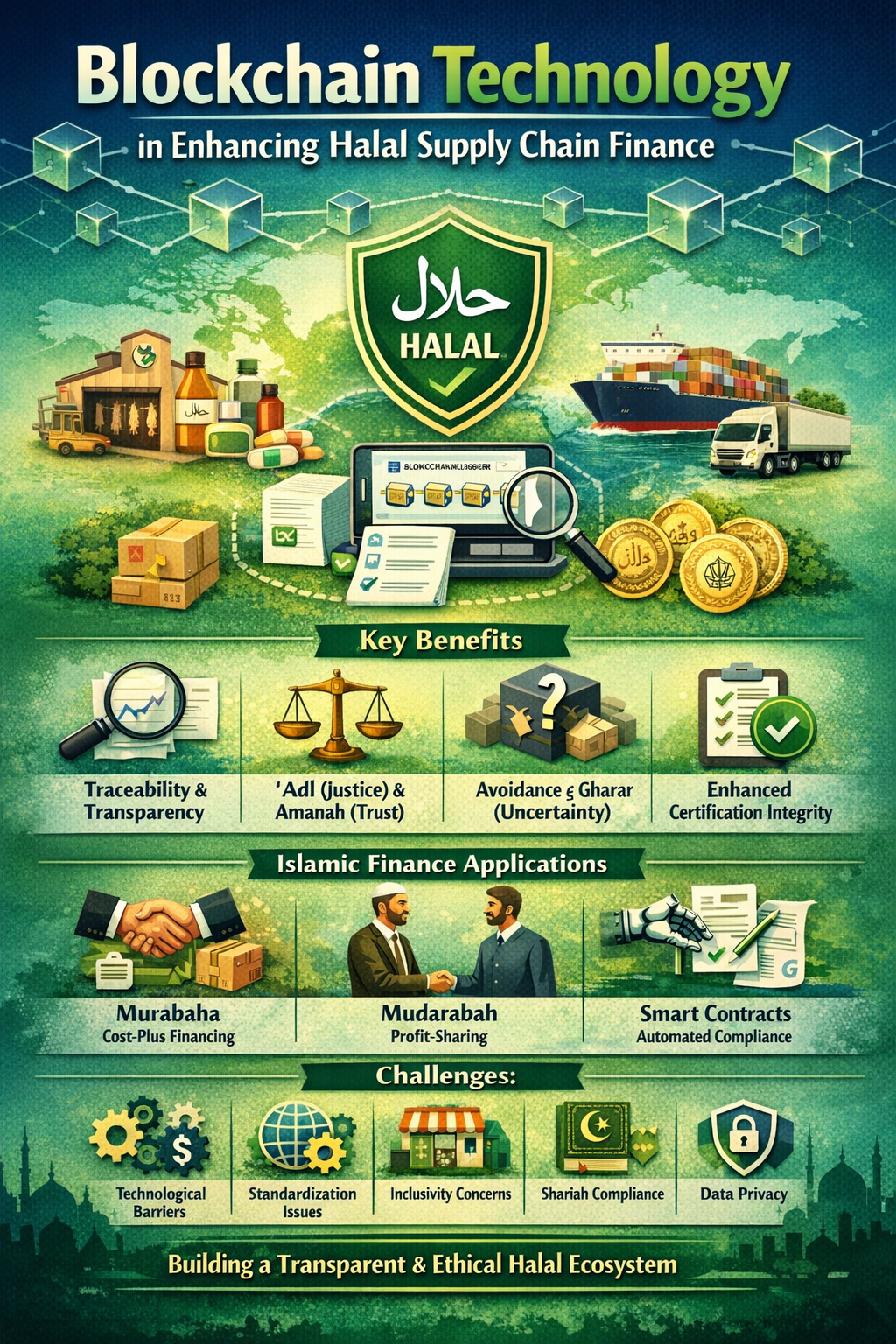
Securing Halal Integrity: Blockchain as the Future of Supply Chain Finance
The rapid expansion of the global halal industry has heightened the need for greater transparency, traceability, and accountability across increasingly complex supply chains. Ensuring that products comply with halal and tayyib standards throughout their lifecycle is not only a technical challenge but also a religious obligation grounded in Islamic ethical principles. This article examines the potential of blockchain technology to enhance traceability in halal supply chain finance from an Islamic perspective.
Blockchain, as a decentralized and immutable digital ledger, offers a reliable mechanism for recording and verifying transactions across the supply chain. Its ability to provide real-time, tamper-proof data enhances transparency, reduces uncertainty (gharar), and strengthens trust (amanah) among stakeholders. The study explores how blockchain can be integrated into Islamic financial instruments such as mudarabah, as well as its role in improving halal certification systems through secure and verifiable documentation.
Furthermore, the paper highlights the alignment between blockchain technology and key Islamic principles, including justice (‘adl), accountability (hisbah), and ethical conduct in trade. While the benefits are significant, the article also addresses challenges related to technological barriers, standardization, inclusivity, data privacy, and Shariah compliance.
The findings suggest that blockchain has strong potential to support a more transparent, efficient, and ethically grounded halal ecosystem. However, its successful implementation requires collaboration among industry stakeholders, technology experts, and Islamic scholars to ensure that innovation remains aligned with Shariah principles. Ultimately, the adoption of blockchain can contribute to building a trustworthy global halal marketplace that reflects the true spirit of Islamic economic values.
1. Introduction
The global halal economy has experienced significant and sustained growth over the past decade, driven by increasing demand from a growing Muslim population and heightened awareness of ethical consumption. Today, the halal industry extends far beyond its traditional association with food to include sectors such as pharmaceuticals, cosmetics, fashion, logistics, tourism, and financial services. This expansion reflects not only the economic potential of the halal market but also its broader relevance as a system of ethical and responsible consumption.
As halal markets become more globalized and complex, supply chains have grown longer and more fragmented, often spanning multiple countries and regulatory environments. This complexity introduces new risks, including contamination, mislabeling, fraud, and inconsistencies in certification standards. Consequently, the need for enhanced transparency, traceability, and accountability has become more pressing than ever. Consumers, regulators, and businesses alike require reliable mechanisms to verify that products meet halal requirements at every stage—from sourcing and production to distribution and financing.
For Muslims, the consumption of halal is not merely a lifestyle choice but a fundamental religious obligation. The Qur’anic command to consume what is lawful (halal) and wholesome (tayyib) places responsibility on both producers and consumers to ensure the integrity of goods and services. This responsibility extends throughout the entire value chain, meaning that any breach—whether intentional or accidental—can compromise the permissibility of a product. In this regard, traceability is not just a technical requirement but a moral and spiritual necessity, ensuring that trust is upheld between all parties involved.
However, traditional supply chain systems often struggle to meet these expectations. Many rely on paper-based documentation, siloed databases, and manual verification processes, which are susceptible to human error, delays, and manipulation. These limitations undermine confidence in halal certification and create gaps in accountability. As a result, there is a growing recognition of the need for innovative solutions that can provide greater visibility, reliability, and integrity across the supply chain.
In this context, blockchain technology has emerged as a promising tool to address these longstanding challenges. By offering a decentralized, transparent, and immutable system for recording transactions, blockchain enables real-time tracking and verification of goods and financial flows. Its ability to create a secure and tamper-resistant audit trail makes it particularly well-suited for enhancing traceability in complex halal supply chains.
From an Islamic perspective, the significance of blockchain extends beyond its technical capabilities. Its emphasis on transparency, accountability, and trust aligns closely with core ethical principles in Islam, such as amanah (trustworthiness), ‘adl (justice), and the avoidance of gharar (uncertainty). By strengthening these values in commercial practices, blockchain has the potential to not only improve operational efficiency but also reinforce the moral foundations of halal trade and finance.
Therefore, the integration of blockchain into halal supply chain finance represents more than a technological advancement; it reflects an opportunity to align modern innovation with timeless Islamic principles. As the halal industry continues to evolve, exploring such synergies will be essential in building a more transparent, ethical, and trustworthy global halal ecosystem.
2. The Importance of Halal Traceability in Islam
Islam places profound emphasis on the consumption of what is halal (lawful) and tayyib (pure, wholesome, and ethically sound). This dual requirement reflects a holistic approach that goes beyond the permissibility of ingredients to encompass the entire process by which goods are produced, handled, and delivered. In Islamic teachings, the integrity of a product is not determined solely at the point of consumption but is shaped by every stage of its journey—from the origin of raw materials to the final transaction.
This comprehensive view means that halal compliance must be maintained across all components of the supply chain, including sourcing, processing, packaging, storage, transportation, and even financing. For instance, food products must not only avoid prohibited substances but must also be processed using permissible methods, free from cross-contamination, and handled in hygienic and ethical conditions. Similarly, logistics and storage must ensure that halal goods are not mixed with non-halal items, preserving their integrity throughout distribution.
In this context, traceability becomes a critical mechanism for safeguarding halal integrity. Without the ability to track and verify each step in the supply chain, it becomes difficult to ensure that products remain compliant. Any break in the chain—whether due to negligence, lack of oversight, or intentional fraud—can compromise the halal status of the product. Even minor uncertainties regarding sourcing or handling can render a product doubtful (mashbooh), which Muslims are encouraged to avoid.
The issue of uncertainty is particularly significant in Islamic commercial law. The concept of gharar (excessive uncertainty or ambiguity) is strictly prohibited, as it can lead to injustice, deception, and disputes. In the context of halal supply chains, a lack of transparency regarding the origin, composition, or handling of products introduces elements of gharar, undermining the ethical validity of transactions. Therefore, ensuring clear, verifiable information at every stage is not only a practical necessity but also a religious obligation.
Moreover, the principle of amanah (trust) plays a central role in Islamic economic ethics. All participants in the supply chain—producers, manufacturers, distributors, certifiers, and financiers—are entrusted with the responsibility to uphold honesty and integrity in their dealings. Breaching this trust, whether through mislabeling, concealment, or negligence, is considered a serious ethical violation. Traceability systems serve as a means of reinforcing this trust by holding all parties accountable and providing verifiable evidence of compliance.
Despite its importance, achieving effective traceability through traditional systems remains challenging. Many halal supply chains rely on fragmented documentation, manual record-keeping, and inconsistent certification practices. These systems are often vulnerable to human error, delays, and manipulation, creating opportunities for fraud and misrepresentation. As a result, consumers may lose confidence in halal labels, and businesses may face reputational risks.
From an Islamic perspective, such shortcomings are not merely operational issues but ethical concerns that affect the credibility of the entire halal ecosystem. Ensuring robust traceability is therefore essential to protect consumers, uphold religious obligations, and maintain the integrity of the market. It enables greater accountability, reduces the risk of non-compliance, and supports informed decision-making by all stakeholders.
In essence, halal traceability is deeply rooted in Islamic values. It embodies the principles of amanah by ensuring trustworthiness, avoids gharar by eliminating uncertainty, and promotes ‘adl (justice) by preventing deception and harm. As supply chains continue to grow in complexity, the need for reliable and transparent traceability systems becomes increasingly vital—not only to meet market demands but also to fulfill the ethical and spiritual objectives of Islam.
3. Blockchain Technology: A Tool for Transparency
Blockchain technology represents a significant advancement in the way data and transactions are recorded, verified, and shared across complex systems. At its core, blockchain is a decentralized digital ledger that operates across a network of computers, where each transaction is securely recorded in a “block” and linked to previous records in a chronological “chain.” This structure ensures that once information is entered and validated, it becomes virtually immutable—meaning it cannot be altered or deleted without consensus from the network. Each transaction is time-stamped and encrypted, creating a transparent and tamper-resistant audit trail that can be accessed by authorized participants.
Unlike traditional centralized databases, which are controlled by a single authority and are vulnerable to manipulation or system failures, blockchain distributes control across multiple stakeholders. This decentralization enhances security and trust, as no single party can unilaterally modify records. In addition, blockchain systems often incorporate consensus mechanisms that require agreement among participants before transactions are validated, further strengthening data integrity.
In the context of halal supply chains, blockchain offers a powerful solution to the challenges of traceability and transparency. Every stage of the supply chain—from the sourcing of raw materials to processing, packaging, transportation, storage, and final delivery—can be recorded on the blockchain. Each participant, including suppliers, manufacturers, logistics providers, certification bodies, and retailers, can input verified data into the system. This creates a comprehensive and continuous record of the product’s journey, enabling stakeholders to trace its origin and verify its compliance with halal requirements at any point in time.
For example, a halal food product can be tracked back to the farm where its ingredients were sourced, with records confirming that the animals were slaughtered according to Islamic guidelines, processed in certified facilities, and transported under appropriate conditions. Similarly, in pharmaceuticals or cosmetics, blockchain can verify that ingredients are free from prohibited substances and that manufacturing processes meet halal standards. This level of visibility significantly reduces reliance on fragmented and paper-based systems, which are often prone to delays, errors, and inconsistencies.
Furthermore, blockchain minimizes the risk of fraud and misrepresentation, which are persistent challenges in global supply chains. False halal labeling, unauthorized certification, and product substitution can be more easily detected and prevented when all transactions are recorded transparently and cannot be altered. The ability to verify information in real time enhances confidence among consumers and strengthens the credibility of halal certification systems.
Another important feature of blockchain is its compatibility with emerging technologies such as the Internet of Things (IoT). Sensors and tracking devices can be integrated into the supply chain to automatically record data—such as temperature, location, and handling conditions—directly onto the blockchain. This ensures that halal products are not only sourced correctly but also maintained under appropriate conditions throughout transportation and storage, further safeguarding their integrity.
From an Islamic perspective, the transparency offered by blockchain aligns closely with the ethical principles governing economic activity. Islam strongly emphasizes honesty (sidq), accountability, and the prohibition of deceit in trade. The Prophet Muhammad (peace be upon him) warned against fraudulent practices and stressed that those who deceive are not among the righteous. By providing a system where information is open, verifiable, and resistant to manipulation, blockchain supports these moral imperatives and helps create a more trustworthy marketplace.
Additionally, blockchain reinforces the principle of accountability by ensuring that all actions within the supply chain are recorded and traceable. This discourages unethical behavior and encourages participants to uphold their responsibilities with integrity. In doing so, it complements the Islamic concept of amanah (trust), where individuals are accountable not only to one another but ultimately to God for their actions.
In summary, blockchain technology serves as a transformative tool for enhancing transparency in halal supply chains. By enabling secure, real-time, and tamper-proof record-keeping, it addresses many of the limitations of traditional systems while aligning with core Islamic values. Its adoption has the potential to strengthen trust, improve compliance, and ensure that halal products truly meet the ethical and religious standards expected by Muslim consumers worldwide.
4. Alignment with Islamic Ethical Principles
Blockchain technology is not merely a technical innovation; it also has profound ethical implications, particularly when examined through the lens of Islamic teachings. The principles that underpin blockchain—transparency, accountability, and immutability—closely align with the moral and legal foundations of Islamic economic conduct. In the context of halal supply chains and finance, this alignment highlights the potential of blockchain to reinforce not only operational efficiency but also the ethical integrity of the system.
Amanah (Trust) is a central concept in Islam, referring to the responsibility entrusted to individuals to act with honesty, integrity, and reliability. In commercial transactions, every participant—whether a producer, supplier, financier, or certifier—is entrusted with maintaining the authenticity and compliance of products. Breaches of trust, such as mislabeling, concealment of defects, or fraudulent certification, are considered serious ethical violations. Blockchain strengthens amanah by creating a system where all transactions are recorded accurately and cannot be altered retroactively. This ensures that participants are held accountable for their actions, fostering a culture of honesty and responsibility across the supply chain. When information is transparent and verifiable, trust is no longer based solely on reputation but is reinforced by evidence.
‘Adl (Justice) is another fundamental principle that governs all aspects of Islamic life, including economic activity. Justice in trade requires fairness, honesty, and the protection of all parties from harm or exploitation. In traditional supply chains, a lack of transparency can create opportunities for unfair practices, such as price manipulation, counterfeit goods, or false halal claims. Blockchain addresses these issues by providing equal access to reliable information for all stakeholders. This transparency helps ensure that no party is unjustly disadvantaged and that transactions are conducted on a fair and informed basis. By reducing asymmetry of information, blockchain promotes equitable relationships between producers, businesses, and consumers, thereby upholding the principle of ‘adl.
The avoidance of Gharar (Uncertainty) is a key requirement in Islamic commercial law. Transactions involving excessive ambiguity or lack of clarity are prohibited because they can lead to disputes, injustice, and exploitation. In the context of halal supply chains, uncertainty may arise from unclear sourcing, inadequate documentation, or inconsistent certification standards. Blockchain significantly reduces such uncertainty by providing clear, real-time, and tamper-proof information about every stage of the supply chain. Stakeholders can verify the origin, handling, and status of products with confidence, ensuring that transactions are based on complete and accurate information. This elimination of ambiguity not only enhances efficiency but also ensures compliance with Shariah principles.
Hisbah (Accountability and Market Oversight) refers to the Islamic system of ensuring ethical behavior and compliance within the marketplace. Historically, this role was carried out by appointed officials who monitored trade practices, prevented fraud, and protected consumer rights. In the modern context, regulatory bodies and halal certification authorities perform similar functions. Blockchain enhances hisbah by providing these institutions with powerful tools for monitoring and verification. With access to a transparent and immutable ledger, regulators can track activities across the supply chain, detect irregularities, and ensure that standards are consistently upheld. This strengthens governance mechanisms and reduces the likelihood of corruption or negligence.
Beyond these specific principles, blockchain also supports broader Islamic values such as sidq (truthfulness), ihsan (excellence), and maslahah (public interest). By improving the reliability and integrity of halal systems, blockchain contributes to the overall welfare of society, protecting consumers and promoting ethical business practices. It encourages stakeholders to act with greater diligence and responsibility, knowing that their actions are recorded and subject to scrutiny.
In essence, the integration of blockchain into halal supply chains represents a convergence of modern technology and timeless ethical values. It demonstrates how innovation can be harnessed to uphold and strengthen the moral framework of Islamic commerce. By reinforcing trust, ensuring justice, eliminating uncertainty, and enhancing accountability, blockchain not only improves the functionality of supply chains but also deepens their alignment with the principles that define halal in its truest sense.
Thus, blockchain should not be viewed solely as a tool for efficiency, but as a means of revitalizing ethical conduct in economic activities. Its adoption has the potential to elevate the standards of halal commerce, ensuring that they remain faithful to Islamic teachings while meeting the demands of an increasingly complex and interconnected global economy.
5. Enhancing Halal Supply Chain Finance
Islamic finance is founded on a distinct set of principles that emphasize ethical conduct, fairness, and real economic activity. Central to this framework is the prohibition of riba (interest), the encouragement of risk-sharing, and the requirement that financial transactions be linked to tangible assets. These principles aim to promote justice, prevent exploitation, and ensure that wealth is generated through legitimate and productive means. Within halal supply chains, financing plays a crucial role in enabling the movement of goods, supporting producers, and facilitating trade. However, ensuring that such financing remains transparent, compliant, and efficient has long been a challenge.
Blockchain technology offers a transformative opportunity to enhance halal supply chain finance by addressing these challenges through improved transparency, traceability, and automation. By integrating financial transactions with real-time supply chain data, blockchain creates a unified system where both the movement of goods and the flow of funds can be monitored simultaneously. This reduces information asymmetry, strengthens trust between parties, and ensures that financial activities are directly linked to underlying assets—an essential requirement in Islamic finance.
Mudarabah (profit-sharing partnerships) can benefit significantly from blockchain integration. In a mudarabah arrangement, one party provides capital while the other contributes expertise and management, with profits shared according to a pre-agreed ratio and losses borne by the capital provider. One of the common challenges in such partnerships is the lack of transparency in profit calculation and reporting, which can lead to mistrust and conflict. Blockchain addresses this issue by enabling real-time recording of financial performance, expenses, and revenues. All parties have access to the same verified data, ensuring that profit distribution is conducted fairly and transparently in accordance with agreed terms.
Another important innovation is the use of smart contracts, which are self-executing agreements coded onto the blockchain. These contracts automatically enforce the terms and conditions of a transaction when predefined criteria are met. In halal supply chain finance, smart contracts can be used to automate payments, release funds upon delivery confirmation, or enforce compliance with contractual obligations. For example, payment to a supplier can be triggered automatically once blockchain records confirm that goods have been delivered and meet halal certification requirements. This reduces delays, minimizes human intervention, and eliminates the risk of manipulation or breach of contract.
Beyond these specific instruments, blockchain can also support other Islamic financing models such as wakalah (agency-based financing) and ijarah (leasing). In each case, the technology enhances transparency and ensures that all actions are properly documented and verifiable. This not only improves operational efficiency but also strengthens Shariah compliance by providing clear evidence that transactions adhere to Islamic principles.
From an ethical perspective, the integration of blockchain into halal supply chain finance reinforces the values of amanah (trust) and ‘adl (justice). By making financial transactions transparent and traceable, it ensures that all parties act responsibly and are held accountable for their commitments. It also reduces the likelihood of fraud, misrepresentation, and exploitation, thereby promoting fairness and integrity in financial dealings.
Furthermore, blockchain can improve access to financing for smaller businesses and producers within the halal ecosystem. By providing verifiable data on supply chain activities and financial performance, it reduces the risk perceived by financiers, making it easier for smaller participants to secure funding. This contributes to greater inclusivity and supports the broader Islamic objective of promoting equitable economic development.
In conclusion, blockchain technology has the potential to significantly enhance halal supply chain finance by aligning modern financial practices with the core principles of Islamic economics. Through improved transparency, real-time verification, and automated execution of contracts, it addresses many of the limitations of traditional systems. More importantly, it strengthens trust, ensures compliance, and promotes ethical conduct, making it a valuable tool for advancing a more resilient and Shariah-compliant halal financial ecosystem.
6. Strengthening Halal Certification Systems
Halal certification bodies occupy a central position in the global halal ecosystem, serving as the primary authorities responsible for verifying that products and processes comply with Islamic requirements. Their role extends across multiple stages of the supply chain, including inspection of raw materials, auditing of production facilities, monitoring of logistics, and issuing of certification labels. For consumers, these certifications act as a key source of assurance that products meet the standards of halal and tayyib. However, as the halal industry becomes more globalized and complex, existing certification systems face significant challenges.
One of the major issues is the lack of standardization across different countries and certification bodies. Diverse interpretations of halal standards, varying levels of rigor in inspection processes, and inconsistent regulatory frameworks can lead to confusion and mistrust among consumers. In addition, traditional certification systems often rely on paper-based documentation or isolated digital databases, which are vulnerable to errors, duplication, and even deliberate fraud. Cases of counterfeit halal certificates, unauthorized use of halal logos, and misrepresentation of compliance have been reported, undermining the credibility of the entire system.
Blockchain technology offers a powerful solution to these challenges by providing a secure, transparent, and tamper-resistant platform for managing certification data. By recording halal certification information on a blockchain, every certificate issued can be uniquely identified, time-stamped, and permanently stored. This ensures that once a certification is granted, it cannot be altered, forged, or duplicated without detection. Each stage of the certification process—from application and inspection to approval and renewal—can be documented on the blockchain, creating a comprehensive and verifiable audit trail.
A unified blockchain-based certification system would enable seamless access to reliable information for all stakeholders, including consumers, businesses, regulators, and certification authorities. Through simple digital tools, such as QR codes on product packaging, consumers could instantly verify the authenticity of halal claims by accessing blockchain records. This process can be done bi-suhulah (with ease), enhancing confidence and empowering consumers to make informed choices. Businesses, in turn, can demonstrate compliance more effectively, while regulators can monitor adherence to standards in real time.
Moreover, blockchain can facilitate greater harmonization among different halal certification bodies by providing a shared platform for data exchange and verification. While differences in standards may still exist, a common technological infrastructure can improve coordination, reduce duplication of efforts, and enhance mutual recognition of certifications across borders. This is particularly important in international trade, where products often pass through multiple jurisdictions before reaching consumers.
From an Islamic perspective, strengthening halal certification systems through blockchain aligns closely with the principle of hisbah—the concept of accountability, supervision, and the promotion of ethical conduct in the marketplace. Historically, hisbah was implemented through appointed officials who ensured that trade practices adhered to Islamic principles, protected consumers from fraud, and maintained fairness in transactions. In the modern context, certification bodies and regulatory authorities perform a similar function. Blockchain enhances this role by providing them with accurate, real-time data and robust monitoring capabilities, enabling more effective oversight and enforcement.
Additionally, blockchain supports the broader Islamic values of transparency (shafafiyyah) and trust (amanah). By making certification data openly verifiable while maintaining security, it reduces opportunities for deception and strengthens the integrity of the halal label. This not only protects consumers but also safeguards the reputation of businesses that adhere to ethical standards.
Despite its advantages, implementing blockchain in halal certification systems requires careful consideration. Collaboration among certification bodies, governments, and industry stakeholders is essential to develop common standards and ensure interoperability. There is also a need for investment in technological infrastructure and training to enable effective adoption. Importantly, Shariah scholars must be involved in the design and governance of such systems to ensure that they remain aligned with Islamic principles.
In conclusion, blockchain technology has the potential to significantly strengthen halal certification systems by enhancing transparency, preventing fraud, and improving accessibility of information. By creating a secure and unified framework for verification, it addresses many of the limitations of current systems while reinforcing the ethical and regulatory foundations of the halal industry. Ultimately, this contributes to a more trustworthy marketplace, where consumers can have greater confidence that the products they consume truly meet the standards of halal in both form and substance.
7. Challenges and Considerations
Despite its significant potential to transform halal supply chains and finance, the adoption of blockchain technology is not without challenges. While the benefits of transparency, traceability, and efficiency are compelling, several practical, technical, and ethical considerations must be addressed to ensure successful and sustainable implementation—particularly within the context of Islamic principles.
One of the primary obstacles is technological barriers. Implementing blockchain systems often requires substantial investment in infrastructure, software development, and ongoing maintenance. For many organizations, especially in developing countries where a large portion of halal production takes place, these costs can be prohibitive. In addition, there is a shortage of skilled professionals with expertise in blockchain technology, which can hinder adoption and limit the effectiveness of implementation. Without adequate training and capacity-building, stakeholders may struggle to integrate blockchain into existing systems or fully utilize its capabilities.
Another significant challenge relates to standardization issues. The halal industry itself is characterized by diverse standards and regulatory frameworks across different countries and certification bodies. Similarly, blockchain platforms vary in design, protocols, and governance structures. The absence of unified standards for both halal certification and blockchain implementation can create interoperability problems, making it difficult for different systems to communicate and share data effectively. This fragmentation may limit the scalability of blockchain solutions and reduce their overall impact. Therefore, developing common frameworks and promoting international collaboration are essential for achieving consistency and integration.
Inclusivity concerns also play a critical role in the adoption of blockchain technology. Small and medium-sized enterprises (SMEs), farmers, and local producers form the backbone of many halal supply chains, yet they may lack the financial resources, technical knowledge, or digital infrastructure required to adopt advanced technologies. If blockchain implementation is not approached inclusively, it risks creating a digital divide where only larger, well-resourced organizations can participate, leaving smaller stakeholders marginalized. From an Islamic perspective, this raises concerns about fairness and equity, as economic systems should promote broad participation and avoid concentration of advantage. Efforts must therefore be made to ensure that blockchain solutions are accessible, affordable, and user-friendly for all participants.
A particularly important consideration is Shariah compliance. While blockchain is a neutral technology, its applications must be carefully structured to align with Islamic legal and ethical principles. For instance, financial transactions conducted on blockchain platforms must avoid riba (interest), gharar (excessive uncertainty), and maysir (speculation or gambling). The use of cryptocurrencies and tokenization, for example, has sparked debate among scholars regarding their permissibility, particularly when associated with speculative trading. Similarly, smart contracts must be designed to reflect valid Islamic contractual structures, ensuring clarity, fairness, and mutual consent. This necessitates the active involvement of Shariah scholars in the development and governance of blockchain-based systems to ensure compliance and build confidence among users.
Data privacy and confidentiality present another critical challenge. While blockchain is valued for its transparency, not all information within supply chains or financial transactions should be publicly accessible. Sensitive business data, personal information, and proprietary processes must be protected to prevent misuse or exploitation. Islam places strong emphasis on safeguarding privacy and respecting the rights of individuals and organizations. Therefore, blockchain systems must strike a careful balance between transparency and confidentiality, potentially through the use of permissioned blockchains or encryption techniques that restrict access to authorized parties בלבד (only).
Furthermore, there are regulatory and legal considerations that cannot be overlooked. Many jurisdictions are still in the early stages of developing policies and regulations for blockchain technology. The lack of clear legal frameworks can create uncertainty for businesses seeking to adopt blockchain solutions, particularly in cross-border transactions. Aligning regulatory approaches with both technological innovation and Islamic legal requirements will be essential to foster trust and encourage adoption.
Addressing these challenges requires a collaborative and multidisciplinary approach. Industry stakeholders, including producers, manufacturers, financial institutions, and certification bodies, must work closely with technology experts to develop practical and scalable solutions. At the same time, Islamic scholars play a crucial role in providing guidance on Shariah compliance, ensuring that technological advancements remain aligned with religious principles. Governments and international organizations can also contribute by establishing supportive policies, promoting standardization, and investing in education and infrastructure.
In conclusion, while blockchain holds great promise for enhancing halal supply chains and finance, its successful implementation depends on carefully navigating a range of challenges. By addressing technological, regulatory, ethical, and inclusivity concerns in a coordinated manner, stakeholders can unlock the full potential of blockchain while upholding the values of justice, trust, and responsibility that are central to Islam.
8. Conclusion
Blockchain technology presents a transformative opportunity to address some of the most pressing challenges facing the halal industry today, particularly in the areas of traceability, transparency, and financial integrity. As halal supply chains become increasingly complex and globalized, the need for reliable systems that can ensure compliance at every stage has never been more critical. In this regard, blockchain offers a robust solution by enabling secure, immutable, and real-time tracking of both goods and financial transactions.
By enhancing transparency, blockchain helps eliminate information asymmetry and reduces the risk of fraud, misrepresentation, and error. Its ability to create a verifiable and tamper-proof record of transactions directly addresses the issue of gharar (uncertainty), which is prohibited in Islamic commercial law. At the same time, the accountability it enforces among all participants strengthens the principle of amanah (trust), ensuring that each party fulfills its responsibilities with integrity. In doing so, blockchain not only improves operational efficiency but also reinforces the ethical foundations that underpin halal practices.
Furthermore, the integration of blockchain into halal supply chain finance aligns closely with the broader objectives of Islamic economics, which emphasize justice (‘adl), fairness, and the promotion of societal welfare (maslahah). By facilitating transparent, asset-backed, and ethically structured financial transactions, blockchain supports the development of a more inclusive and trustworthy economic system. It also enhances consumer confidence by providing clear and accessible information about the origin and handling of products, enabling more informed and conscientious choices.
However, the successful adoption of blockchain is not guaranteed and requires careful, deliberate implementation. Technological innovation must be accompanied by strong governance frameworks, clear regulatory guidance, and collaboration among key stakeholders. Industry players, certification bodies, financial institutions, and technology providers must work together to develop standardized systems that are scalable, interoperable, and accessible to all participants, including small and medium-sized enterprises.
Equally important is the role of Shariah governance in guiding the application of blockchain technology. Islamic scholars and experts must be actively involved in ensuring that blockchain-based solutions comply with the principles of Islamic law, avoiding elements such as riba, gharar, and maysir. This collaboration is essential not only for ensuring compliance but also for building trust and acceptance among Muslim consumers and businesses.
In addition, considerations of inclusivity and ethical responsibility must remain at the forefront. Efforts should be made to ensure that technological advancements do not widen existing inequalities or exclude vulnerable participants from the halal ecosystem. Education, capacity-building, and investment in infrastructure will be key to enabling widespread adoption and maximizing the benefits of blockchain technology.
In conclusion, blockchain has the potential to significantly enhance traceability in halal supply chain finance while reinforcing the ethical and spiritual principles that define halal. Its adoption represents an important step toward modernizing the halal industry in a manner that remains faithful to Islamic values. As the industry continues to evolve, embracing such innovations—guided by wisdom, collaboration, and adherence to Shariah—can help build a more transparent, efficient, and ethically grounded global marketplace. Ultimately, this reflects the true spirit of halal: a system rooted not only in permissibility, but in integrity, trust, and excellence in all aspects of economic life.
Yours sincerely,
Dr. Thamina (Samina) Anwar
CEO & Founder
Global Halal Shura Hub
📱 WhatsApp Community: https://chat.whatsapp.com/ISSstU726tqBjVXlYYnHGN
🌐 Website: https://globalhalalshurahub.com
📧 Email: globalhalalshurahubsocialmedia@gmail.com
📘 Facebook:
https://www.facebook.com/profile.php?id=61588247732733
https://www.facebook.com/profile.php?id=61588077462429
📷 Instagram: https://www.instagram.com/globalhalalshurahub/
🔗 LinkedIn:
https://www.linkedin.com/in/dr-thamina-anwar-806124145/
https://www.linkedin.com/in/global-halal-shura-hub-dr-thamina-samina-anwar-05418b398/
📺 YouTube: https://www.youtube.com/@GlobalHalalShuraHub
May Allah (SWT) bless this effort and allow it to be a source of benefit for the Ummah.