The Geopolitical Halal Imperative: Why Geopolitics is Now a Direct Business Variable – An Islamic Perspective
Date: 14th April 2026
Author: Dr. Thamina (Samina) Anwar
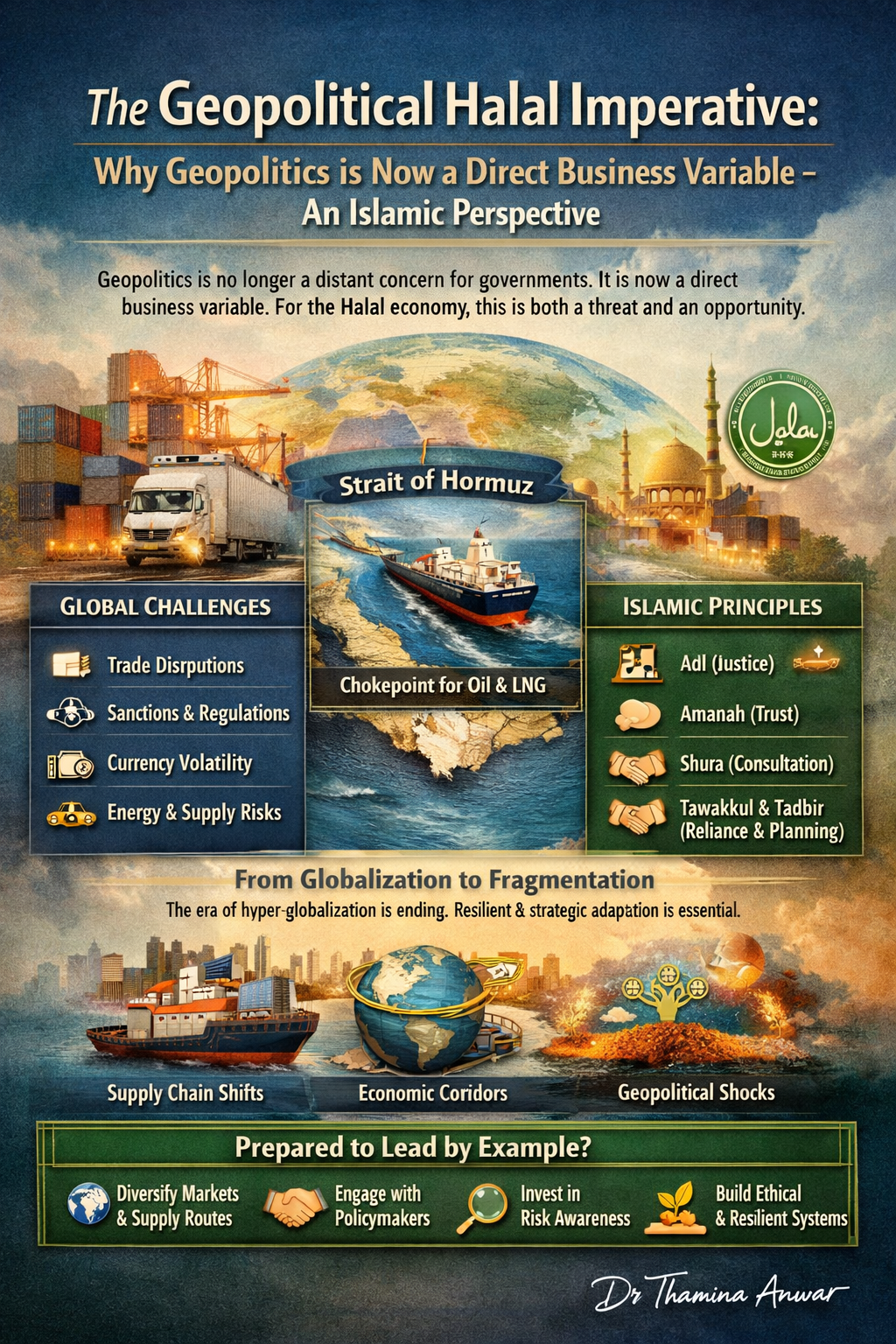
Geopolitics is no longer a distant concern for governments. It is now a direct business variable. For decades, the global Halal economy—spanning food, finance, pharmaceuticals, cosmetics, logistics, and tourism—operated under the assumption that trade followed pure commercial logic: demand, price, and efficiency. That era is ending.
We are witnessing a structural shift. Supply chains are being redesigned not for efficiency but for resilience. Market access is increasingly determined by regulatory and political alignment. Investment flows are moving along strategic corridors—China’s Belt and Road, the Middle East’s economic diversification, Southeast Asia’s digital integration—not just commercial logic. Industries are being affected by policies that sit outside traditional market dynamics, from sanctions to carbon border adjustments to forced labor regulations.
For the Halal ecosystem, this geo-economic environment presents both existential risks and unprecedented opportunities. Islamic principles of justice (Adl), trust (Amanah), consultation (Shura), and avoidance of harm (La Darar wa la Dirar) provide a unique framework for navigating this new world. Countries with mature Halal infrastructure—notably Malaysia, the UAE, Indonesia, Türkiye, and Saudi Arabia—are positioned to become strategic partners in resilient, ethical supply chains. However, this requires a fundamental mindset shift: from reactive compliance to structural adaptability.
This article argues that businesses operating in the Halal ecosystem can no longer ask only “Where is the demand?” They must ask “Where is the risk, and how is it evolving?”
And they must answer from an Islamic worldview that prioritizes Tawakkul (reliance on Allah) combined with Tadbir (strategic planning). The companies that respond structurally—not reactively—will diversify markets with intention, build closer engagement with policymakers, invest in early understanding of regulatory trends, and reassess long-term positioning. In this environment, competitiveness is no longer just about product or price. It is about awareness, positioning, and adaptability.
For the global Halal economy, which exceeded USD 3 trillion in 2024, the question is no longer whether geopolitics matters. It is whether the ecosystem is prepared to operate in a world where geopolitics increasingly defines the rules of trade—and whether it can lead by example, demonstrating that ethical, transparent, and resilient commerce is not a constraint but a strategic advantage.
Part 1: The Geo-Economic Shift – From Globalization to Fragmentation
1.1 The End of the Hyper-Globalized Era
For three decades following the Cold War, the dominant logic of international business was simple: maximize efficiency. Companies sourced raw materials from the cheapest supplier, manufactured in the lowest-cost labor market, and sold to the wealthiest consumers. This logic produced the Halal industry as we know it today—Brazilian chicken processed in the Middle East, New Zealand lamb sold in Malaysia, Indian spices packaged in the UAE, and Islamic finance products structured in London or Luxembourg.
But the assumptions underpinning this model have fractured. The 2008 financial crisis exposed the fragility of interconnected finance. The COVID-19 pandemic shattered just-in-time supply chains. The Russia-Ukraine war weaponized food, energy, and finance. The US-China strategic competition has bifurcated technology standards, investment flows, and even currency reserves. The Gaza conflict has reignited boycotts and repositioned brands along political lines. And climate change is redrawing agricultural maps.
For the Halal ecosystem, these are not abstract geopolitical developments. They are direct business variables that affect:
Certification mutual recognition (e.g., OIC countries versus non-OIC certifiers)
Logistics corridors (Red Sea security, Strait of Hormuz, South China Sea)
Currency stability for imports of Halal raw materials
Regulatory alignment (e.g., EU’s deforestation regulation, US Uyghur Forced Labor Prevention Act)
Consumer sentiment (boycotts driven by perceived injustice)
1.2 Defining the Geo-Economic Environment
A purely economic environment assumes that markets operate on supply and demand, with governments providing only background rules. A geo-economic environment acknowledges that governments actively shape markets using economic tools to achieve strategic objectives—sanctions, tariffs, export controls, investment screening, and industrial policy.
The Halal industry is acutely sensitive to this shift because it sits at the intersection of several geopolitical fault lines:
The Muslim World’s Diversity: The OIC has 57 member states with vastly different geopolitical alignments. Saudi Arabia, Iran, Türkiye, Pakistan, Indonesia, and Malaysia do not always share strategic interests. A Halal certifier recognized in one country may be rejected in another due to political tensions.
The Rise of Economic Corridors: The Belt and Road Initiative (BRI) has built ports, railways, and industrial zones across Muslim-majority countries. The India-Middle East-Europe Corridor (IMEC) is emerging as a counter. Halal logistics providers must choose—or hedge—between these competing systems.
Energy and Food Security: Many Muslim-majority countries are net food importers. Geopolitical shocks (e.g., Black Sea grain blockade) directly affect the price and availability of Halal-certified staples. Similarly, energy prices affect the cost of Halal manufacturing and cold chain logistics.
Digital Sovereignty: Halal e-commerce, blockchain traceability, and AI-driven auditing depend on data flows and cloud infrastructure. The fragmentation of the internet into regional blocs (e.g., China’s Great Firewall, EU’s GDPR, ASEAN’s data frameworks) creates compliance complexity.
1.3 Why Halal Businesses Can No Longer Ignore Geopolitics
Many Halal businesses—especially small and medium enterprises (SMEs)—still treat geopolitics as a “government problem.” This is a dangerous assumption. Consider the following scenarios that have become routine:
A Halal meat exporter in Australia loses access to a Middle Eastern market due to a diplomatic dispute (e.g., the 2018 Australia-Iran sanctions fallout).
A Malaysian Halal cosmetics company finds its supply chain disrupted because a key chemical ingredient from China is delayed due to US export controls.
A Turkish Halal textile manufacturer faces boycotts in Europe because of political tensions over migration or human rights.
An Indonesian Halal fintech company cannot process cross-border payments because of sanctions on Russian banks.
In each case, the business did nothing wrong. Yet its operating environment changed overnight due to decisions made in foreign capitals.
The Islamic Principle of Tadbir (Strategic Foresight): Islam does not encourage fatalism. While Tawakkul (reliance on Allah) is a core virtue, it is accompanied by Tadbir—taking calculated, prudent measures. The Prophet Muhammad (peace be upon him) said,
“Tie your camel first, then put your trust in Allah” (Tirmidhi).
Geopolitical risk management is the modern equivalent of tying the camel. It is not a lack of faith; it is a requirement of Aql (reason) and Hifdh al-Mal (protection of wealth), one of the higher objectives (Maqasid) of Shariah.
1.4 STRAIT OF HORMUZ GEOPOLITICAL RISK BLOCK
Among these, the Strait of Hormuz represents one of the most critical chokepoints for the Halal economy. Roughly 20% of global oil and a significant portion of LNG exports pass through this narrow waterway between Oman and Iran. For Halal industries—particularly food production, cold chain logistics, and manufacturing—any disruption in Hormuz directly translates into energy price volatility, increased transportation costs, and supply chain delays.
For example, a temporary closure or military escalation in the Strait would:
Increase fuel costs for Halal-certified logistics and shipping globally
Disrupt exports from GCC countries (Saudi Arabia, UAE, Qatar), which are key Halal hubs
Affect refrigeration and cold chain integrity due to rising energy prices
Trigger inflation in staple Halal goods, particularly in import-dependent OIC countries
From an Islamic perspective, this reinforces the principle of Tadbir (strategic planning): Halal businesses must not assume uninterrupted access to critical trade routes. Instead, they should proactively diversify logistics pathways (e.g., Red Sea alternatives, overland GCC corridors, or Eurasian rail networks) and build energy-cost resilience into their pricing and contracts.
Part 2: Islamic Principles for Navigating a Geo-Economic World
2.1 Adl (Justice) as a Strategic Framework
In a fragmented world, businesses are pressured to take sides. The Islamic response is not neutrality for its own sake, but Adl (justice) as an active principle. The Quran commands:
“O you who have believed, be persistently standing firm for Allah, witnesses in justice, and do not let the hatred of a people prevent you from being just. Be just; that is nearer to righteousness” (Quran 5:8).
For Halal businesses, this means:
Avoiding exploitative supply chains even when they are geopolitically convenient (e.g., sourcing from regions with forced labor, even if cheaper).
Maintaining transparency about the origin and journey of products, regardless of political pressure to obscure.
Refusing to participate in boycotts that are not based on clear, proven injustice (while recognizing that consumer-led boycotts based on conscience are a separate matter).
Adl also implies that Halal businesses should not weaponize their certification. A Halal logo should never be used to signal political allegiance. It is a religious and ethical marker, not a geopolitical flag.
2.2 Amanah (Trust) in Supply Chains
The concept of Amanah (trust) is foundational to Islamic commerce. In a geo-economic environment where trust between nations is eroding, Halal businesses that can demonstrate Amanah gain a structural advantage.
Amanah in supply chains means:
Verifiable traceability: Not just claiming Halal, but providing immutable proof (blockchain, third-party audits).
Resilience through honesty: Not hiding risks from customers or regulators. Disclosing potential disruptions early.
Long-term relationships over short-term gains: In a volatile world, partners who do not abandon each other during crises are rare. Halal businesses should prioritize Wafa (faithfulness to contracts).
The Quran states:
“Indeed, Allah commands you to render trusts to whom they are due” (Quran 4:58).
In a geopolitical context, this extends to honoring trade agreements, respecting intellectual property, and not exploiting regulatory loopholes created by political chaos.
2.3 Shura (Consultation) as Risk Management
Geopolitical risk is complex and multi-faceted. No single executive or government department can foresee all developments. The Islamic principle of Shura (consultation) offers a practical methodology: bring diverse perspectives together before making strategic decisions.
For Halal businesses, Shura can be operationalized as:
Cross-functional geopolitical risk committees that include supply chain, legal, finance, and Shariah compliance officers.
Industry-wide consultation through Halal industry bodies (e.g., the World Halal Food Council, national Halal authorities) to share intelligence and coordinate responses.
Engagement with policymakers not as lobbying, but as naseeha (sincere advice), providing ground-level insights to help governments design better regulations.
The Prophet’s practice of Shura—consulting his companions before battles and treaties—demonstrates that collective wisdom reduces the risk of catastrophic error. In a geo-economic environment, the cost of error can be bankruptcy.
2.4 La Darar wa la Dirar (No Harm and No Reciprocating Harm)
A famous legal maxim derived from a Prophetic hadith states:
“There should be no harm (darar) and no reciprocating harm (dirar).” Source: Sunan Ibn Majah (Hadith no. 2341).
This principle has profound implications for geopolitical strategy.
Avoiding harm: Halal businesses should not enter markets or supply chains that are likely to cause harm to the company (e.g., exposure to sanctions) or to others (e.g., funding conflict zones).
No reciprocating harm: Even when a business is harmed by a geopolitical act (e.g., a tariff or boycott), it should not retaliate in kind if that retaliation would cause greater injustice or violate contracts.
This maxim also supports diversification. Relying on a single geopolitical bloc is a form of darar (harm) to the business itself. Spreading risk across multiple, stable jurisdictions is a prudent application of la darar.
2.5 Tawakkul and Tadbir: The Balance
Perhaps the most misunderstood Islamic concept in business is Tawakkul (reliance on Allah). Some interpret it as passivity: “Whatever happens is God’s will.” This is a distortion. The Quran pairs Tawakkul with action:
“And rely upon Allah; and sufficient is Allah as a Disposer of affairs” (Quran 33:3) – after the Prophet had already taken military and diplomatic measures.
In the context of geopolitical risk, Tawakkul means:
Accepting that not all risks can be controlled or predicted.
Not falling into anxiety or despair when shocks occur.
Continuing to act ethically even when the environment is hostile.
Tadbir (planning) means:
Conducting scenario planning for geopolitical disruptions.
Building financial reserves (as the Prophet advised: “A believer is not stung from the same hole twice” – Bukhari).
Developing alternative suppliers, logistics routes, and markets.
The balance is this: plan as if everything depends on you; rely as if everything depends on Allah.
Part 3: How Geopolitics is Reshaping the Halal Ecosystem – Sector by Sector
3.1 Halal Food: The New Geopolitics of Agriculture
The Halal food industry, the largest segment of the ecosystem (over USD 1.5 trillion), is being transformed by three geopolitical drivers:
Food Sovereignty vs. Global Supply Chains: The COVID-19 pandemic and the Russia-Ukraine war exposed the vulnerability of countries that import most of their Halal food. Gulf states (UAE, Saudi Arabia, Qatar) are now investing heavily in domestic agriculture and strategic food reserves, often in third countries (e.g., Saudi investment in Sudanese and Ukrainian farmland). This is reducing their reliance on distant suppliers. For Halal exporters in Brazil, Australia, India, and the US, this means demand is becoming more concentrated and relationship-driven, not purely price-driven.
Sanctions and Certification: When countries are sanctioned (e.g., Iran, Russia, Syria), Halal certification bodies face a dilemma. Certifying products from a sanctioned country may be legal locally but could expose the certifier to secondary sanctions or reputational risk. Conversely, refusing certification may be seen as taking a political side. Some OIC countries have established “neutral” certification hubs (e.g., Malaysia’s JAKIM) that certify based purely on Shariah compliance, not political alignment. This neutrality is a strategic asset.
Climate Migration and Agricultural Shifts: Climate change is redrawing agricultural maps. Traditional Halal grain suppliers (e.g., Ukraine, Russia, India) are facing unpredictable yields. New regions (e.g., sub-Saharan Africa, Central Asia) are becoming viable. This is a geopolitical opportunity for countries like Kazakhstan, which is positioning itself as a Halal grain hub for the OIC. However, it also introduces new risks: water conflicts, land grabs, and climate refugees disrupting labor markets.
Case Study – Brazilian Halal Chicken: Brazil is the world’s largest exporter of Halal chicken, primarily to the Middle East. Its success is based on scale, cost, and a robust Halal certification system (many Brazilian slaughterhouses are certified by multiple OIC-recognized bodies). However, Brazil’s geopolitical alignment—its relationship with China, its stance on the Ukraine war, its environmental record in the Amazon—is now being scrutinized by importing countries. Some Middle Eastern buyers are diversifying to Türkiye and India as a hedge. Brazil’s response has been to deepen bilateral trade agreements (e.g., with the UAE and Saudi Arabia) and invest in traceability technology to prove Halal integrity beyond doubt.
3.2 Islamic Finance: The Currency of Geopolitical Alignment
Islamic finance, with assets exceeding USD 3 trillion, is inherently cross-border. Sukuk (Islamic bonds) are issued in one country, sold to investors in another, and often structured in a third (e.g., Malaysia, UAE, or London). Geopolitics affects Islamic finance in several ways:
Reserve Currencies and Riba: The global financial system is dollar-centric. But sanctions on Russia and the weaponization of the SWIFT system have prompted discussions of alternative payment systems. China, Russia, and several OIC countries (e.g., Iran, Türkiye, Malaysia) have explored bilateral currency swaps and a potential “Islamic digital currency” backed by gold or commodities. While a fully Shariah-compliant, geopolitically neutral reserve currency is still distant, the trend is clear: Islamic finance institutions must now consider currency risk as a geopolitical variable, not just an economic one.
Sukuk and Sovereign Risk: Sukuk issued by countries with geopolitical tensions (e.g., Pakistan, Egypt, Türkiye) carry higher risk premiums. Investors are increasingly asking not just about credit ratings, but about political stability, military alliances, and exposure to great-power competition. This is pushing some sovereign issuers to include geopolitical risk disclosures in their sukuk prospectuses.
Fintech and Cross-Border Payments: Islamic fintech companies offering cross-border payments (e.g., TransferWise alternatives, blockchain-based remittance) are caught between competing regulatory regimes. The US and EU require compliance with anti-money laundering (AML) and counter-terrorism financing (CTF) rules that may conflict with the financial laws of Iran or Syria. Some Islamic fintechs have chosen to operate only within “friendly” blocs (e.g., ASEAN + GCC), effectively redrawing their market map along geopolitical lines.
Islamic Principle: The prohibition of Riba (usury) and Gharar (excessive uncertainty) actually aligns with geopolitical risk management. A contract that depends on stable, predictable conditions is more Shariah-compliant than one that speculates on volatile geopolitical outcomes. Therefore, Islamic financial products that build in geopolitical contingencies (e.g., sukuk with clauses for supply chain disruption) are not just prudent; they are more faithful to the spirit of Adl.
3.3 Halal Pharmaceuticals and Cosmetics: Regulatory Battlegrounds
The Halal pharmaceutical and cosmetics sectors are growing rapidly (projected to exceed USD 150 billion by 2030). However, they are highly sensitive to regulatory geopolitics.
Ingredient Sourcing: Many pharmaceutical ingredients (APIs) are produced in China and India. Geopolitical tensions (e.g., US-China decoupling) could disrupt the supply of Halal-critical ingredients like gelatin alternatives, plant-based capsules, and alcohol-free preservatives. Halal pharmaceutical companies are now actively seeking secondary sources in Türkiye, Malaysia, and Eastern Europe.
Cosmetics and the “Clean Beauty” Geopolitics: The global shift toward “clean beauty” (avoiding toxins, animal testing) aligns with Halal cosmetics. However, the EU’s stricter regulations on chemicals (REACH) are being adopted by some Muslim-majority countries, while others maintain looser standards. This regulatory divergence is creating a two-tier Halal cosmetics market: premium (EU-aligned) and value (less regulated). Geopolitical alignment with the EU or China determines which tier a country can supply.
3.4 Halal Logistics and Cold Chain: The New Silk Roads
Halal logistics—ensuring that Halal products remain uncontaminated from farm to fork—is a specialized field. Geopolitics is reshaping logistics corridors:
STRAIT OF HORMUZ IN LOGISTICS CONTEXT: Beyond the Red Sea, the Strait of Hormuz remains an under-discussed but high-impact vulnerability in Halal logistics. Unlike the Suez Canal, which primarily affects transit time, Hormuz disruptions would directly impact energy supply—the lifeblood of cold chain systems. A sustained disruption could simultaneously raise shipping costs and compromise temperature-controlled Halal goods, creating both economic and Shariah compliance risks (e.g., spoilage or contamination concerns).
As a result, leading Halal logistics providers are beginning to treat energy security as part of Halal integrity itself—investing in distributed cold storage, alternative fuel sources, and regional processing hubs closer to end markets.
The Red Sea Crisis: Houthi attacks on shipping in the Red Sea (2023–2024) forced many Halal shipments from Asia to Europe to reroute around the Cape of Good Hope, adding weeks and significant cost. This exposed the vulnerability of the Suez Canal route. In response, Halal logistics providers are investing in alternative corridors: the China-Pakistan Economic Corridor (CPEC), the Trans-Caspian International Transport Route (Middle Corridor), and rail links from China to Europe via Central Asia and Türkiye.
Port Politics: Major ports in the Muslim world—Kuala Linggi (Malaysia), Jebel Ali (UAE), Hamad (Qatar), Piraeus (Greece, operated by China)—are sites of geopolitical competition. Control over these ports determines who can certify, inspect, and tax Halal goods. Some Halal exporters are now diversifying their port usage to avoid being trapped by a single geopolitical actor.
Cold Chain as Critical Infrastructure: Halal meat and pharmaceuticals require uninterrupted cold chains. Geopolitical instability (e.g., cyberattacks on logistics software, energy shortages affecting refrigeration) is causing Halal logistics companies to invest in backup power systems, redundant data centers, and alternative fuel sources. This is expensive, but it is becoming a competitive differentiator.
Islamic Principle – Rafq (Gentleness/Kindness) in Logistics:
The Prophet (PBUH) said,
“Indeed, Allah loves kindness (rifq) in all matters” (Bukhari).
In logistics, rifq translates to humane treatment of animals during transport, minimal spoilage (avoiding israf), and fair treatment of logistics workers. A Halal logistics provider that embodies rifq will not only be more resilient but will also attract customers who value ethical supply chains.
3.5 Halal Tourism: The Geopolitics of Hospitality
Halal tourism (hotels with prayer facilities, Halal food, gender-segregated pools) is a growing niche. Geopolitics affects it directly:
Visa Policies and Diplomatic Relations: A Muslim tourist from Indonesia may choose Malaysia over Thailand if diplomatic relations sour, or Türkiye over Egypt. Conversely, the UAE’s visa liberalization for Indian and Russian tourists has boosted its Halal tourism sector, even as geopolitical tensions with some neighbors persist.
Boycotts and Travel Patterns: The Gaza conflict led to calls for boycotting “pro-Israel” destinations. While no country is entirely pro- or anti- any position, perceived alignment affects tourist flows. Turkey and Malaysia have seen increased Halal tourism from the Arab world as a result.
Safe Havens: Halal tourists increasingly seek destinations that are politically stable, safe, and respectful of Islamic practices. This has benefited Malaysia, Indonesia, and the UAE, while deterring travel to historically popular but unstable countries (e.g., Egypt after the Arab Spring, Tunisia, Lebanon).
Part 4: Strategic Responses for the Halal Ecosystem
4.1 From Reactive to Structural Adaptation
The worst response to geopolitical volatility is reactive firefighting—scrambling to find new suppliers when a border closes, or panic-diversifying markets after a boycott begins. The better approach is structural adaptation: building resilience into the business model before the shock.
Structural adaptation includes:
Multi-polar certification: Obtaining Halal certification from multiple recognized bodies (e.g., JAKIM in Malaysia, ESMA in UAE, MUI in Indonesia, SMIIC standards) to ensure market access even if one certifier loses recognition due to geopolitical disputes.
Buffer inventories: Maintaining strategic reserves of critical Halal ingredients (e.g., gelatin alternatives, Halal enzymes) to weather supply disruptions.
Geopolitical risk mapping: Regularly updating a heat map of countries based on political stability, regulatory alignment, and trade agreement coverage.
Scenario planning: Conducting tabletop exercises for scenarios like “US sanctions on China,” “closure of the Strait of Hormuz,” or “EU ban on deforestation-linked products.”
4.2 The Opportunity for Malaysia and Other Halal Hubs
Malaysia is often cited as the gold standard for Halal ecosystem development, with its robust certification body (JAKIM), Halal industrial parks, and Halal education programs. Geopolitical fragmentation presents Malaysia with a unique opportunity to become a neutral, trusted Halal hub.
Why Malaysia?
Geopolitical neutrality: Malaysia maintains diplomatic relations with both Western and Eastern blocs, and is not a party to major conflicts. It is a member of the OIC, ASEAN, and the Non-Aligned Movement.
Advanced Halal infrastructure: World-class Halal certification, logistics, and finance.
Legal system: A common law system (inherited from British rule) that is familiar to international investors, combined with Islamic commercial law.
Multicultural workforce: Malay, Chinese, and Indian populations provide language and cultural bridges to multiple markets.
Strategic moves for Malaysia (and similar hubs like UAE, Türkiye):
Mutual recognition agreements (MRAs): Proactively sign MRAs with Halal certification bodies from both Western and Eastern countries, becoming the “Switzerland of Halal.”
Halal dispute resolution: Establish an international Halal arbitration center (based on Islamic principles) to resolve commercial disputes arising from geopolitical disruptions.
Geopolitical risk insurance: Work with Islamic insurers (Takaful) to offer products that cover losses from political violence, sanctions, and supply chain rerouting.
Halal data corridor: Develop a secure, Shariah-compliant data infrastructure for Halal traceability that is not subject to extraterritorial data laws (e.g., US CLOUD Act, China’s Cybersecurity Law).
4.3 Building Resilience Through Islamic Principles
The Halal ecosystem can draw on Islamic principles to build resilience:
Geopolitical Challenge | Islamic Principle | Practical Response |
Supply chain concentration | Tawhid (oneness of Allah) implies no dependency on any single nation | Diversify suppliers across multiple countries |
Regulatory unpredictability | Shura (consultation) | Engage proactively with regulators; participate in standard-setting |
Currency volatility | Prohibition of Riba (usury) and Gharar (excessive uncertainty) | Use commodity-backed instruments, avoid speculative hedging |
Loss of market access | Tawakkul (reliance on Allah) + Tadbir (planning) | Maintain multiple market entry options; build cash reserves |
Boycotts and reputational risk | Adl (justice) and Sidq (truthfulness) | Transparent communication; avoid political grandstanding |
4.4 The Role of Government and Industry Bodies
Individual businesses cannot solve geopolitical risks alone. Collective action is required.
Governments of Muslim-majority countries should:
Establish Halal geopolitical intelligence units within trade ministries to monitor and forecast risks.
Negotiate Halal-specific trade agreements that include mutual recognition of certification, fast-track dispute resolution, and supply chain emergency protocols.
Invest in Halal agricultural self-sufficiency to reduce vulnerability to food supply shocks.
Create Halal strategic reserves (similar to petroleum reserves) for critical Halal ingredients.
Industry bodies (e.g., World Halal Food Council, national Halal authorities) should:
Develop geopolitical risk assessment frameworks tailored to the Halal industry.
Maintain red lists of high-risk suppliers or logistics routes (confidential for members).
Facilitate collective bargaining for shipping and insurance during crises.
Organize regular scenario exercises for members.
Part 5: Case Studies – Halal Businesses Navigating Geopolitics
Case Study 1: A Malaysian Halal Meat Exporter During the Red Sea Crisis
Background: A medium-sized Halal meat exporter in Malaysia ships frozen beef to Europe. The usual route is via the Strait of Malacca, Indian Ocean, Red Sea, Suez Canal, and Mediterranean.
Geopolitical Shock: In late 2023, Houthi attacks in the Red Sea caused insurance premiums to skyrocket and many shipping lines to reroute via the Cape of Good Hope. Transit time increased from 18 days to 35 days, and costs rose 30%.
Response: The company had previously invested in a blockchain-based cold chain monitoring system (inspired by Amanah principles). They used this data to demonstrate to European buyers that product integrity was maintained despite the longer route. They also activated a pre-negotiated agreement with a Turkish logistics partner to offload in Mersin and distribute overland to Europe, bypassing the Red Sea entirely. While costs increased, the company retained all its customers and even gained new ones who valued its reliability.
Islamic Lesson: The company’s investment in Amanah (trust) through technology and its diversification (multiple logistics partners) were acts of Tadbir that turned a crisis into a competitive advantage.
Case Study 2: Indonesian Halal Cosmetics and the China-US Tech War
Background: An Indonesian Halal cosmetics company sources a specialized, alcohol-free preservative from a Chinese supplier. The preservative is also used in pharmaceuticals and is subject to US export controls because of its dual-use potential.
Geopolitical Shock: The US imposes restrictions on the export of certain chemical precursors to China. The Chinese supplier cannot obtain key inputs, leading to a six-month shortage.
Response: The Indonesian company had already mapped alternative suppliers in India and Türkiye as part of a Shura-based risk assessment. They switched to a Turkish supplier within 45 days, though at a 15% higher cost. They also reformulated one product line to use a different preservative sourced locally from palm oil derivatives, turning a problem into an innovation. They marketed the new line as “100% ASEAN-sourced Halal,” which appealed to regional consumers.
Islamic Lesson: Adl (justice) required the company to not exploit the crisis by raising prices unfairly. Instead, they absorbed some cost and communicated transparently with customers, strengthening loyalty.
Case Study 3: Islamic Fintech and Cross-Border Sanctions
Background: A London-based Islamic fintech startup offers Shariah-compliant remittances to several Muslim-majority countries, including Syria and Sudan.
Geopolitical Shock: The US and EU expand sanctions on Syria, including prohibitions on providing financial services to certain Syrian banks. The fintech’s compliance team realizes that some of their correspondent banking relationships could be jeopardized.
Response: The fintech decides to exit the Syrian market entirely, rather than risk violating sanctions (la darar principle – avoiding harm to the company and its other customers). However, they set up a dedicated Waqf (endowment) to support Syrian refugees in neighboring countries via permissible channels. They also invest in a blockchain-based, peer-to-peer remittance system that does not rely on sanctioned intermediaries, partnering with a UAE-based Islamic bank.
Islamic Lesson: Exiting a market is not a failure if done for ethical reasons. The Waqf was an act of Ihsan (excellence) that mitigated the reputational damage and fulfilled the social responsibility of Islamic finance.
Part 6: The Future – Geopolitics, Halal, and the New World Order
6.1 Megatrends Shaping the Halal Ecosystem (2025–2035)
The Rise of Regional Blocs: The world is dividing into economic blocs: US-led (North America, EU, Japan, South Korea, Australia), China-led (BRI partners, Russia, Central Asia, parts of Africa), and a “neutral” bloc (India, ASEAN, GCC, Türkiye). The Halal ecosystem spans all three, but neutral countries like Malaysia, UAE, and Indonesia will become the preferred hubs for Halal trade.
Food as a Weapon: Countries will increasingly use food exports as geopolitical leverage. Halal importers must build strategic reserves and diversify sources. The OIC may develop a collective food security mechanism (a “Halal Food Bank”).
Digital Sovereignty and Halal Tech: The internet may fragment. Halal blockchain platforms will need to operate on multiple, compatible ledgers. AI auditing tools will need to comply with different data privacy regimes (GDPR, China’s PIPL, etc.). Halal tech companies that build for interoperability will thrive.
Climate Geopolitics: Carbon border adjustments (e.g., EU’s CBAM) will affect Halal exporters. Countries with high carbon footprints (e.g., Brazil, India, China) may face tariffs. Halal certification may eventually include a carbon component (a “Halal-Carbon” label) to maintain market access.
Demographic Shifts: The Muslim population is growing faster than non-Muslim populations, especially in Africa and Asia. This will shift economic weight toward OIC countries over the long term. However, many of these countries are politically unstable. Geopolitical risk in the Halal industry will increasingly be about internal conflicts (civil wars, coups) rather than just great-power competition.
Strait of Hormuz as a Structural Energy Chokepoint: The Strait of Hormuz will emerge as a defining variable in the Halal economy’s cost structure and resilience. As one of the world’s most critical energy chokepoints, any disruption—whether due to military escalation, sanctions, or maritime insecurity—will directly impact fuel prices, shipping costs, and the viability of cold chain logistics. For the Halal ecosystem, which depends heavily on temperature-controlled transport (meat, pharmaceuticals) and energy-intensive production, this creates a systemic vulnerability. Over the next decade, businesses and governments will increasingly invest in energy diversification, regional processing hubs, and alternative logistics corridors to reduce exposure to Hormuz-related shocks. In Islamic terms, this reflects a shift toward deeper Tadbir (strategic foresight), where energy security becomes inseparable from Halal supply chain integrity.
6.2 The Halal Ecosystem as a Model for Ethical Globalization
In a fragmented, conflict-prone world, the Halal ecosystem offers a model of commerce based on shared ethical principles rather than shared political allegiances. Halal is not a nationality; it is a standard. A Halal product from China and a Halal product from the US can both be certified by the same Malaysian body, and a Muslim consumer in Indonesia can trust both equally—provided the certification is credible.
This is the geopolitical power of Halal: it transcends borders without erasing them. It allows trade to continue even when political relations are strained. It provides a common language of trust (Amanah) that diplomats cannot easily replicate.
For this potential to be realized, the Halal ecosystem must:
Strengthen mutual recognition among OIC countries and beyond.
Resist politicization of certification (e.g., refusing to deny certification based on the country of origin unless Shariah demands it).
Invest in verification technology (blockchain, AI) to make trust independent of political goodwill.
Educate consumers that Halal is about religious compliance and ethics, not about political loyalty.
6.3 A Call to Action for Halal Businesses
The question for businesses is no longer whether geopolitics matters. It is whether they are prepared to operate in a world where geopolitics increasingly defines the rules.
Immediate steps for Halal businesses:
Conduct a geopolitical risk audit of your supply chains, markets, and certification dependencies. Identify single points of failure.
Diversify with intention. Do not just add suppliers; add suppliers from different geopolitical blocs.
Engage with policymakers at national and international levels. Join industry associations that advocate for Halal-friendly trade policies.
Build cash/asset reserves: Build cash or asset reserves to weather disruptions. While Islamic finance prohibits interest-based accumulation and discourages idle hoarding, maintaining reserves through Shariah-compliant instruments—such as profit-sharing (Mudarabah) structures—is both permissible and prudent.
Invest in traceability technology that can withstand geopolitical scrutiny. Blockchain, AI, and IoT are not optional; they are the infrastructure of trust.
Train your team on geopolitical awareness. Appoint a “Geopolitical Risk Officer” or integrate risk into existing Shariah compliance roles.
Adopt a long-term horizon. Geopolitical shifts take years to unfold. Do not make decisions based on news headlines; base them on structural trends.
And finally, remember the Islamic foundation:
“And prepare against them whatever you are able of power and of horses of war, by which you may terrify the enemy of Allah and your enemy…” (Quran 8:60).
While this ayah speaks of military preparedness, classical scholars extended it to include economic and logistical preparedness. In the modern context, “preparing power” means building resilient supply chains, diversifying markets, and investing in technology. It is a religious duty to protect the Ummah’s economic well-being.
Conclusion: The Geopolitical Halal Imperative
Geopolitics is no longer a distant concern for governments. It is now a direct business variable. For the Halal ecosystem, this is both a threat and an opportunity. The threat is disruption: blocked shipping lanes—from the Red Sea to the Strait of Hormuz—broken certification agreements, volatile currencies, energy price shocks, and divided consumer loyalties. The opportunity is leadership: a chance to demonstrate that commerce based on Adl (justice), Amanah (trust), Shura (consultation), and Ihsan (excellence) is more resilient, more ethical, and ultimately more successful than the zero-sum geopolitics of the past.
The companies that respond structurally—not reactively—will diversify markets and supply chains with intention, build closer engagement with policymakers and industry bodies, invest in understanding regulatory and geopolitical trends early, and reassess long-term positioning, not just short-term opportunities.
In this environment, competitiveness is no longer just about product or price. It is about awareness, positioning, and adaptability. For countries like Malaysia, the UAE, Türkiye, and Indonesia, this is also a strategic opportunity. Those who can align industry capabilities with emerging global shifts will not only remain relevant—they will become strategic partners in new supply chains and markets.
The Halal ecosystem has a unique advantage: its ethical framework is not contingent on any single political system. It predates modern nation-states and will outlast them. By returning to the Prophetic principles of fair trade, transparency, and trust, and by embracing the technological tools of the 21st century, the Halal industry can navigate the geo-economic storm and emerge as a beacon of ethical globalization.
The question for businesses is no longer whether geopolitics matters. It is whether they are prepared to operate in a world where it increasingly defines the rules.
And for the Halal ecosystem, the answer must be: yes, we are prepared—by the grace of Allah, and by our own diligent Tadbir.
Yours sister,
Dr. Thamina (Samina) Anwar
CEO & Founder
Global Halal Shura Hub
📱 WhatsApp Community: https://chat.whatsapp.com/KrWXFhHBuy6BkA3s4LYKQ2https://chat.whatsapp.com/ISSstU726tqBjVXlYYnHGN
🌐 Website: https://globalhalalshurahub.com
📧 Email: globalhalalshurahubsocialmedia@gmail.com
📘 Facebook:
https://www.facebook.com/profile.php?id=61588247732733
https://www.facebook.com/profile.php?id=61588077462429
📷 Instagram: https://www.instagram.com/globalhalalshurahub/
🔗 LinkedIn:
https://www.linkedin.com/in/dr-thamina-anwar-806124145/
https://www.linkedin.com/in/global-halal-shura-hub-dr-thamina-samina-anwar-05418b398/
📺 YouTube: https://www.youtube.com/@GlobalHalalShuraHub
May Allah (SWT) bless this effort and allow it to be a source of benefit for the Ummah.