
🌐 Global Time Zones
 Turkey — 10:00 AM
 Egypt — 9:00 AM
 United Kingdom — 8:00 AM
 South Africa — 9:00 AM
 Nigeria — 8:00 AM
 Pakistan — 12:00 PM
 Bangladesh — 1:00 PM
 Indonesia (Jakarta) — 2:00 PM
 Malaysia — 3:00 PM
 Australia (Sydney/Melbourne) — 5:00 PM
 Aotearoa New Zealand — 7:00 PM
Theme 2: Money in Islam
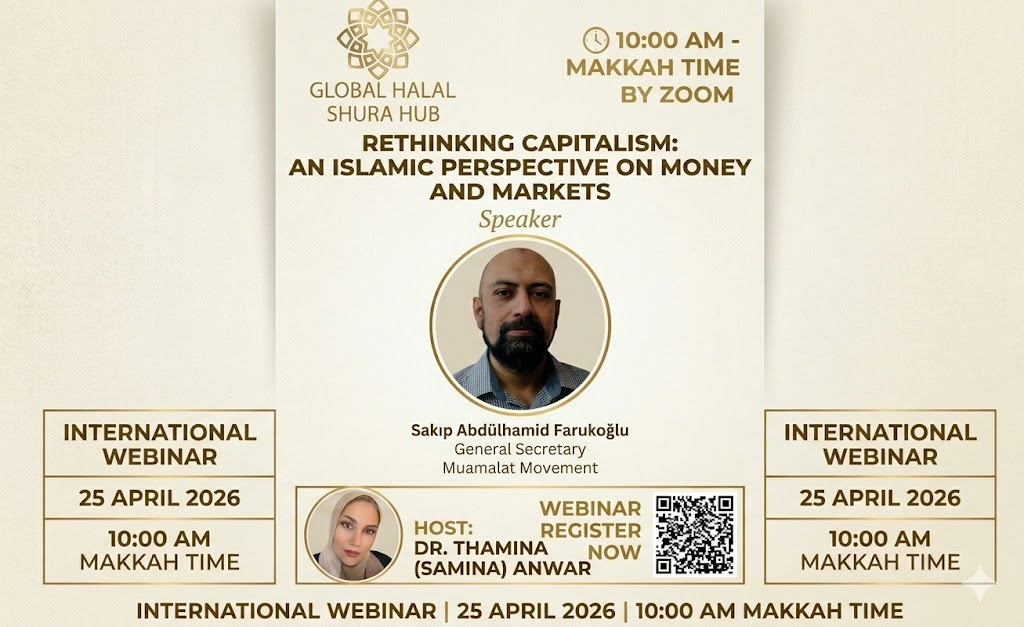
About Profile of Panelist 2: Sakıp Abdülhamid Farukoğlu
Sakıp Abdülhamid Farukoğlu, General Secretary of the Muamalat Movement, works on reviving and applying muʿāmalāt (Islamic commercial law) to modern economic systems. Based in Ankara and trained under leading scholars since 2022, his focus is on developing practical, legally grounded alternatives to conventional finance using classical Islamic principles of trade, contracts, and economic justice.
His work emphasises transitioning from debt-based fiat economies to asset-backed models, particularly gold-based systems, while promoting lawful exchange, transparency, and fairness. Through research, policy engagement, and scholarship, he advances a muʿāmalāt-based framework aimed at addressing inflation, financial instability, and systemic inequality.
We are pleased to welcome him as our second panellist and look forward to his insights on implementing muʿāmalāt in today’s context, especially the transition to asset-backed systems and the legal and institutional challenges involved in achieving sustainable economic justice.
1. What distinction makes the modern system problematic?
Islam makes a fundamental distinction between:
‘Ayn: present, tangible, possessed value
Dayn: owed, deferred value, or a claim
The key principle is that Dayn cannot be used as payment.
However, most forms of modern money function as Dayn:
paper currency represents a claim
bank balances are claims
digital money consists of claims
2. Why is using Dayn as payment not permitted?
A debt is not payment—it is only a claim to future payment.
In Islamic law, valid payment must be real, immediate, and present, not deferred or promised. This means payment cannot take the form of:
“I owe you”
“I promise to pay”
“It will be settled later”
When claims replace actual payment, delay enters the transaction, undermining fairness and certainty in exchange.
3. What is Riba an-Nasiah, and how does it relate to the modern system?
Riba refers to unjustified increase in transactions and appears in two forms:
Riba al-Fadl: increase in quantity
Riba an-Nasiah: increase through delay
The Qur’an states:
“Allah has permitted trade and forbidden Riba” (2:275),
and warns of severe consequences for persisting in it (2:279).
Riba an-Nasiah arises when exchange is not immediate—when:
one side is ‘Ayn (present value)
the other is Dayn (deferred claim)
This creates unjustified delay and compromises the integrity of the transaction.
In the modern system:
Money itself largely functions as Dayn
Therefore, delay—and by extension Riba—is embedded structurally
This suggests that the issue is not limited to interest-bearing loans; it is systemic. Avoiding individual loans does not necessarily remove exposure to Riba if the medium of exchange itself is debt-based.
4. What must money be in Islam?
For money to be valid, it must:
be accepted by mutual consent (Qur’an 4:29)
be ‘Ayn (present and tangible)
function as a reliable measure and store of value
not cause harm
not itself be debt
5. What did Muslims historically use as money?
While various items can serve as money through mutual agreement, gold and silver became the dominant standards due to their qualities:
durability
divisibility
portability
widespread acceptance
The Dinar (gold) and Dirham (silver) hold particular significance, as they are directly linked to:
Zakat thresholds (Nisab)
specific legal rulings, including Hudud
Yours Sister,
Dr. Thamina (Samina) Anwar
CEO & Founder
Global Halal Shura Hub🌐 Connect With Us
📱 WhatsApp Community:
👉 https://chat.whatsapp.com/KrWXFhHBuy6BkA3s4LYKQ2🌐 Website: https://globalhalalshurahub.com
📧 Email: globalhalalshurahubsocialmedia@gmail.com📷 Instagram: https://www.instagram.com/globalhalalshurahub/
🔗 LinkedIn:
https://www.linkedin.com/in/dr-thamina-anwar-806124145/
https://www.linkedin.com/in/global-halal-shura-hub-dr-thamina-samina-anwar-05418b398/📺 YouTube: https://www.youtube.com/@GlobalHalalShuraHub