
🌐 Global Time Zones
 Turkey — 10:00 AM
 Egypt — 9:00 AM
 United Kingdom — 8:00 AM
 South Africa — 9:00 AM
 Nigeria — 8:00 AM
 Pakistan — 12:00 PM
 Bangladesh — 1:00 PM
 Indonesia (Jakarta) — 2:00 PM
 Malaysia — 3:00 PM
 Australia (Sydney/Melbourne) — 5:00 PM
 Aotearoa New Zealand — 7:00 PM
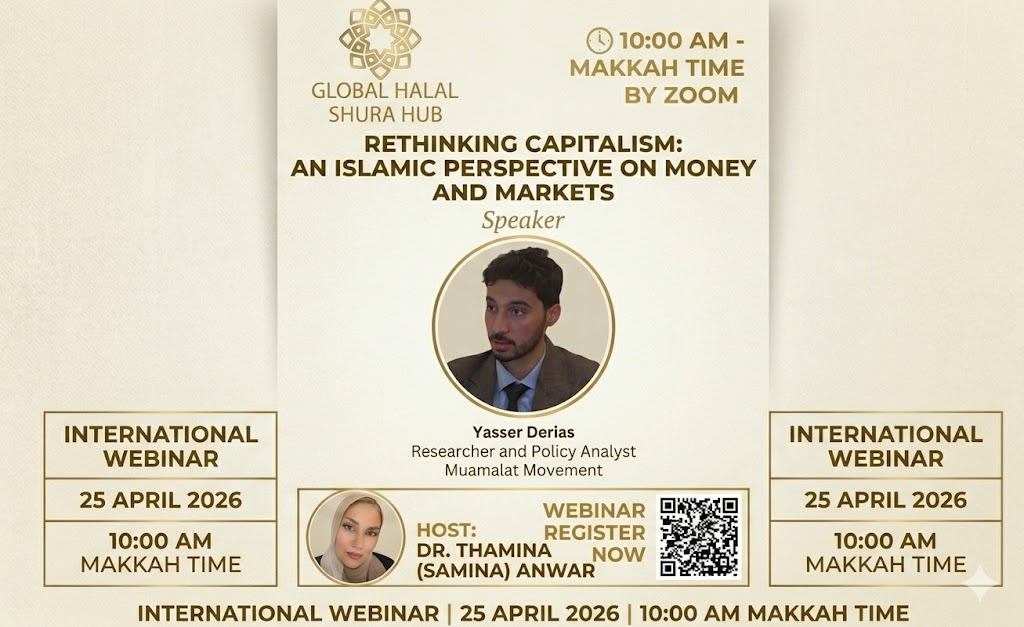
Theme3: The Way Forward — The Model of Muamalat in Madinah
About Profile of Panelist 3: Yasser Derias
Muʿāmalāt (معاملات) refers to the part of Islamic law that governs dealings between people, especially in financial, commercial, and social transactions.
Yasser Derias is a researcher and policy analyst specialising in muʿāmalāt, focused on applying its principles to modern economic systems. Based in Ankara and involved in the Muamalat Movement, he works on developing asset-backed alternatives to fiat economies, emphasising lawful exchange, institutional integrity, and long-term reform.
His research includes gold-based monetary models, public markets and profit-sharing finance. With a background in engineering and data analysis, he brings a structured, multidisciplinary approach to advancing muʿāmalāt as a practical solution to issues like inflation, financial instability, and economic injustice.
We are pleased to welcome him as our third panellist and look forward to his insights on implementing muʿāmalāt in today’s context, with particular focus on the model of Muamalat in Madinah. He will be addressing the following key questions:
1. Why is Madinah central?
Madinah represents the place where the Prophetic model took full social form:
Allah praises its early generations (3:110)
Islam was completed there (5:3)
law, trade, and worship were fully integrated
The ‘Amal of Madinah preserves this lived practice—reflecting the Sunnah as it was implemented in society.
2. What are the key institutions?
The Madinan model was built on core economic institutions, including:
the Suq (marketplace)
the Dinar and Dirham (gold and silver currency)
Qirad (profit-sharing finance)
Together, these supported societies that were both prosperous and ethically grounded.
3. Why is the Suq important?
The Suq is a public institution, comparable in status to the mosque:
open and accessible to all
free from taxation
not privately owned
As a Waqf, it exists for public benefit:
no monopolies
no restricted access
no permanent control by elites
4. How does the Suq sustain society?
It provides essential services to traders and the wider community
These services generate revenue
Revenue is reinvested back into the community
This creates a broader ecosystem of Awqaf—institutions dedicated to collective welfare and long-term sustainability.
5. How can this model be applied today?
Application does not mean copying the past mechanically, but reviving its principles:
reintroducing gold and silver currency, potentially supported by digital systems
developing large-scale public marketplaces using modern logistics
replacing interest-based lending with Qirad
The aim is a principled revival, not a historical replica. Contemporary examples—such as major trade hubs like Yiwu in China—demonstrate that large-scale, integrated market ecosystems can still function effectively today.
Yours Sister,
Dr. Thamina (Samina) Anwar
CEO & Founder
Global Halal Shura Hub🌐 Connect With Us
📱 WhatsApp Community:
👉 https://chat.whatsapp.com/KrWXFhHBuy6BkA3s4LYKQ2🌐 Website: https://globalhalalshurahub.com
📧 Email: globalhalalshurahubsocialmedia@gmail.com📷 Instagram: https://www.instagram.com/globalhalalshurahub/
🔗 LinkedIn:
https://www.linkedin.com/in/dr-thamina-anwar-806124145/
https://www.linkedin.com/in/global-halal-shura-hub-dr-thamina-samina-anwar-05418b398/📺 YouTube: https://www.youtube.com/@GlobalHalalShuraHub