-
📝 Registration
👉 https://docs.google.com/forms/d/e/1FAIpQLSdE_nXEaatMXzPmvEySeZO8sW3PFKzRggZ-PD81O_7Q9TmVDw/viewform
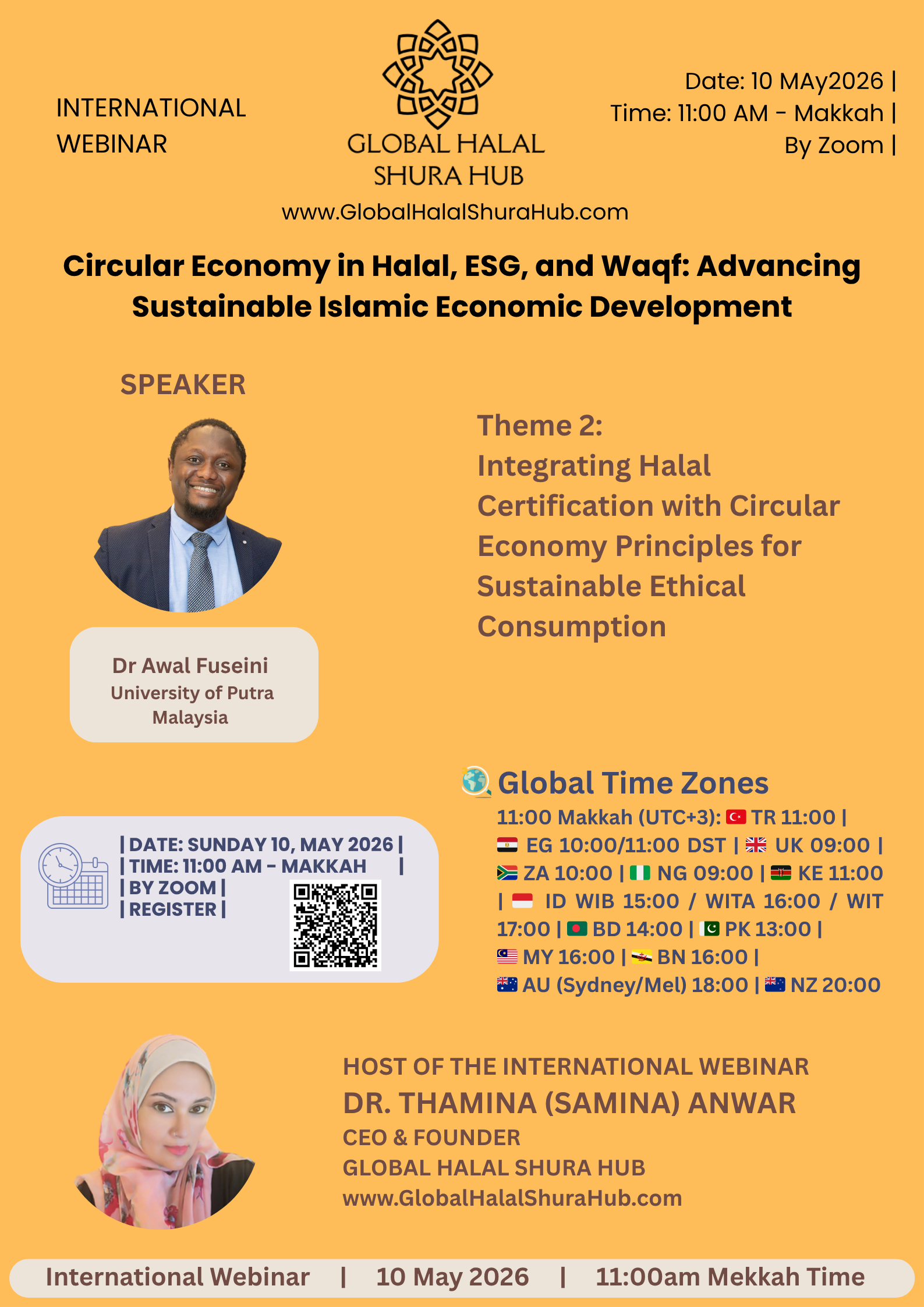
📅 Sunday, 10 May 2026
🕙 11:00 AM (Makkah Time / UTC+3)
🌍 Global Time Zones
 Turkey (TRT, UTC+3): 11:00 AM
 Egypt (EET, UTC+2 / DST UTC+3): 10:00 AM (or 11:00 AM DST)
 United Kingdom (BST, UTC+1): 09:00 AM
 South Africa (SAST, UTC+2): 10:00 AM
 Nigeria (WAT, UTC+1): 09:00 AM
 Kenya (EAT, UTC+3): 11:00 AM
 Indonesia:
• WIB (Western): 03:00 PM
• WITA (Central): 04:00 PM
• WIT (Eastern): 05:00 PM
 Bangladesh (BST, UTC+6): 02:00 PM
 Pakistan (PKT, UTC+5): 01:00 PM
 Malaysia (MYT, UTC+8): 04:00 PM
 Brunei (BNT, UTC+8): 04:00 PM
 Australia (Sydney/Melbourne, AEST UTC+10): 06:00 PM
 Aotearoa New Zealand (NZST, UTC+12): 08:00 PM
Our second panel speaker is Dr. Awal Fuseini , and he will focus on theme 2: “Integrating Halal Certification with Circular Economy Principles for Sustainable Ethical Consumption”
AboutDr. Awal Fuseini :
Dr. Awal Fuseini is a highly accomplished meat scientist, halal industry expert, and leading advocate for integrating circular economy principles into halal certification and sustainable food systems. With a PhD in Animal Science from the University of Bristol and his current role as an Honorary Research Fellow at Universiti Putra Malaysia, he is widely recognised as an international authority in halal meat production, livestock welfare, halal assurance systems, and sustainable food governance. His work spans scientific research, policy development, and industry engagement, positioning him at the intersection of academia, regulatory systems, and global halal market transformation.
Dr. Fuseini’s expertise is particularly focused on advancing halal certification through the integration of circular economy principles, including sustainable sourcing, waste minimisation, by-product valorisation, resource efficiency, and environmentally responsible production across the entire halal value chain. His contributions emphasise the transformation of halal systems from compliance-based frameworks into sustainability-driven ecosystems that support ethical production, food security, environmental stewardship, and long-term economic resilience. Through his research, advisory work, and international collaborations, he has engaged with academic institutions, certification bodies, policymakers, and food industry stakeholders to strengthen halal governance and align it with global sustainability objectives.
Beyond his technical and policy contributions, Dr. Fuseini is actively involved in a range of international academic, industry, and advisory networks related to halal science, food systems, animal welfare, and sustainable agriculture. He participates in global conferences, expert panels, and cross-sector dialogues that shape contemporary thinking on halal integrity and sustainability integration. His multidisciplinary engagement allows him to contribute to diverse organisations working on food security, ethical supply chains, and sustainable development within the halal industry.
In addition to his academic and institutional roles, Dr. Fuseini is widely regarded as a highly respected and gifted international speaker, regularly invited to deliver keynote addresses, expert lectures, and policy presentations across universities, industry forums, and global halal conferences. He is known for his ability to communicate complex scientific, ethical, and regulatory issues in a clear, engaging, and practical manner, making his insights accessible to both technical and non-technical audiences. His presentations often bridge science, faith-based ethics, and sustainability, helping audiences understand how circular economy thinking can be practically applied within halal certification and global food systems transformation.
Through this combination of academic excellence, industry leadership, international collaboration, and public engagement, Dr. Fuseini continues to play a pivotal role in shaping the future of halal certification. His work reinforces the evolution of halal systems into globally credible frameworks that not only ensure Shariah compliance but also actively contribute to sustainable ethical consumption, environmental regeneration, and responsible global food governance.
We are very honoured that Dr. Awal Fuseini is our second panel speaker, where he will educate us on the crucial theme: “Integrating Halal Certification with Circular Economy Principles for Sustainable Ethical Consumption.” This critical discussion addresses one of the most essential dimensions of halal certification transformation, and he will explore the following key questions:
-
How can halal certification systems be restructured to incorporate circular economy principles such as waste minimisation, sustainable sourcing, recycling, and product lifecycle management?
-
What role does halal certification play in shaping sustainable ethical consumption patterns among Muslim consumers in both domestic and global markets?
-
How can circular economy integration strengthen the credibility, resilience, and international competitiveness of halal-certified businesses?
-
What operational, legal, and governance challenges exist in aligning halal certification standards with environmental sustainability and ESG frameworks?
-
How can halal-certified supply chains reduce waste, emissions, and resource inefficiencies while preserving end-to-end Shariah compliance?
-
What policy and regulatory reforms are necessary for governments and certification bodies to embed circular economy objectives into halal governance systems?
-
How does consumer awareness of sustainability and environmental ethics influence demand for halal-certified products with circular economy attributes?
-
In what ways can halal certification authorities incentivise producers and manufacturers to adopt circular production models and sustainable innovation?
-
How can waste-to-value innovation be effectively implemented in halal sectors such as food, cosmetics, pharmaceuticals, and manufacturing under existing certification standards?
-
What long-term economic growth, environmental preservation, and social welfare benefits can result from integrating halal certification with circular economy strategies?
I look forward to your participation and valuable insights, in shaa Allah. Please share this opportunity widely within your networks so that others may benefit.
Yours Sister,
Dr. Thamina (Samina) Anwar
CEO & Founder
Global Halal Shura Hub
🌐 Connect With Us
📱 WhatsApp Community:
👉 https://chat.whatsapp.com/KrWXFhHBuy6BkA3s4LYKQ2
🌐 Website: https://globalhalalshurahub.com
📧 Email: globalhalalshurahubsocialmedia@gmail.com
📷 Instagram: https://www.instagram.com/globalhalalshurahub/
🔗 LinkedIn:
https://www.linkedin.com/in/dr-thamina-anwar-806124145/
https://www.linkedin.com/in/global-halal-shura-hub-dr-thamina-samina-anwar-05418b398/
📺 YouTube: https://www.youtube.com/@GlobalHalalShuraHub