
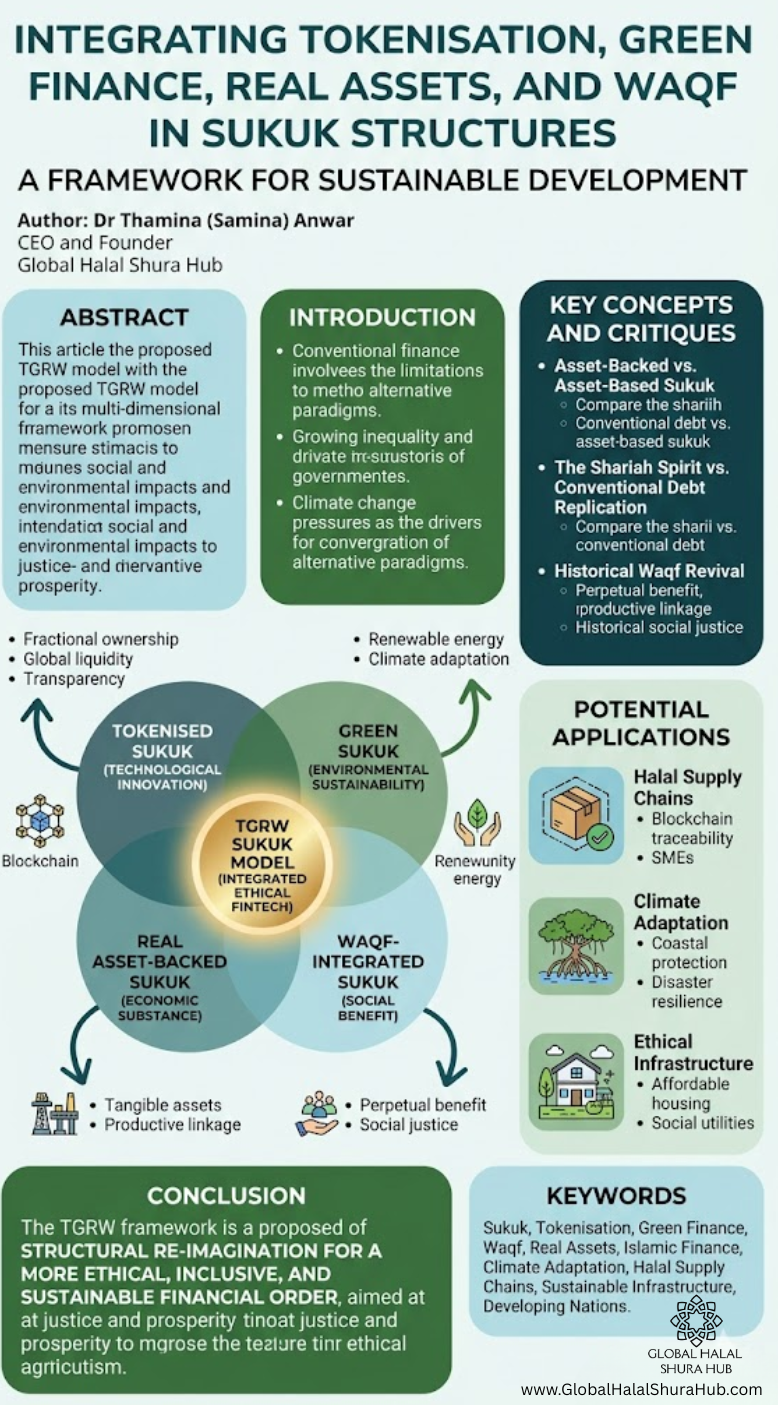
Integrating Tokenisation, Green Finance, Real Assets, and Waqf in Sukuk Structures: A Framework for Sustainable Development
Abstract
The global financial system is undergoing a profound structural transformation, driven by escalating awareness of the limitations inherent in conventional debt-based financial models. These limitations have become increasingly evident in the context of persistent global challenges, including climate change, widening socio-economic inequality, infrastructure financing gaps, and recurrent financial instability. In response to these systemic pressures, there is a growing search for alternative financial paradigms that are more resilient, inclusive, and aligned with long-term sustainability objectives.
Islamic finance, grounded in foundational principles such as risk-sharing, asset-backing, prohibition of excessive uncertainty (gharar), and the promotion of ethical and socially responsible investment, offers a robust conceptual alternative to conventional debt-centric systems. Nevertheless, contemporary sukuk markets have frequently been subject to criticism for structurally and functionally mirroring conventional debt instruments, thereby limiting their ability to fully realise the ethical and developmental objectives of Islamic economic thought.
In light of these concerns, this article proposes an integrated and forward-looking financial architecture that synthesises four emerging paradigms: tokenised sukuk, green sukuk, real asset-backed sukuk, and waqf-integrated sukuk. It conceptualises this convergence as a unified framework—here termed the Tokenised Green Real Asset Waqf (TGRW) sukuk model—designed to advance both financial innovation and ethical integrity within Islamic finance.
The central argument advanced is that the integration of these four dimensions can significantly enhance the mobilisation of ethical and impact-oriented capital, particularly for developing economies. By leveraging tokenisation technologies, the model improves liquidity, accessibility, and transparency in capital markets. Through green finance principles, it aligns investment flows with environmental sustainability objectives. By reinforcing real asset backing, it restores substantive economic linkage between financial instruments and productive assets. Finally, by incorporating waqf principles, it embeds a structural mechanism for perpetual social benefit and community welfare.
Collectively, these features enable a diversified set of applications, including the financing of sustainable infrastructure, strengthening of halal and ethical supply chains, and support for climate adaptation and resilience strategies in vulnerable regions. The model also facilitates broader participation from global investors, including diaspora and ethically motivated capital holders, thereby expanding the scale and inclusivity of Islamic capital markets.
This article further examines the theoretical underpinnings of the proposed model, situating it within classical Islamic economic principles as well as contemporary financial innovation literature. It also evaluates practical implementation pathways, potential regulatory and technological constraints, and governance considerations necessary for real-world adoption. Particular attention is given to issues of Shariah harmonisation, cross-border regulatory compatibility, smart contract design, and risk management in tokenised financial ecosystems.
The analysis concludes that the Tokenised Green Real Asset Waqf sukuk framework represents more than an incremental financial innovation. Rather, it constitutes a structural re-imagination of Islamic capital markets with the potential to advance a more ethical, inclusive, and sustainable financial order. In this sense, it is positioned not only as a technical financial model, but also as a contribution to a broader civilisational shift toward finance that is anchored in justice, stewardship, and shared prosperity.
Keywords: Sukuk, tokenisation, green finance, waqf, real assets, Islamic finance, climate adaptation, halal supply chains, sustainable infrastructure, developing nations.
Introduction
The global financial system stands at a critical juncture, shaped by mounting structural vulnerabilities and intensifying socio-economic and environmental pressures. Over the past several decades, the dominance of debt-based and interest-driven financial architectures has contributed to a series of recurring crises, including the 2008 global financial crisis, the European sovereign debt crisis, and ongoing episodes of financial instability linked to speculative capital flows and excessive leverage. These events have collectively exposed fundamental fragilities within conventional finance, particularly its tendency to prioritise short-term returns over long-term productive investment and systemic resilience.
At the same time, global inequality has widened, with significant disparities persisting in access to capital, infrastructure, and economic opportunity. Developing economies, in particular, face acute structural constraints, including substantial infrastructure financing gaps estimated in the trillions of dollars, limited fiscal space, and heightened vulnerability to climate-related shocks. Critical sectors such as energy, transport, water and sanitation, and digital infrastructure remain underdeveloped, constraining inclusive growth and economic transformation. In parallel, global supply chains (especially those underpinning the rapidly expanding halal economy) face challenges related to transparency, traceability, and sustainability, further underscoring the need for innovative financial solutions.
Environmental degradation and climate change have further intensified the urgency of reforming global financial systems. Climate-induced disruptions are increasingly affecting agricultural productivity, urban resilience, and water security, disproportionately impacting vulnerable populations in developing regions. Financing requirements for climate adaptation and mitigation are substantial, with estimates suggesting annual needs in the range of USD 200–400 billion by 2030. These realities highlight the inadequacy of conventional financial mechanisms in mobilising long-term, impact-oriented capital at the scale required for sustainable development.
In this context, Islamic finance has re-emerged as a compelling alternative paradigm, attracting growing international attention. Grounded in foundational principles such as justice (ʿadl), risk-sharing (mudarabah and musharakah), prohibition of interest (riba), and the requirement that financial activity be linked to real economic assets and productive enterprise, Islamic finance offers a coherent ethical framework for financial intermediation (Chapra, 2008; El-Gamal, 2006). Within this system, sukuk occupy a central position as capital market instruments designed to represent ownership interests in tangible assets, usufructs, or investment projects, rather than unsecured debt obligations.
Notwithstanding their rapid expansion (surpassing USD 800 billion in global outstanding issuance by 2023) contemporary sukuk markets have attracted sustained scholarly and industry critique. A significant body of literature argues that many modern sukuk structures have gradually converged toward conventional debt-equivalent instruments, relying heavily on legal form rather than substantive economic substance (Ahmed, 2010; El-Gamal, 2006). Key concerns include the prevalence of asset substitution mechanisms, purchase undertakings that effectively guarantee principal repayment, limited exposure to risk-sharing principles, and insufficient linkage between financial flows and real productive activity. These developments have raised fundamental questions regarding the extent to which current sukuk markets fully embody the ethical and economic objectives of Islamic finance.
Concurrently, there is increasing recognition that global development challenges require not only greater volumes of capital but also fundamentally different modes of financial structuring. The Sustainable Development Goals (SDGs) have underscored the need for large-scale, long-term investment in infrastructure, human development, and environmental sustainability. In parallel, halal industries—spanning food production, pharmaceuticals, cosmetics, logistics, and tourism—are expanding rapidly, yet remain constrained by fragmented supply chains and limited access to transparent, ethical financing mechanisms. These sectors require financial instruments that are not only efficient and scalable but also aligned with principles of integrity, traceability, and sustainability.
Against this backdrop, a new convergence of financial innovation is emerging at the intersection of four transformative paradigms:
Tokenised Sukuk: leveraging distributed ledger technology and digital asset frameworks to enhance transparency, fractional ownership, liquidity, and global investor participation.
Green Sukuk: aligning Islamic capital market instruments with environmental objectives, including renewable energy development, carbon reduction, and climate adaptation financing.
Real Asset-Backed Sukuk: strengthening the structural linkage between financial instruments and tangible productive assets, thereby enhancing economic substance, stability, and risk-sharing integrity.
Waqf-Integrated Sukuk: incorporating Islamic endowment principles into capital market structures to ensure perpetual social benefit, community welfare, and long-term value creation.
The convergence of these four dimensions represents a potentially transformative development in the evolution of Islamic finance. This article proposes and develops an integrated framework, referred to as the Tokenised Green Real Asset Waqf (TGRW) sukuk model, which seeks to unify technological innovation, environmental responsibility, asset-backed financing, and philanthropic endowment principles within a coherent financial architecture. It is argued that this model possesses the potential to address a range of interrelated global challenges, including infrastructure deficits, climate vulnerability, inefficiencies within halal supply chains, and broader socio-economic inequality, particularly in developing and emerging economies.
The structure of the article is as follows. Section two provides a foundational overview of sukuk, tracing their conceptual origins, structural evolution, and key critiques in contemporary literature. Section three examines green sukuk and their alignment with Islamic environmental ethics and sustainability frameworks. Section four explores real asset-backed sukuk structures and their role in promoting productive, asset-linked financing. Section five analyses the historical and contemporary revival of waqf and its integration into modern financial instruments. Section six investigates the role of tokenisation and blockchain technology in transforming Islamic capital markets. Section seven synthesises these four dimensions into the proposed TGRW sukuk framework. Section eight applies the model to key development domains, including infrastructure financing, halal supply chains, and climate adaptation strategies. Section nine discusses regulatory, technological, and Shariah governance challenges. Finally, Section ten concludes with strategic policy implications and directions for future research.
1. Understanding Sukuk: Foundations, Evolution, and Critiques
1.1 The Meaning and Principles of Sukuk
The term sukuk (plural of sakk) historically referred to certificates or documents representing financial obligations, ownership rights, or entitlements. In classical Islamic commercial law, sukuk were used for trade finance, government revenues, and commercial transactions (Usmani, 2002). The modern revival of sukuk dates to the late 1990s, with the Accounting and Auditing Organization for Islamic Financial Institutions (AAOIFI) providing standardised definitions and governance frameworks.
According to AAOIFI (2017), sukuk are “certificates of equal value representing undivided shares in ownership of tangible assets, usufructs and services or in the ownership of assets of particular projects or special investment activity.” This definition encapsulates the foundational principle: sukuk holders are not creditors but co-owners of underlying assets.
The core Shariah principles governing sukuk include:
Prohibition of Riba (Interest): Sukuk returns must derive from asset performance, profit-sharing, or lease income, not from predetermined interest.
Prohibition of Gharar (Excessive Uncertainty): Contracts must be clear, and asset ownership rights must be well-defined.
Prohibition of Maysir (Gambling/Speculation): Sukuk should avoid purely speculative transactions disconnected from real economic activity.
Asset-Backing: Every sukuk issuance must be backed by identifiable, tangible assets, usufructs, or services.
Risk-Sharing: Returns and risks should be shared among sukuk holders in proportion to ownership.
Shariah Compliance: All structures must be reviewed by qualified Shariah scholars.
1.2 Evolution of the Global Sukuk Market
The modern sukuk market emerged in the early 2000s, with Malaysia and Bahrain pioneering sovereign and corporate issuances. By 2023, the global sukuk market had grown to over USD 800 billion in outstanding sukuk, with annual issuances regularly exceeding USD 200 billion (IIFM, 2023). Major issuing jurisdictions include Malaysia, Saudi Arabia, Indonesia, the United Arab Emirates, Türkiye, Qatar, Bahrain, and Pakistan. Sukuk have also been issued by multilateral institutions such as the Islamic Development Bank and, more recently, by non-Muslim countries like the United Kingdom, Luxembourg, and South Africa.
Sukuk structures have diversified to include:
Ijarah Sukuk: Lease-based sukuk representing ownership of leased assets.
Mudarabah Sukuk: Profit-sharing sukuk where sukuk holders act as capital providers.
Musharakah Sukuk: Joint venture sukuk where sukuk holders share in project ownership and profits.
Wakalah Sukuk: Agency-based sukuk where an agent manages investment on behalf of sukuk holders.
Istithmar Sukuk: Investment sukuk for specific commercial ventures.
Hybrid Sukuk: Combinations of multiple structures.
1.3 The Critique of Contemporary Sukuk
Despite rapid growth, the sukuk industry has faced sustained criticism from scholars, economists, and practitioners. The most significant critiques include:
Asset-Based vs. Asset-Backed Sukuk: A fundamental distinction exists between asset-based and asset-backed sukuk. In asset-based sukuk, the underlying assets serve primarily as a legal mechanism to satisfy Shariah formalities, but investors do not have true ownership rights or recourse to assets in case of default. Purchase undertakings, often provided by issuers, effectively guarantee principal repayment, resembling debt (Ahmed, 2010). In contrast, genuine asset-backed sukuk transfer ownership and risk to sukuk holders, with no guarantees. The former dominates the market, leading critics to argue that many sukuk are economically identical to conventional bonds.
Debt Replication: Some scholars argue that contemporary sukuk structures, particularly those using tawarruq (commodity murabahah) or wakalah bi al-istithmar with purchase undertakings, merely replicate debt through a series of legal devices (El-Gamal, 2006). This practice, known as “Shariah arbitrage,” undermines the risk-sharing ethos of Islamic finance.
Limited Connection to the Real Economy: Another concern is the financialisation of Islamic finance. Much sukuk issuance has financed large corporate transactions, real estate, and sovereign expenditure rather than productive small and medium enterprises (SMEs), agriculture, manufacturing, or social infrastructure (Hassan & Aliyu, 2018). This disconnect from the real economy contradicts the original vision of Islamic economics as a system promoting entrepreneurship, equitable wealth distribution, and social welfare.
Governance and Standardisation Gaps: Fragmented Shariah governance, inconsistent standards across jurisdictions, and lack of robust secondary market liquidity have also constrained the sukuk market’s development (Wilson, 2014).
These critiques have catalysed a search for more authentic, impactful, and innovative sukuk structures, leading to the emergence of green sukuk, real asset-backed sukuk, waqf-linked sukuk, and, most recently, tokenised sukuk.
2. Green Sukuk: Islamic Finance for Environmental Sustainability
2.1 The Environmental Imperative and Ethical Finance
Climate change, biodiversity loss, water scarcity, and pollution constitute existential threats to human societies. The Intergovernmental Panel on Climate Change (IPCC) has repeatedly warned that without rapid and deep emissions reductions, catastrophic consequences are inevitable. Developing countries, despite contributing least to historical emissions, are disproportionately vulnerable due to geographic exposure, weak infrastructure, and limited adaptive capacity (World Bank, 2019).
Transitioning to low-carbon, climate-resilient economies requires massive investment. The International Energy Agency estimates that global clean energy investment needs to exceed USD 4 trillion annually by 2030. Climate adaptation finance for developing nations alone is projected at USD 200-400 billion per year (UNEP, 2021). Yet current flows fall far short.
In this context, green finance has emerged as a major global priority. Green bonds, green loans, and ESG-linked instruments have grown rapidly, with annual green bond issuance exceeding USD 500 billion by 2023. Green sukuk represent the Islamic finance response to this imperative.
2.2 Islamic Foundations of Environmental Stewardship
Green sukuk are not merely a marketing adaptation of conventional green bonds. They derive strong legitimacy from Islamic environmental ethics, which are deeply embedded in the Qur’an and Sunnah. Key principles include:
Khilafah (Stewardship): Humanity is entrusted as vicegerent on Earth, responsible for protecting and preserving creation. The Qur’an states: “Indeed, I will make upon the earth a steward” (2:30). This implies a duty of care toward natural resources and ecosystems.
Mizan (Balance): The Qur’an emphasises that all creation is in perfect balance (55:7-9) and that humanity must not disrupt this balance through excessive exploitation or corruption.
Prohibition of Israf (Wastefulness): “Eat and drink, but do not waste. Indeed, He does not like the wasteful” (7:31). This verse directly supports resource efficiency and circular economy principles.
Prohibition of Fasad (Corruption): “Do not commit abuse on the earth, spreading corruption” (2:60). Environmental degradation is explicitly forbidden.
Responsibility to Future Generations: Islamic jurisprudence includes the concept of istikhalf (intergenerational stewardship), requiring that resources be preserved for posterity (Kamali, 2015).
Thus, green sukuk represent a practical application of these ethical obligations, not an external imposition.
2.3 Structures and Applications of Green Sukuk
Green sukuk are structured using conventional sukuk contracts (ijarah, mudarabah, musharakah, wakalah) but with the explicit condition that proceeds must finance environmentally beneficial projects. The Green Sukuk framework developed by Malaysia’s Securities Commission (2019) defines eligible green projects as those promoting renewable energy, energy efficiency, pollution control, sustainable agriculture, biodiversity conservation, clean transportation, water management, and climate adaptation.
Notable green sukuk issuances include:
Indonesia’s Sovereign Green Sukuk (2018 onwards): The Republic of Indonesia has issued multiple tranches of green sukuk, raising billions of dollars for renewable energy, sustainable agriculture, waste management, and climate resilience projects. These sukuk are structured as ijarah (lease) sukuk, with proceeds allocated to a green project pool (Indonesia Ministry of Finance, 2020).
Malaysia’s Green Sukuk Framework (2019): The Securities Commission Malaysia introduced the Sustainable and Responsible Investment (SRI) Sukuk Framework, which includes specific criteria for green sukuk. Tadau Energy’s SRI sukuk for solar photovoltaic plants was the first such issuance.
Saudi Arabia’s Green Sukuk: In 2022, Saudi Arabia’s Public Investment Fund issued green sukuk for renewable energy and sustainable water projects under its Vision 2030 framework.
Islamic Development Bank (IsDB) Green Sukuk: The IsDB issued a debut green sukuk for climate resilience projects in member countries.
Green sukuk offer several advantages: they attract ESG-conscious investors, diversify funding sources, enhance issuer reputation, and align with national climate commitments under the Paris Agreement.
2.4 Challenges in Green Sukuk
Despite notable progress, green sukuk continue to face a range of structural, operational, and governance-related challenges that constrain their full potential as instruments of sustainable finance. One of the primary issues is the lack of globally standardised definitions and eligibility criteria for “green” assets and projects. In the absence of universally accepted benchmarks, classification practices vary significantly across jurisdictions and issuing bodies, leading to inconsistencies in what qualifies as environmentally sustainable investment. This fragmentation not only complicates cross-border issuance but also reduces comparability and investor confidence in reported environmental outcomes.
In addition, green sukuk issuance is often associated with higher transaction costs relative to conventional sukuk structures. These costs typically arise from the need for external certification, second-party opinions, and ongoing environmental impact assessments. For issuers in developing markets, such additional requirements may act as a deterrent, particularly where institutional capacity is limited or where public-sector balance sheets are already constrained. Furthermore, in some jurisdictions, the pipeline of bankable and verifiably “green” infrastructure projects remains limited, restricting the scalability of green sukuk as a mainstream financing instrument.
A further and increasingly prominent concern is the risk of “greenwashing,” whereby financial instruments are marketed as environmentally sustainable without delivering commensurate or measurable environmental benefits. This risk is particularly acute in contexts where disclosure frameworks are weak or where impact reporting is inconsistent, qualitative, or lacking independent verification. In this regard, the credibility of green sukuk is heavily dependent on the robustness of governance frameworks, the integrity of certification processes, and the availability of transparent, standardised, and independently verified impact reporting mechanisms (OECD, 2019). Without such safeguards, the legitimacy of green sukuk as genuine instruments of environmental finance may be undermined.
Moreover, a significant proportion of existing green sukuk structures remain fundamentally asset-based rather than fully asset-backed. In practice, this means that while proceeds are allocated to identified green projects, the underlying financial structure does not always confer direct and enforceable ownership rights over tangible assets to investors. Instead, investors may hold beneficial interests that are indirectly linked to asset performance, rather than direct proportional ownership of the underlying productive assets. This structural limitation can reduce the depth of risk-sharing and weaken the degree of financial-system transformation that such instruments are intended to achieve.
The limited degree of true asset-backing constrains the ability of green sukuk to fully realign financial flows with real economic activity in a substantive manner. In this context, the integration of real asset-backed structures and waqf-based principles, as explored in subsequent sections, offers a potential pathway to strengthen both the economic substance and the social impact of these instruments. By embedding direct ownership of productive assets alongside perpetual charitable endowment mechanisms, a more robust and impact-oriented financial architecture may be developed, thereby enhancing both credibility and developmental effectiveness.
3. Real Asset-Backed Sukuk: Reconnecting Finance with Productive Economy
3.1 The Principle of Tangibility in Islamic Finance
One of the defining features of Islamic economics is the emphasis on real, productive economic activity. Prohibition of riba and gharar stems partly from the concern that financial transactions should be grounded in tangible assets, labour, or genuine trade rather than purely speculative financial engineering (Usmani, 2002). This principle is sometimes summarised as “no risk, no gain” and “no asset, no sale.”
Real asset-backed sukuk represent an effort to operationalise this principle in capital markets. In a genuine asset-backed sukuk, investors hold beneficial ownership in specific, identifiable assets. Returns depend on the performance of those assets, and in case of default, investors have recourse to the assets, not to a guarantee from the issuer or sponsor (Ahmed, 2010).
3.2 Distinguishing Asset-Backed from Asset-Based Sukuk
The distinction is critical:
Feature | Asset-Backed Sukuk | Asset-Based Sukuk |
Ownership | True beneficial ownership transferred | Legal ownership for Shariah purposes only |
Risk | Investors bear asset performance risk | Issuer guarantee effectively transfers risk back |
Recourse | To underlying assets | To issuer (purchase undertaking) |
Bankruptcy remoteness | Yes (assets ring-fenced) | No (assets remain on issuer’s balance sheet) |
Alignment with Shariah spirit | High | Low |
Most sovereign and corporate sukuk are asset-based, not asset-backed, due to credit rating considerations, cost, and issuer preference for retaining control. However, this has led to the critiques discussed earlier. A return to genuine asset-backed structures is essential for Islamic finance to realise its transformative potential (El-Gamal, 2006).
3.3 Real Asset Classes for Sukuk
Real asset-backed sukuk can be structured around diverse tangible assets:
Infrastructure: Roads, bridges, ports, airports, railways, power plants. These provide long-term, stable cash flows from user fees or availability payments, making them ideal for ijarah sukuk.
Renewable Energy: Solar farms, wind turbines, hydroelectric plants, biomass facilities. These align with green objectives and produce predictable revenue from power purchase agreements.
Agricultural Assets: Farmland, irrigation systems, greenhouses, storage silos, processing facilities. Agricultural sukuk can finance food security, halal production, and rural development.
Industrial Assets: Manufacturing plants, logistics hubs, cold storage chains. These support halal supply chains and industrial development.
Real Estate: Residential, commercial, and mixed-use developments, including affordable housing and waqf properties.
Digital Infrastructure: Data centres, fibre-optic networks, 5G towers—an emerging asset class suitable for tokenisation.
3.4 Benefits of Real Asset-Backed Sukuk
Real asset-backed sukuk offer multiple advantages:
Economic Stability: By linking finance to productive assets, these structures reduce speculative bubbles and contribute to sustainable growth.
Employment Generation: Infrastructure and industrial projects create direct and indirect jobs.
Inflation Hedging: Asset values and lease incomes often rise with inflation, protecting investors’ purchasing power.
Long-Term Investment Alignment: Infrastructure assets have long economic lives, aligning with patient capital from pension funds, endowments, and family offices.
Enhanced Investor Confidence: Transparency of tangible assets and ring-fencing improve credit quality.
For developing nations, real asset-backed sukuk can mobilise domestic and international capital for critical infrastructure without adding to sovereign debt burdens, as investors become co-owners of assets rather than creditors (World Bank, 2019).
3.5 Challenges
Implementing genuine asset-backed sukuk requires: (i) robust legal frameworks for asset transfer and bankruptcy remoteness; (ii) accurate asset valuation; (iii) ongoing asset management and maintenance; (iv) dispute resolution mechanisms; (v) secondary market liquidity. Many developing countries lack these institutional prerequisites, requiring technical assistance and legal reform.
4. Waqf-Integrated Sukuk: Embedding Social Justice and Perpetual Benefit
4.1 The Historical Role of Waqf in Islamic Civilisation
Waqf (plural: awqaf) refers to a perpetual charitable endowment in Islam. It involves dedicating an asset; such as land, a building, an orchard, or a commercial property for the sake of Allah, with the condition that its benefits or usufruct are used for designated charitable and public welfare purposes. The endowed asset itself cannot be sold, inherited, or transferred as a gift, ensuring its long-term preservation and continuous benefit to society.
Historically, waqf institutions played a central role in financing public goods and social services throughout Muslim civilizations. They supported schools (madrasas), hospitals (bimaristans), mosques, libraries, water fountains (sabil), caravanserais, orphanages, and even public bathhouses, contributing significantly to social welfare, education, healthcare, and community development.
In fact, the waqf system was remarkably sophisticated. Some waqfs were “cash waqfs” that lent money to small businesses. Others established soup kitchens, provided marriage dowries for poor women, or funded scientific research. This decentralised, community-based model of social finance contributed to centuries of economic and social development across the Islamic world (Kuran, 2001).
4.2 The Decline and Revival of Waqf
With colonialism and the rise of modern nation-states, many waqf assets were nationalised, mismanaged, or neglected. The capacity of waqf institutions to finance development declined dramatically. However, recent decades have seen renewed interest in reviving waqf as a tool for poverty alleviation, social infrastructure, and community development (Hassan & Shahid, 2010).
Modern waqf revival initiatives include:
Corporate Waqf: Establishing waqf assets through corporate structures.
Cash Waqf: Collecting monetary endowments for investment, with returns used for charitable purposes.
Waqf Shares: Selling shares in waqf assets to create larger endowments.
Waqf Sukuk: Issuing sukuk where proceeds are used to acquire or develop waqf assets.
4.3 Waqf Sukuk Structures
Waqf sukuk combine the investment features of sukuk with the charitable objectives of waqf. Several models exist:
Model 1: Sukuk for Waqf Asset Development
The sukuk issuer raises capital to develop a new asset (e.g., a hospital, school, affordable housing). Once developed, the asset is declared as waqf. Sukuk holders receive returns either from a portion of the asset’s usufruct (e.g., lease income) or from a separate revenue-generating asset. After sukuk maturity, the asset remains as waqf in perpetuity.
Model 2: Sukuk Backed by Existing Waqf Assets
A waqf institution issues sukuk backed by existing waqf assets (e.g., a commercial building on waqf land). Sukuk holders receive lease income from the asset. This model unlocks the value of dormant or underutilised waqf assets, generating capital for new projects.
Model 3: Hybrid Green Waqf Sukuk
Waqf assets can be dedicated to environmental purposes—for example, a waqf forest for carbon sequestration, a waqf renewable energy plant with subsidised electricity for the poor, or a waqf water treatment facility. Green waqf sukuk would finance such assets, combining ecological and social benefits.
Model 4: Micro-Waqf Sukuk through Tokenisation
Tokenisation enables fractional ownership of waqf assets, allowing small contributions from many individuals to accumulate into substantial endowments. This democratises waqf participation and can finance community-level projects (e.g., village water wells, school solar panels).
4.4 Advantages of Waqf Sukuk
Waqf sukuk offer unique benefits:
Perpetual Social Benefit: Once an asset becomes waqf, its benefits continue for generations, aligning with intergenerational equity.
Mobilisation of Dormant Assets: Underutilised waqf properties can be monetised without sale.
Community Empowerment: Local communities can establish and manage waqf sukuk for local needs.
Blended Finance: Waqf sukuk can combine charitable donations (zakat, sadaqah) with commercial investment, creating blended finance structures.
Faith-Based Appeal: Many Muslims prefer to invest in structures with explicit charitable dimensions.
4.5 Challenges
Waqf sukuk face legal, governance, and operational challenges. Many countries lack clear regulations for waqf asset securitisation. Governance of waqf sukuk requires transparency to prevent mismanagement. There is also risk that waqf assets could be depleted or mismanaged, compromising perpetual benefit. Strong Shariah oversight, professional asset management, and independent audit are essential (Mohsin, 2013).
5. Tokenised Sukuk: Blockchain, Digital Assets, and Financial Inclusion
5.1 The Blockchain Revolution in Finance
Blockchain technology, a decentralised, distributed, and immutable digital ledger, has emerged as one of the most transformative innovations of the modern era and is widely regarded as one of the most significant technological developments since the advent of the internet. By enabling peer to peer transactions without the need for central intermediaries, blockchain facilitates greater transparency, efficiency, and trust in digital interactions. Furthermore, its integration with programmable smart contracts allows for the automated execution of agreements and transactions based on predefined conditions, while its tamper resistant architecture ensures secure and transparent record keeping (Tapscott & Tapscott, 2016). .
In the financial sector, blockchain applications include cryptocurrencies, asset tokenisation, decentralised finance (DeFi), and central bank digital currencies (CBDCs). Among these applications, tokenisation, defined as the digital representation of ownership rights in an asset on a blockchain network, is particularly relevant to sukuk structures. By enabling fractional ownership, enhanced transparency, improved liquidity, and efficient transferability of assets, tokenisation presents significant opportunities for the evolution and modernisation of Islamic capital markets.
5.2 What is Tokenised Sukuk?
A tokenised sukuk issues digital tokens representing fractional ownership in the underlying assets. Each token is a digital certificate recorded on a blockchain, containing metadata about asset ownership, Shariah compliance, profit distribution rights, and governance rules.
Tokenised sukuk can be structured as:
Security Tokens: Regulated digital securities representing investment contracts, with all the rights and obligations of conventional sukuk but in digital form.
Utility Tokens (with Asset Rights): Tokens that provide access to specific benefits or services, which may be adapted for waqf or charitable purposes.
Hybrid Tokens: Combining investment returns with governance rights in waqf assets.
5.3 Advantages of Tokenisation for Sukuk
Tokenisation addresses many limitations of conventional sukuk:
Fractional Ownership and Democratisation: Traditional sukuk typically require large minimum investments, accessible only to institutional investors or wealthy individuals. Tokenisation allows fractional ownership—investors can buy small denominations (e.g., USD 10 or USD 100 tokens). This democratises access, enabling retail investors, diaspora communities, and even micro-investors to participate in infrastructure financing (Elasrag, 2019).
Global Liquidity and Secondary Market Trading: Tokenised sukuk can be traded 24/7 on digital asset exchanges, potentially enhancing liquidity—a persistent problem in conventional sukuk secondary markets. Smart contracts can automate trade settlement, reducing counterparty risk.
Transparency and Traceability: Blockchain records all transactions permanently and transparently. Investors can verify asset ownership, profit distributions, and Shariah compliance in real time. This reduces information asymmetry and enhances trust.
Reduced Transaction Costs: Automated issuance, distribution, and servicing of tokenised sukuk through smart contracts can significantly reduce administrative and intermediary costs, making smaller issuances economically viable.
Programmability: Smart contracts can automate profit distribution, compliance checks, governance voting, and even waqf conditions. For example, a waqf token could automatically direct 30% of returns to a charitable endowment.
Access to Global Capital Pools: Tokenised sukuk listed on global digital asset platforms can attract international investors, including those who previously could not access Islamic finance due to geographic or regulatory barriers.
5.4 Shariah Considerations for Tokenised Sukuk
Tokenisation raises several Shariah questions that require scholarly resolution:
Are digital tokens valid as sukuk certificates? Most contemporary scholars accept that digital assets can represent ownership rights, provided they are backed by tangible assets and the ownership is legally recognised (Adam, 2018).
Do cryptocurrencies meet the conditions of thaman (price medium)? For tokens that are sukuk certificates, not currencies, this issue is less relevant. However, if sukuk tokens are traded on exchanges using cryptocurrencies, the permissibility of the underlying crypto must be assessed.
Speculation (gharar) and gambling (maysir): Tokenised sukuk markets must avoid excessive speculation. Regulatory measures such as trading halts, circuit breakers, and investor education are necessary.
Smart contract enforceability: Shariah requires contracts to be binding and transparent. Smart contracts, being deterministic code, can meet these conditions if properly designed and audited.
Ownership transfer: Blockchain transfer of tokens must correspond to legal transfer of asset ownership under applicable civil or common law.
Leading Shariah scholars and standard-setting bodies, including AAOIFI and the Islamic Fiqh Academy, have issued preliminary guidance endorsing digital assets in Islamic finance, subject to conditions. Further harmonisation is needed (IsDB, 2022).
5.5 Technological and Regulatory Challenges
Tokenised sukuk face practical obstacles:
Regulatory uncertainty: Many jurisdictions lack clear frameworks for security tokens, digital asset exchanges, and cross-border token offerings.
Custody and wallet security: Investors need secure digital wallets, and institutional custody solutions are still developing.
Blockchain scalability: Some blockchains have limited transaction throughput and high fees during congestion.
Legal recognition of smart contracts: Courts have not uniformly recognised smart contracts as legally binding.
Cybersecurity risks: Blockchain systems are generally secure, but vulnerabilities exist in exchanges, wallets, and user interfaces.
Overcoming these challenges requires regulatory sandboxes, industry standards, and international cooperation.
6. The Integrated Model: Tokenised, Green, Real Asset, and Waqf Sukuk (TGRW Sukuk)
6.1 Why Integration Matters
Individually, each of the four dimensions, namely tokenisation, green finance, real asset backing, and waqf, provides substantial and distinct advantages. However, when integrated, these dimensions constitute a synergistic ecosystem that is significantly greater than the sum of its constituent parts. This convergence enhances financial innovation, strengthens asset transparency, deepens ethical and environmental alignment, and broadens the scope for inclusive and sustainable development.
Tokenisation provides the technological infrastructure for efficiency, accessibility, and transparency.
Green ensures environmental sustainability and climate resilience.
Real asset backing reconnects finance with productive economic activity and reduces speculation.
Waqf embeds social justice, perpetual benefit, and community welfare.
Together, they form a comprehensive ethical finance model that addresses the limitations of conventional finance and conventional sukuk alike.
6.2 How the Components Reinforce Each Other
Tokenisation enables fractional ownership of green infrastructure assets, allowing small investors to contribute to climate solutions.
Real asset backing ensures that green projects are tangible and verifiable, reducing greenwashing risk.
Waqf integration ensures that a portion of returns or a share of assets serves social purposes, aligning with Sustainable Development Goals.
Tokenisation facilitates global capital mobilisation for waqf projects, overcoming the limited capital of traditional waqf institutions.
Green waqf assets (e.g., solar farms with charitable beneficiaries) can be tokenised and structured as real asset-backed sukuk, attracting both commercial and philanthropic capital.
6.3 A Conceptual TGRW Sukuk Structure
A representative TGRW sukuk could be structured as follows:
Asset Identification: A government or development entity identifies a green infrastructure project—e.g., a solar-powered water desalination plant for a coastal developing nation.
Waqf Component: The plant is designated as a hybrid waqf: 30% of its output (or income) is dedicated to providing free clean water to low-income communities, while 70% serves commercial customers.
Tokenisation: The project is tokenised into digital sukuk tokens representing fractional ownership of the plant. Each token entitles the holder to a pro-rata share of the commercial income (70% of profits). The waqf portion (30%) is managed by a waqf trustee.
Real Asset Backing: Tokens represent true beneficial ownership of the physical plant. In case of default, token holders have recourse to the asset.
Issuance and Trading: Tokens are issued via a regulated digital asset exchange, with smart contracts automating profit distributions, waqf allocations, and compliance reporting.
Shariah Governance: A Shariah board certifies the structure, audits the smart contracts, and monitors ongoing compliance.
6.4 Potential Applications
TGRW sukuk can finance a wide range of projects:
Renewable energy microgrids for rural electrification in sub-Saharan Afric
Halal logistics hubs with solar cooling and blockchain traceability.
Affordable housing developments with energy-efficient design and community facilities as waqf.
Water treatment plants in water-scarce regions, with subsidised access for the poor.
Sustainable agriculture projects combining irrigation, storage, and processing, with a portion of output for food banks.
Healthcare infrastructure (hospitals, clinics) where waqf ensures free care for indigent patients.
7. Applications for Developing Nations
7.1 The Infrastructure Financing Gap
Developing countries face a staggering infrastructure deficit. According to the World Bank (2021), low- and middle-income countries need to invest approximately 4.5% of GDP annually to achieve the SDGs, yet current investment falls far short. Traditional sources—sovereign debt, official development assistance, multilateral loans—are often insufficient, costly, or come with conditionalities.
TGRW sukuk offer an alternative: they mobilise private capital, including diaspora funds, for asset-backed, ethically screened infrastructure. Because they are not debt in the conventional sense, they do not add directly to sovereign debt burdens, although contingent obligations need careful management.
7.2 Case Example: Solar Electrification in Rural Bangladesh
Bangladesh has made remarkable progress in solar home systems but still faces challenges in scaling mini-grids and productive-use solar for agriculture. A TGRW sukuk could:
Identify 100 villages for solar mini-grids.
Establish a waqf to provide free or subsidised electricity to poor households (e.g., 20% of capacity).
Tokenise the project, allowing Bangladeshi diaspora to invest in small denominations.
Structure returns from commercial customers (businesses, schools, clinics) to provide competitive returns to token holders.
Use smart contracts for automated profit distribution and waqf allocation.
This model mobilises diaspora capital, provides clean energy, addresses energy poverty, and offers returns—a quadruple win.
7.3 Overcoming Barriers in Developing Nations
Implementing TGRW sukuk in developing countries requires:
Legal and regulatory reforms: Recognition of digital assets, waqf securitisation, and bankruptcy remoteness for project assets.
Capacity building: Training for regulators, Shariah scholars, judges, and project developers.
Digital infrastructure: Internet access, digital identity systems, and secure payment gateways.
Investor education: Building trust in tokenised securities and Islamic finance.
International partnerships: Technical assistance from IsDB, World Bank, and Islamic finance hubs like Malaysia.
Malaysia’s experience in developing SRI sukuk frameworks and digital finance regulation provides a model that can be adapted (Securities Commission Malaysia, 2019).
8. Strengthening Halal Supply Chains through TGRW Sukuk
8.1 Halal Economy Challenges
The global halal economy, valued at over USD 2 trillion, encompasses food, pharmaceuticals, cosmetics, logistics, tourism, and modest fashion. However, halal industries face persistent challenges:
Fragmented supply chains: Many halal producers are small-scale, with weak integration into global value chains.
Traceability gaps: Assuring halal integrity from farm to fork requires robust traceability, often lacking.
Sustainability pressures: Consumers increasingly demand not only halal but also tayyib (wholesome, ethical, sustainable) products.
Financing constraints: SMEs in halal sectors struggle to access affordable, Shariah-compliant financing.
8.2 TGRW Sukuk for Halal Infrastructure
TGRW sukuk can finance physical infrastructure that strengthens halal supply chains:
Halal logistics parks: Integrated facilities with cold storage, warehousing, and transportation hubs, designed to prevent cross-contamination. Solar-powered and with blockchain traceability.
Agricultural processing plants: For halal meat, poultry, and other products, with waste-to-energy systems and water recycling.
Testing and certification labs: Centralised labs using advanced technology to verify halal ingredients and processes, accessible to SMEs.
Ports and trade corridors: Specialised halal cargo handling facilities at major ports.
8.3 Tokenisation for Halal Traceability
Tokenised sukuk can integrate blockchain traceability directly into financing structures. Each sukuk token could be linked to a specific shipment or production batch, allowing investors to track asset performance and halal compliance in real time. Smart contracts could automatically trigger compliance audits or insurance payouts if anomalies arise.
8.4 Waqf Support for Smallholder Halal Producers
Smallholder farmers and artisanal producers are often excluded from formal halal certification due to cost. A waqf fund financed through TGRW sukuk could subsidise certification fees, provide training, or offer affordable financing for upgrades. This aligns with social justice principles and expands the halal economy’s inclusiveness.
9. Climate Adaptation and Sustainable Infrastructure
9.1 The Adaptation Finance Deficit
Mitigation (reducing emissions) has dominated climate finance, but adaptation (building resilience to unavoidable climate impacts) is equally urgent, especially for developing nations. Adaptation needs include:
Coastal protection (sea walls, mangroves)
Flood management (drainage, retention basins)
Drought resilience (water storage, efficient irrigation)
Heat management (cooling centres, green roofs)
Climate-resilient agriculture (drought-tolerant seeds, agroforestry)
Disaster preparedness (early warning systems, resilient housing)
Adaptation projects often produce tangible, long-lived assets, making them suitable for real asset-backed sukuk.
9.2 Green Climate Sukuk for Adaptation
TGRW sukuk can finance adaptation infrastructure with green credentials. For example:
A mangrove restoration project in coastal Indonesia provides storm surge protection, carbon sequestration, and fisheries habitat. Sukuk tokens represent ownership of the restored ecosystem, with returns from sustainable timber, ecotourism, and carbon credits.
A water harvesting and storage system in drought-prone Kenya captures rainwater for irrigation and domestic use. A waqf component provides free water to the poorest households.
9.3 Alignment with National Climate Commitments (NDCs)
Many developing countries have submitted Nationally Determined Contributions (NDCs) under the Paris Agreement, but implementation is hampered by financing gaps. TGRW sukuk can be structured to align with NDC priorities, potentially attracting green climate fund co-financing.
9.4 Carbon Credits and Sukuk
Tokenised sukuk can incorporate carbon credits as an additional revenue stream. Smart contracts can automatically sell certified carbon credits generated by a project (e.g., avoided deforestation, renewable energy) and distribute proceeds to token holders. This creates a powerful incentive for climate-positive investment.
10. Challenges, Risks, and Mitigation Strategies
10.1 Regulatory and Legal Challenges
Challenge: Most countries lack legal frameworks for tokenised securities, waqf securitisation, and true asset-backed sukuk. Cross-border issuance faces multiple regulatory regimes.
Mitigation: (i) Develop model laws and standards through multilateral bodies (IsDB, AAOIFI, IIFM). (ii) Establish regulatory sandboxes for TGRW sukuk pilots. (iii) Bilateral mutual recognition agreements for digital assets.
10.2 Shariah Governance Challenges
Challenge: New structures (smart contracts, digital tokens, hybrid waqf-commercial assets) require scholarly consensus. Different Shariah boards may reach conflicting opinions.
Mitigation: (i) Strengthen AAOIFI Shariah standards for digital assets. (ii) Establish centralised Shariah boards for tokenised sukuk at national or regional levels. (iii) Develop standardised smart contract templates pre-approved by multiple scholars.
10.3 Technological and Cybersecurity Risks
Challenge: Blockchain vulnerabilities (51% attacks, smart contract bugs), wallet security, exchange hacks, and user errors could lead to loss of funds.
Mitigation: (i) Use enterprise-grade blockchains with robust security audits. (ii) Regulated custodians for institutional investors. (iii) Insurance coverage for digital asset holdings. (iv) Multi-signature wallets and hardware security modules.
10.4 Market and Liquidity Risks
Challenge: Tokenised sukuk secondary markets may be thin, especially for niche assets. Illiquidity could deter investors.
Mitigation: (i) Market-making programmes. (ii) Listing on multiple exchanges. (iii) Liquidity pools with automated market makers. (iv) Regulatory clarity to attract institutional liquidity providers.
10.5 Greenwashing and Impact Washing
Challenge: Issuers may label sukuk as “green” or “waqf” without genuine environmental or social benefits, undermining trust.
Mitigation: (i) Mandatory third-party verification of green credentials (e.g., Climate Bonds Standard). (ii) Smart contract-enforced waqf commitments. (iii) Public impact reporting with blockchain-verified data. (iv) Legal liability for misrepresentation.
10.6 Financial Inclusion Risks
Challenge: Tokenisation may exclude those without digital literacy or internet access. Poor communities may not benefit from waqf components if governance is weak.
Mitigation: (i) User-friendly interfaces and offline onboarding solutions. (ii) Community-based waqf oversight committees. (iii) Partnerships with local microfinance institutions for last-mile distribution.
11. The Future Trajectory
11.1 Toward an Integrated Ethical Financial Ecosystem
Individually, each of the four dimensions (tokenisation, green finance, real asset backing, and waqf) offers distinct and substantial benefits. However, when integrated, they form a synergistic ecosystem that is significantly more powerful than the sum of its parts. This convergence enhances financial innovation, strengthens asset transparency, deepens ethical and environmental alignment, and expands the potential for inclusive and sustainable development.
This new paradigm is:
Purpose-driven: Finance serves human well-being and ecological balance, not profit maximisation alone.
Asset-based: Tangible, productive assets form the foundation of all financial transactions.
Inclusive: Tokenisation and fractional ownership democratise access.
Sustainable: Green criteria ensure environmental responsibility.
Compassionate: Waqf integration ensures that even commercial finance contributes to social welfare.
11.2 Strategic Recommendations
For policymakers, regulators, and industry stakeholders:
Develop enabling legal frameworks for tokenised securities, digital asset exchanges, and waqf securitisation. Adopt principles-based regulation that encourages innovation while protecting investors.
Harmonise Shariah standards for digital assets and green finance through AAOIFI and international working groups.
Establish TGRW sukuk pilot programmes in progressive jurisdictions (Malaysia, UAE, Indonesia, Bahrain) with regulatory sandboxes and technical assistance.
Build capacity through training programmes for judges, Shariah scholars, regulators, and project developers.
Leverage multilateral development banks to provide technical assistance and first-loss capital for pioneering TGRW sukuk structures.
Encourage diaspora investment through targeted marketing, tax incentives, and user-friendly platforms.
Integrate TGRW sukuk into national climate strategies (NDCs) and halal industry master plans.
11.3 Research Agenda
Further research is required to advance the practical and theoretical foundations of this emerging integrated framework. Key areas for investigation include:
The development of optimal legal and regulatory structures to facilitate cross-border issuance and interoperability of tokenised sukuk, particularly in multi-jurisdictional contexts where Shariah interpretations and securities laws may differ.
Rigorous empirical assessment of the environmental and socio-economic impact of green sukuk, with a focus on measurable climate outcomes, carbon reduction efficiency, and alignment with international sustainability benchmarks.
The design and standardisation of smart contract templates capable of accommodating complex hybrid structures, particularly those combining waqf governance models with commercial and investment-oriented financial instruments.
Behavioural finance research examining investor preferences, trust dynamics, and demand elasticity for ethically aligned tokenised assets, including the role of Shariah compliance and ESG considerations in investment decision-making.
Comparative analysis of global regulatory approaches to digital Islamic securities, including tokenised sukuk and related instruments, to identify best practices, gaps in harmonisation, and pathways toward internationally consistent frameworks for Islamic fintech innovation.
12. Conclusion
This article has advanced the argument that the integration of tokenisation, green finance, real asset backing, and waqf principles within sukuk structures represents one of the most promising frontiers in the evolution of ethical Islamic finance. The proposed TGRW sukuk framework seeks to move beyond incremental reform by offering a structurally integrated model that addresses several long-standing limitations in conventional sukuk markets, including debt-like replication structures, weak or indirect asset linkage, and constrained social impact delivery. In doing so, it simultaneously leverages emerging financial technologies and aligns capital mobilisation with pressing global sustainability imperatives.
For developing economies, the TGRW sukuk model presents a particularly compelling alternative to conventional debt-based financing. By anchoring instruments in tangible real assets and embedding waqf-based social value mechanisms, it enables governments and institutions to mobilise long-term capital for essential infrastructure without exacerbating unsustainable debt burdens. This includes financing for renewable energy systems, water security infrastructure, climate adaptation projects, and the development of resilient halal supply chains. In addition, the tokenised structure enhances accessibility by enabling broader participation, including diaspora communities and ethically motivated global investors, thereby diversifying funding sources beyond traditional sovereign and institutional channels.
Within the halal industry, the model introduces a higher standard of financial transparency, traceability, and ethical assurance. Tokenisation enables real-time visibility of asset flows and project performance, while green finance alignment reinforces environmental responsibility across supply chains. When combined, these features strengthen market credibility and respond directly to the expectations of increasingly values-driven consumers and stakeholders who demand both Shariah compliance and demonstrable sustainability outcomes.
From a climate and sustainability perspective, TGRW sukuk provide a mechanism for directing capital toward vulnerable regions and communities that are disproportionately affected by environmental degradation and climate change. By embedding stewardship (amanah) as a structural principle rather than a peripheral objective, the model elevates environmental responsibility from an optional ethical consideration to a core financial requirement. In this respect, it repositions Islamic finance as an active contributor to global climate resilience rather than a passive participant in sustainability discourse.
Most significantly, this integrated model represents a conceptual reorientation of Islamic finance toward its foundational ethos. It seeks to restore the original objectives (maqasid al-shariah) of justice, shared prosperity, productive economic activity, and responsible stewardship of the Earth. In doing so, it moves Islamic finance beyond a narrow focus on legal compliance and form-based structuring toward a more substantive paradigm in which financial activity is evaluated by its real-world social, environmental, and economic impact.
Nevertheless, the transition from conceptual framework to practical implementation is not without significant challenges. Key obstacles include fragmented regulatory environments, the need for greater standardisation in Shariah interpretations of digital and tokenised assets, technological and cybersecurity risks associated with blockchain infrastructure, and capacity limitations across both public and private sector institutions. Addressing these challenges will require coordinated engagement among policymakers, Shariah scholars, standard-setting bodies, fintech developers, and financial institutions, alongside sustained investment in education and institutional capacity-building.
Despite these constraints, the potential benefits of the TGRW sukuk model are substantial. It offers a pathway toward a financial system that is not only Shariah-compliant in form, but ethically grounded in substance; not only commercially viable, but socially and environmentally transformative; and not only technologically innovative, but fundamentally aligned with long-term human and ecological well-being.
In an era defined by climate instability, widening inequality, and growing disillusionment with conventional financial systems, tokenised green real asset waqf sukuk present a forward-looking and values-driven alternative. They embody the possibility of a financial architecture that integrates ancient ethical principles with modern technological capability; one that serves humanity, safeguards the planet, and contributes to a more just and sustainable intergenerational future.
References
Accounting and Auditing Organization for Islamic Financial Institutions (AAOIFI). (2017). Shari’ah standards. AAOIFI.
Adam, M. (2018). Blockchain and Islamic finance: Opportunities and challenges. International Shari’ah Research Academy (ISRA).
Ahmed, H. (2010). The Sukuk market: A critical assessment. In S. Nazim Ali (Ed.), Islamic finance: Current legal and regulatory issues (pp. 45-67). Islamic Research and Training Institute.
Chapra, M. U. (2008). The Islamic vision of development in the light of Maqasid al-Shariah. Islamic Research and Training Institute (IRTI).
Cizakca, M. (2000). A history of philanthropic foundations: The Islamic world from the seventh century to the present. Boğaziçi University Press.
Elasrag, H. (2019). Blockchain technology and Islamic finance. MPRA Paper No. 93745. Munich Personal RePEc Archive.
El-Gamal, M. A. (2006). Islamic finance: Law, economics, and practice. Cambridge University Press.
Hassan, M. K., & Aliyu, S. (2018). A contemporary survey of Islamic banking literature. Journal of Financial Stability, 34, 12-43.
Hassan, M. K., & Shahid, M. A. (2010). Waqf as a social safety net. Review of Islamic Economics, 14(2), 79-102.
Indonesia Ministry of Finance. (2020). Indonesia green sukuk: Allocation and impact report. Republic of Indonesia.
International Islamic Financial Market (IIFM). (2023). Sukuk report: A comprehensive study of the global sukuk market. IIFM.
Islamic Development Bank (IsDB). (2022). Digital assets and Islamic finance: A framework for tokenised sukuk. IsDB Group.
Kamali, M. H. (2015). Maqasid al-Shariah made simple. The International Institute of Islamic Thought (IIIT).
Kuran, T. (2001). The provision of public goods under Islamic law: Origins, impact, and limitations of the waqf system. Law & Society Review, 35(4), 841-898.
Mohsin, M. I. A. (2013). Revitalising waqf (endowment) for socio-economic development. International Shari’ah Research Academy (ISRA).
OECD. (2019). ESG investing: Practices, progress and challenges. OECD Publishing.
Securities Commission Malaysia. (2019). Sustainable and responsible investment sukuk framework. Securities Commission Malaysia.
Tapscott, D., & Tapscott, A. (2016). Blockchain revolution: How the technology behind bitcoin is changing money, business, and the world. Portfolio/Penguin.
United Nations Environment Programme (UNEP). (2021). Halal and sustainable: Aligning Islamic finance with the circular economy. UNEP.
Wilson, R. (2014). Legal, regulatory and governance issues in Islamic finance. Edinburgh University Press.
World Bank. (2019). The role of Islamic social finance in achieving the SDGs. World Bank Group.
World Bank. (2021). Infrastructure financing in developing countries: Bridging the gap. World Bank.
Yours Sister,
Dr. Thamina (Samina) Anwar
CEO & Founder
Global Halal Shura Hub
🌐 Connect With Us
📱 WhatsApp Community:
👉 https://chat.whatsapp.com/KrWXFhHBuy6BkA3s4LYKQ2
🌐 Website: https://globalhalalshurahub.com
📧 Email: globalhalalshurahubsocialmedia@gmail.com
📷 Instagram: https://www.instagram.com/globalhalalshurahub/
🔗 LinkedIn:
https://www.linkedin.com/in/dr-thamina-anwar-806124145/
https://www.linkedin.com/in/global-halal-shura-hub-dr-thamina-samina-anwar-05418b398/
📺 YouTube: https://www.youtube.com/@GlobalHalalShuraHub