
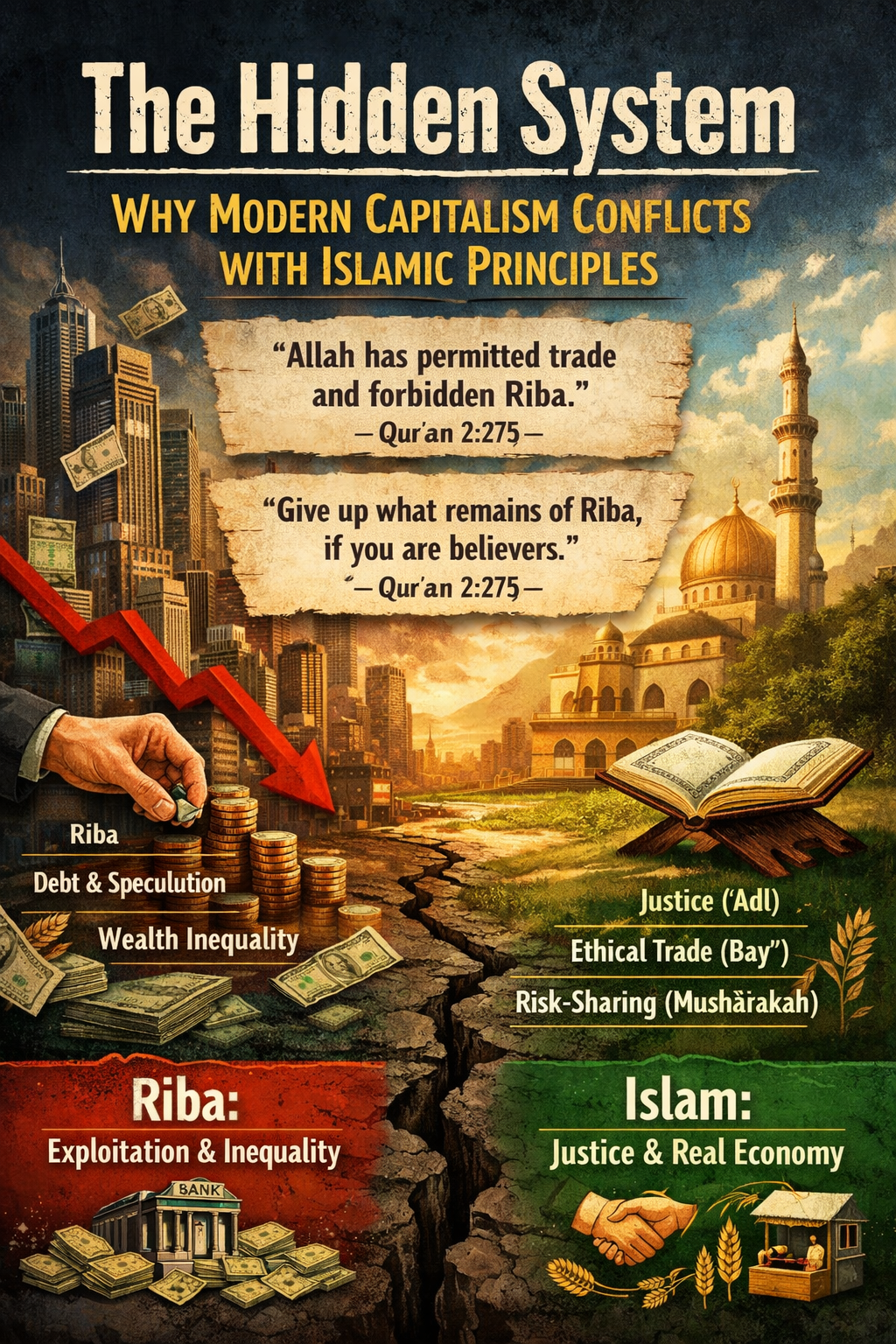
The Hidden System: Why Modern Capitalism Conflicts with Islamic Principles
In today’s world, capitalism is often perceived as a neutral and natural system—an inevitable framework within which all economic activity must operate. However, this perception obscures a deeper reality. Modern capitalism is not merely a system of trade, but a comprehensive economic architecture shaped by human assumptions, historical forces, and philosophical worldviews—many of which stand in tension with Islamic principles.
This paper challenges the widespread assumption that modern capitalism is a neutral and inevitable system. It argues that contemporary capitalism is not merely a framework for trade, but a deeply constructed economic order shaped by philosophical assumptions that often conflict with Islamic principles.
Focusing on the structural role of ribā (interest), debt dependency, and financialisation, the paper demonstrates how these elements form the core of modern economic systems. It highlights how wealth generation has increasingly shifted away from real productivity toward financial abstraction, resulting in systemic inequality, exploitation, and moral imbalance.
Drawing upon Qur’anic guidance and Prophetic teachings, the study contrasts this model with the Islamic economic vision—one rooted in justice (‘adl), balance (mīzān), ethical trade (bay‘), and risk-sharing mechanisms such as mushārakah and muḍārabah. It further explores the severity of the prohibition of ribā in Islam, presenting it not only as a legal injunction but as a safeguard against structural injustice and societal harm.
Ultimately, the paper positions the issue as one of īmān, ethical responsibility, and civilisational direction. It calls for renewed intellectual and practical engagement among Muslims to critically assess prevailing systems, realign economic practices with divine guidance, and contribute to the revival of an Islamic economic paradigm grounded in justice, accountability, and spiritual purpose.
Introduction: The Illusion of “Natural” Systems
We enter this world not as architects of the systems around us, but as inheritors of them.
From our earliest moments, we are shaped—quietly and consistently—by structures we did not choose. Through education, media, and daily life, we are conditioned to accept certain realities without question. Among the most dominant of these is the assumption that capitalism is simply “the way the world works.”
It is presented not as an ideology, but as a natural order—fixed, neutral, and inevitable. Markets, wages, debt, banking, and investment are treated as though they are as unquestionable as the rising of the sun or the passing of time.
But this perception is not truth—it is conditioning.
In reality, capitalism is not natural. It is a human construct, born out of specific historical contexts, shaped by philosophical assumptions, and sustained by power structures. It carries within it a worldview—one that defines success in material terms, measures value through profit, and often prioritises individual gain over collective well-being.
More importantly, it does not merely organise economic life—it shapes the human heart, influences moral priorities, and subtly redefines purpose itself.
As Muslims, we are not left without guidance in these matters.
Allah ﷻ reminds us:
“Then We put you on a straight way (Sharī‘ah) concerning the matter, so follow it and do not follow the desires of those who do not know.”
(Qur’an 45:18)
Islam is not limited to rituals or personal spirituality. It is a complete way of life—a dīn that provides guidance for how we earn, spend, trade, and build societies. It offers a moral and economic framework rooted in justice (‘adl), balance (mīzān), and accountability before Allah.
This leads us to a critical and unavoidable question:
Can a system built on principles that contradict divine guidance ever truly align with Islam?
When we examine modern capitalism—particularly in its current form, driven by debt, interest (ribā), speculation, and financialisation—the answer becomes increasingly clear.
Allah ﷻ declares with severity:
“Allah has permitted trade and forbidden ribā.”
(Qur’an 2:275)
And further:
“O you who believe, fear Allah and give up what remains of ribā, if you are truly believers.”
(Qur’an 2:278)
These are not marginal concerns. They are central to the Islamic worldview.
Modern capitalism, in its dominant global form, is deeply intertwined with ribā-based systems, exploitative financial practices, and widening inequality. It normalises debt as a way of life and elevates profit above ethics. In doing so, it stands in tension with the very foundations of the Islamic economic vision.
This is not merely an intellectual critique or a policy debate.
It is a question of īmān, of obedience, and of the direction we choose as an Ummah.
Are we to passively inherit and perpetuate systems that shape our lives away from divine guidance?
Or are we to critically examine, realign, and strive toward an economic and social order rooted in the principles of Islam?
The path forward requires more than awareness—it requires courage, leadership, and a return to the guidance of Allah ﷻ in every sphere of life.
Capitalism Is Not Trade: Understanding the System Beneath the Surface
One of the most widespread misconceptions of our time is the belief that capitalism is simply the act of buying and selling.
At first glance, this assumption seems harmless—even compatible with Islam. After all, Islam not only permits trade, but honours it. The Messenger of Allah ﷺ himself was a merchant, known for his honesty and trustworthiness. التجارة (trade) in Islam is a means of earning with dignity, fairness, and barakah.
Allah ﷻ clearly states:
“Allah has permitted trade and forbidden ribā.”
(Qur’an 2:275)
This distinction is profound.
It tells us that not all economic activity is equal in the sight of Allah. There is a clear boundary between what is halal and what is harmful—even if both may outwardly appear similar.
So the issue is not commerce.
The issue is the system within which commerce operates.
Capitalism, particularly in its modern form, is not merely a marketplace—it is a comprehensive economic architecture. It is built upon underlying principles and mechanisms that extend far beyond simple trade, shaping how wealth is created, distributed, and valued.
Among its defining features are:
- Debt as the engine of economic growth
Economic expansion is driven not by real productivity alone, but by continuous borrowing. Entire nations, corporations, and individuals are locked into cycles of debt. - Ribā (interest) as a central mechanism
Interest is not a peripheral element—it is foundational. Financial systems depend on it, despite its clear prohibition in Islam. - Money treated as a commodity
Instead of serving as a medium of exchange, money itself is traded, multiplied, and speculated upon—detached from real goods and services. - Wealth accumulation detached from real productivity
Profit is often generated without producing tangible value, but through financial leverage, speculation, and capital gains. - Financial institutions dominating real markets
Banks and financial entities hold disproportionate influence, often overshadowing the real economy of goods, services, and human effort.
In such a system, wealth is frequently generated not through honest trade or meaningful contribution, but through:
- leveraging capital
- manipulating financial instruments
- extracting returns from debt
This represents more than an economic shift—it is a moral transformation.
It redefines success from barakah to accumulation, from service to self-interest, and from accountability to maximisation of gain.
Islam, however, calls us back to a different standard.
The Prophet ﷺ said:
“The truthful and trustworthy merchant will be with the Prophets, the truthful, and the martyrs.”
(Tirmidhi)
This hadith elevates trade not as mere transaction, but as an act of integrity, responsibility, and worship.
The Islamic economic vision is rooted in:
- justice (‘adl)
- transparency
- risk-sharing
- real value creation
- and accountability before Allah ﷻ
It rejects exploitation, prohibits ribā, and places ethical boundaries around wealth.
Therefore, the question is not whether Muslims should engage in trade—we must.
The real question is:
Can we continue to operate within a system whose foundations contradict the very principles that Islam seeks to uphold?
To answer this requires more than surface-level understanding. It demands that we look beneath the system, recognise its assumptions, and realign our economic lives with the guidance of Allah ﷻ.
Ribā: The Hidden Engine of Modern Capitalism
At the very core of the modern economic system lies a force that is often normalised, overlooked, and even justified—yet in Islam, it is among the gravest of prohibitions.
That force is ribā.
Modern economies, as they exist today, are not merely influenced by interest—they are fundamentally dependent on it. Ribā is not a side component; it is the engine that drives the entire system forward.
Every level of society is built upon interest-bearing debt:
- Governments sustain themselves through bonds and sovereign debt
- Corporations grow and expand through loans and leveraged financing
- Individuals navigate life through mortgages, credit cards, and consumer debt
This is not incidental—it is structural.
The system is designed in such a way that continuous borrowing becomes necessary for survival, and repayment with interest becomes unavoidable. Wealth flows upward through debt obligations, concentrating power and resources in the hands of financial institutions.
Yet, what has been normalised in the world stands in direct opposition to the command of Allah ﷻ.
Allah سبحانه وتعالى declares:
“O you who believe, fear Allah and give up what remains of ribā, if you are truly believers.”
(Qur’an 2:278)
And then comes one of the most severe warnings in the entire Qur’an:
“And if you do not, then be informed of a war from Allah and His Messenger.”
(Qur’an 2:279)
This is not simply a legal prohibition—it is a declaration of the destructive nature of ribā.
It is a system that:
- exploits vulnerability
- entrenches inequality
- rewards wealth without effort
- and disconnects finance from real economic activity
Ribā transforms money into a tool of control rather than a means of exchange. It creates a cycle where the borrower becomes increasingly burdened, while the lender accumulates wealth without sharing risk.
This stands in stark contrast to the Islamic model, which is built on:
- risk-sharing instead of risk-shifting
- real trade instead of financial abstraction
- justice instead of exploitation
The prohibition of ribā is not merely about individual transactions—it is about protecting society from systemic injustice.
What we are witnessing today is precisely what the Qur’an warned against: a system where imbalance, inequality, and moral erosion become embedded into the very structure of the economy.
For Muslims, this is not a peripheral issue.
It is a matter of īmān.
To knowingly participate in, justify, or remain indifferent to a system rooted in what Allah has declared as a cause for war is something that demands deep reflection.
The challenge before us is not only to recognise ribā—but to understand how deeply it is embedded in the systems we live within, and to begin the journey toward alternatives that align with the guidance of Allah ﷻ.
Why Ribā Is So Severe
The severity of ribā in Islam is not arbitrary—it is rooted in the profound harm it causes to individuals, societies, and the moral fabric of economic life.
Ribā is not just a financial tool; it is a system that reshapes relationships, concentrates power, and undermines justice.
It is prohibited with such شدت (severity) because it:
- Creates guaranteed profit without risk
One party secures a return regardless of outcome, while the other bears the burden of uncertainty. This violates the Islamic principle that reward must be tied to risk and effort. - Extracts wealth from the vulnerable to the powerful
Those in need are often the ones who borrow, and through interest, their hardship becomes a source of profit for others. - Entrenches inequality
Wealth accumulates in the hands of those who already possess capital, widening the gap between rich and poor. - Encourages debt dependency
Individuals, businesses, and even nations become trapped in cycles of borrowing, where repayment becomes increasingly difficult and freedom increasingly limited. - Disconnects finance from real economic activity
Wealth is generated not through production, trade, or service, but through the mere passage of time on borrowed money.
In a ribā-based system, money begins to grow from money itself—detached from effort, value creation, and real exchange.
This stands in direct contradiction to the economic principles established in Islam.
Islam promotes a system grounded in justice, accountability, and real participation in economic activity. It emphasises:
- Risk-sharing (Mushārakah)
Where all parties share both profit and loss, creating fairness and mutual responsibility. - Partnership (Qirāḍ / Muḍārabah)
Where capital and effort come together in cooperation, not exploitation. - Real, asset-backed exchange (Bay‘)
Where transactions are tied to tangible goods, services, and genuine value.
These principles ensure that wealth is earned through contribution, not extraction; through cooperation, not imbalance.
The prohibition of ribā, therefore, is not merely about avoiding a sin—it is about safeguarding a just economic order.
It protects society from a system where:
- wealth circulates only among the elite
- human need becomes a source of profit
- and financial gain is detached from moral responsibility
Allah ﷻ reminds us:
“So that wealth does not merely circulate among the rich from among you.”
(Qur’an 59:7)
This is the essence of the matter.
Ribā disrupts this balance. Islam restores it.
And for the believer, understanding this is not optional—it is part of living a life aligned with the guidance of Allah ﷻ.
Conclusion: A Call to Conscious Alignment
What has been presented is not merely a critique of capitalism—it is an invitation to reflection, responsibility, and renewal.
We live within systems that have become so deeply embedded that they appear natural, inevitable, and beyond question. Yet, as this discussion has shown, modern capitalism—particularly in its ribā-driven and financialised form—is neither neutral nor aligned with the ethical and spiritual foundations of Islam.
At the heart of this misalignment lies ribā—a mechanism that transforms wealth into a tool of extraction, disconnects finance from real value, and entrenches inequality across societies. Its prohibition in Islam is not merely legal, but moral, social, and civilisational. It is a protection against a system that elevates profit over justice and accumulation over accountability.
For the Muslim, this is not a distant or theoretical concern.
It is a matter of īmān.
The question is no longer whether these systems exist—but how we, as individuals and as an Ummah, choose to respond to them.
Islam does not demand immediate perfection, but it calls for conscious alignment:
to recognise what contradicts divine guidance
to question what has been normalised
and to strive, step by step, toward what is halal, just, and pleasing to Allah ﷻ
This journey requires more than personal awareness—it requires collective revival.
It requires scholars who engage with contemporary realities,
leaders who extend beyond the masjid into economic and social spheres,
and communities willing to build alternatives rooted in Sharī‘ah principles.
It requires courage—to move beyond convenience, beyond inherited systems, and toward intentional living guided by revelation.
Allah ﷻ reminds us:
“Indeed, Allah will not change the condition of a people until they change what is within themselves.”
(Qur’an 13:11)
The revival of an Islamic economic vision does not begin in institutions—it begins in hearts, intentions, and choices.
The path forward is not without challenge, but it is clear:
To move from passive acceptance to purposeful action.
From imitation to authenticity.
From systems of imbalance to systems of justice.
And ultimately, to build a way of life where our economic choices, like our acts of worship, reflect our submission to Allah ﷻ.
Yours sister,
Dr. Thamina Anwar
CEO and Founder
Global Halal Shura Hub
please Join the Global Halal Shura Hub Community
📱 WhatsApp Community
👉 https://chat.whatsapp.com/CZJshg7AycWFJd3CyhSWj3
🌐 Website
https://globalhalalshurahub.com
📧 Email
thaminaanwar11@gmail.com; globalhalalshurahubsocialmedia@gmail.com
📘 Facebook
https://www.facebook.com/profile.php?id=61588247732733
https://www.facebook.com/profile.php?id=61588077462429
📷 Instagram
https://www.instagram.com/globalhalalshurahub/
🔗 LinkedIn
https://www.linkedin.com/in/dr-thamina-anwar-806124145/
https://www.linkedin.com/in/global-halal-shura-hub-dr-thamina-samina-anwar-05418b398/
📺 YouTube Channel
https://www.youtube.com/@GlobalHalalShuraHub
#globalhalalshurahub