
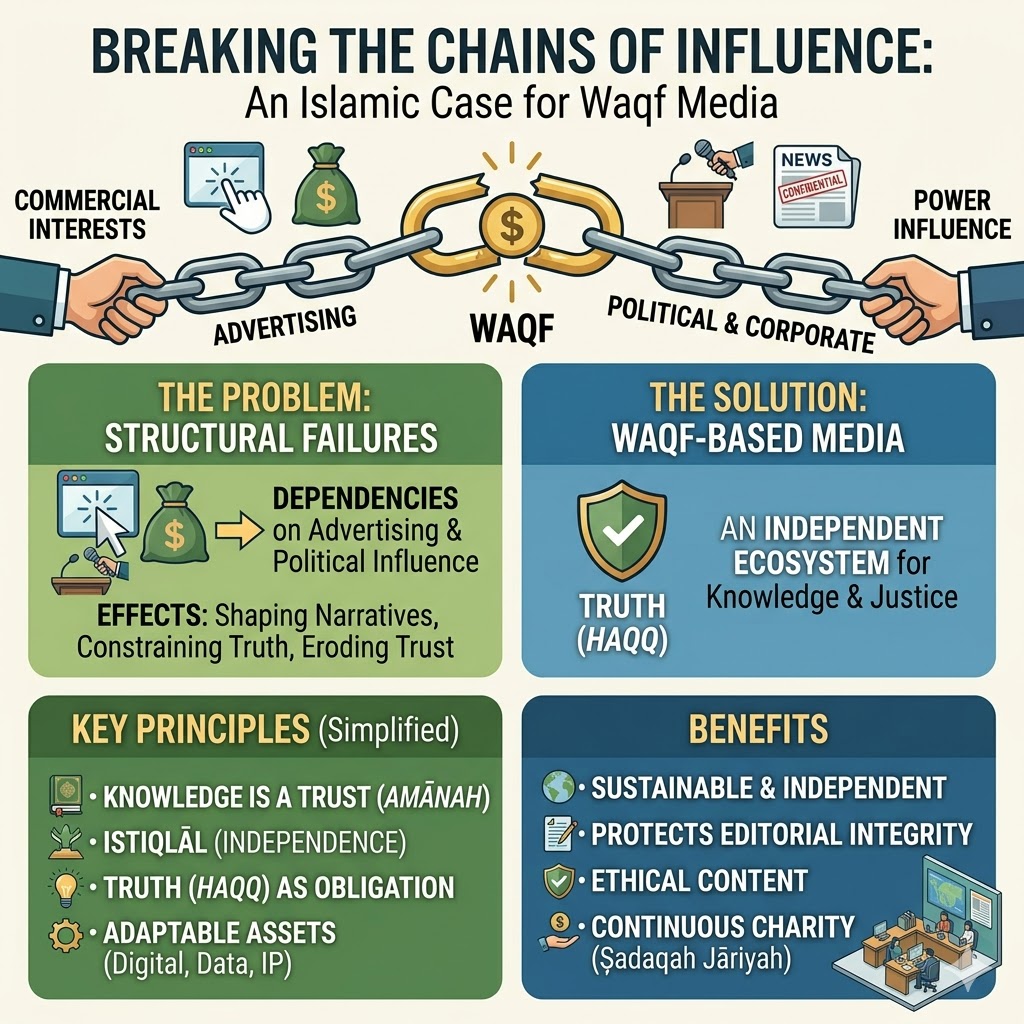
Breaking the Chains of Influence: An Islamic Case for Waqf Media
Date: 11th April 2026
In the contemporary information age, the crisis of media is most commonly framed as a problem of misinformation. However, this article argues that such a diagnosis is incomplete. Rather than treating misinformation as the root issue, it situates it as a symptom of deeper structural failures — specifically, the financial dependency of modern media on advertising, political influence, and corporate sponsorship. These dependencies create systemic pressures that shape narratives, constrain truth, and undermine public trust.
Drawing on Islamic intellectual and institutional traditions, the article reframes knowledge as an amānah (trust) and truth (ḥaqq) as a moral and spiritual obligation. It highlights the historical role of the waqf (endowment) system in sustaining independent knowledge ecosystems — including scholars, libraries, and universities — free from the influence of political and economic power. Crucially, this independence was not incidental, but structurally designed.
Importantly, the concept of waqf is not confined to its traditional association with brick-and-mortar assets such as land or buildings. Rather, its underlying principle — the dedication of income-generating or beneficial assets for public good — is inherently adaptable. In a contemporary context, this can extend to digital platforms, intellectual property, data infrastructures, and media production systems, thereby expanding the scope of what may be endowed in service of knowledge and truth.
Building on this foundation, the article proposes a contemporary reimagining of media through a waqf-based model. Such a model offers a sustainable alternative to existing funding structures by enabling financial istiqlāl (independence), supporting ethical content creation, and protecting editorial integrity. It further positions the revival of waqf as both a civilizational necessity and a form of ṣadaqah jāriyah, combining long-term social impact with enduring spiritual value.
Ultimately, the article contends that addressing the media crisis requires more than reforming content; it demands rethinking the institutional foundations of knowledge production. By integrating Islamic principles with structural design, a waqf-based media framework offers a pathway toward restoring trust, safeguarding truth, and aligning modern media with enduring ethical and spiritual commitments.
Introduction: Reclaiming Truth Through an Islamic Framework
In an age defined by information overload and constant connectivity, the crisis of media has become impossible to ignore. News travels at an unprecedented pace. A headline can circle the globe in seconds, reaching millions before its accuracy is ever questioned. Narratives take shape in real time, often solidifying in the public mind long before facts are fully verified.
In this environment, perception frequently precedes truth. Trust — once the foundation upon which journalism stood — is steadily eroding. Audiences are no longer certain whom to believe. Competing versions of reality coexist, each reinforced by its own ecosystem of platforms, influencers, and interests. The result is not just confusion, but fragmentation: a world where truth feels increasingly subjective.
The dominant explanation for this crisis is “misinformation.” Governments warn against it, platforms attempt to regulate it, and fact-checkers work tirelessly to correct it. It is treated as the central threat to modern information systems.
But this diagnosis, while not incorrect, is incomplete. Misinformation is not the disease. It is a symptom. It is the visible outcome of deeper structural problems — problems rooted not merely in technology or human error, but in the very systems that produce and distribute information.
The deeper issue lies in a question that is rarely asked with the seriousness it deserves.
What Kind of System Produces the Information We Consume?
This question goes beyond journalism. It forces us to look beneath headlines and beyond platforms, into the architecture of modern knowledge itself.
Every piece of information exists within a framework — shaped by incentives, constrained by funding, and influenced by power. What we read, watch, and share is not simply the result of neutral observation; it is the outcome of decisions made within systems that reward certain behaviors and discourage others.
Media, therefore, is not just about content. It is about the conditions under which that content is created.
Who decides what is worth investigating?
Who determines how long a story is pursued?
Who sets the limits on what can be said — and what must remain unsaid?
These questions are rarely visible to the audience, yet they shape everything. And this leads us to an even more critical question:
Who funds it?
Funding is not a passive background element. It is an active force that quietly structures reality. It determines priorities, sets boundaries, and subtly defines what is possible.
A newsroom funded by advertising must think in terms of engagement. Stories are evaluated not only by their importance, but by their ability to attract attention. Complex truths may be simplified. Nuanced discussions may be reduced to polarizing soundbites. Not because journalists lack integrity, but because the system rewards visibility over depth.
A platform sustained by political alignment operates within another set of constraints. Certain narratives are amplified, others are softened, and some are avoided altogether. Over time, this shapes not only coverage, but worldview.
Corporate sponsorship introduces yet another layer. Economic interests create invisible red lines — topics that are too sensitive, critiques that are too costly, investigations that are too risky.
Even without explicit censorship, the effect is profound. Financial dependence does not always silence truth. But it often filters it. It creates an environment where some truths are easier to tell, while others become inconvenient, delayed, or quietly excluded. Over time, this selective visibility reshapes public understanding. What is repeatedly seen becomes reality; what is consistently omitted fades into irrelevance.
From an Islamic perspective, this dynamic raises profound concerns.
Truth (ḥaqq) in Islam is not flexible, nor is it subject to negotiation. It is absolute in its moral weight and binding in its responsibility. The Qur’an commands:
“And do not mix the truth with falsehood or conceal the truth while you know [it].” Quran (2:42)
And again:
“O you who believe, stand firmly for justice, as witnesses to Allah, even if it be against yourselves…” Quran (4:135)
These are not abstract ideals. They are commands that demand consistency, courage, and independence. When the production of information is embedded within systems that reward distortion, sensationalism, or selective silence, the issue transcends professionalism. It is no longer simply about better journalism or improved standards.
Then, It becomes a question of moral integrity and spiritual accountability. Because in such systems, the risk is not only that falsehood is spread — but that truth itself is compromised, diluted, or withheld.
And in Islam, withholding truth is not a neutral act. It is a breach of trust. If knowledge is an amānah (trust), then the systems that produce knowledge must be worthy of that trust. They must enable truth to be spoken fully, not partially. Courageously, not cautiously. Consistently, not selectively.
This is why addressing misinformation alone is insufficient. Fact-checking corrects what is already visible. Regulation attempts to manage what has already gone wrong. But neither addresses the deeper structure — the system that determines what is produced in the first place.
If we are serious about reclaiming truth, we must go further.
We must examine the incentives that shape media.
We must question the dependencies that constrain it.
And ultimately, we must be willing to transform the structures that allow distortion to thrive.
Because until the system changes, the outcomes will not. And until truth is supported by independence, it will always remain vulnerable.
The Crisis Beneath the Surface
Modern media does not operate in a vacuum. It exists within a dense web of economic incentives and political realities that quietly, but powerfully, shape its behavior. What appears on our screens each day is not simply the result of neutral reporting — it is the product of systems that reward certain outcomes and discourage others.
To understand the crisis of media today, we must move beyond surface-level critiques and examine the foundations upon which it stands.
At present, most media institutions rely on three primary sources of funding:
Advertising revenue
Political alliances or state support
Corporate sponsorship
These funding streams are often treated as standard, even inevitable. Yet they are far from neutral. Each carries its own set of expectations, incentives, and pressures — some visible, many invisible.
Advertising-driven media, for instance, is built on attention. Revenue is directly tied to clicks, views, and engagement metrics. In such an environment, stories are not only judged by their importance, but by their ability to capture attention. This naturally favors content that is emotionally charged — outrage, fear, conflict, and controversy.
Nuance struggles to compete with virality. Depth is often sacrificed for immediacy. Over time, this creates a media culture where sensationalism is not an exception, but a structural outcome.
Political funding introduces a different kind of influence. Whether through direct state ownership, subsidies, or ideological alignment, media outlets operating within political ecosystems often develop implicit boundaries. Certain narratives are amplified, while others are softened or avoided.
Even without explicit censorship, a form of internal calibration takes place. Journalists and editors learn — consciously or unconsciously — where the limits lie.
Corporate sponsorship adds yet another layer of constraint. Large corporations, as major financial contributors, hold significant indirect influence. Media platforms may hesitate to critically examine industries, practices, or actors that are tied to their revenue streams.
In this way, influence is not always exercised through direct control. It operates through dependency. And dependency shapes behavior.
In such a system, truth is not always outright denied. There is no need for constant fabrication when selective emphasis can achieve similar results. Instead, truth is often:
Filtered through editorial priorities
Framed to align with acceptable narratives
Deprioritized in favor of more “profitable” content
What is omitted can be as powerful as what is reported.
CASE STUDY: The Cost of Dependency
Consider a specific example: In 2021, a major American news outlet obtained internal documents revealing serious environmental violations by a multinational oil company. The investigation took eight months. But when the story was ready for publication, the outlet’s advertising team flagged that the same oil company was among its top ten annual advertisers, contributing over $12 million. The story was not killed — but it was delayed, then moved from the front page to an inside section, then published on a Friday evening when readership is lowest. No explicit censorship occurred. No journalist was ordered to lie. Yet the truth was effectively buried. This is not conspiracy. This is the silent logic of structural dependency.
From an Islamic perspective, this reality raises a serious and unavoidable concern. Islam does not treat truth as a flexible or negotiable concept. Truth (ḥaqq) and justice (ʿadl) are central to the moral order established by Allah. They are not subject to market dynamics or political convenience.
The Qur’an commands:
“O you who believe, stand firmly for justice, as witnesses to Allah, even if it be against yourselves…” Qur’an(4:135)
This ayah establishes a principle of profound significance: truth must be upheld regardless of personal, social, or material cost. It demands independence — not only of speech, but of structure.
A system that makes truth costly to uphold is, by definition, a system in tension with this command.
Justice (ʿadl) and truth (ḥaqq) are not optional ideals. They are divine obligations. They require consistency, courage, and, crucially, freedom from undue influence.
When media systems are structured in ways that compromise these values — even subtly — the issue extends far beyond professional ethics. Because it is no longer just about standards or practices.
It is about accountability before Allah (SWT).
It becomes moral — because truth (ḥaqq) and justice (ʿadl) are obligations, not preferences. Distorting, filtering, or withholding truth is not merely a professional lapse; it is a violation of what is right.
It becomes spiritual — because every word conveyed, every fact omitted, and every narrative shaped carries consequences in the Hereafter. The transmission of knowledge is an amānah, and breaching it is not only a social harm, but a sin.
In this light, media is not just an industry. It is a space of witnessing — where individuals and institutions either uphold truth or fall short of it.
And that makes the stakes far greater than reputation or credibility. Because in Islam, the distortion or suppression of truth is not merely a failure of practice. It is a breach of trust (amānah), a deviation from justice, and a matter for which one is accountable before Allah.
This reframes the entire conversation. The crisis of media is not only about misinformation, bias, or declining standards. It is about the misalignment between the structures we have built and the values we claim to uphold.
If truth is sacred, then the systems that produce it must also be designed to protect it. Otherwise, no amount of reform at the surface level will be sufficient.
Knowledge as an Amānah (Trust)
In Islam, knowledge is not a commodity to be traded, packaged, or optimized for consumption. It is an amānah — a sacred trust from Allah, entrusted to human beings with responsibility and accountability.
This understanding transforms the very nature of information. Knowledge is no longer neutral data; it is a moral burden. It must be sought with sincerity, conveyed with honesty, and protected from distortion.
The Prophet ﷺ warned:
“Whoever is asked about knowledge and conceals it will be bridled with a bridle of fire on the Day of Judgment.”
This hadith is not merely a caution against silence. It is a profound statement about the ethics of knowledge. To withhold truth, to obscure it, or to manipulate it for personal or worldly gain is not just an intellectual failure — it is a moral transgression with consequences that extend beyond this life.
Information, in this sense, carries weight. It carries responsibility. It carries accountability beyond dunyā — into the Hereafter.
This perspective stands in stark contrast to the modern treatment of information, where knowledge is often reduced to content: produced rapidly, consumed quickly, and evaluated primarily by its ability to attract attention.
Within an Islamic framework, such a reduction is deeply problematic. Knowledge is not meant to entertain at the expense of truth. It is not meant to persuade at the expense of honesty. It is not meant to serve power at the expense of justice. Rather, it is meant to guide, to clarify, and to uphold ḥaqq.
Islamic Epistemology and Media
Islamic epistemology distinguishes between ʿilm (knowledge) and ẓann (conjecture or opinion). The Qur’an repeatedly warns against following that of which one has no knowledge:
“And do not pursue that of which you have no knowledge. Indeed, the hearing, the sight, and the heart — about all those [one] will be questioned” Qur’an(17:36).
Modern media, driven by speed, often blurs this line. Breaking news is frequently based on unverified sources; punditry masquerades as analysis; and emotional speculation is packaged as insight. From an Islamic standpoint, this is not merely poor practice — it is a violation of the epistemic trust placed in human beings. To speak without knowing, to broadcast without verifying, to amplify without reflecting — these actions erode the very foundation of ʿilm.
In this light, media — in its ideal form — can be understood as a contemporary extension of this amānah. It is one of the most powerful mechanisms through which knowledge is disseminated in the modern world. It informs societies, shapes collective understanding, and influences decisions at every level — from personal beliefs to public policy.
With such influence comes immense responsibility. If knowledge is sacred, then the institutions that produce and distribute it cannot be morally neutral. They must be grounded in integrity, guided by truth, and structured in a way that protects them from corruption.
But here lies the tension. Integrity requires independence. And independence is difficult to sustain within systems of dependency.
When the survival of media institutions depends on pleasing advertisers, maintaining political favor, or securing corporate funding, the amānah of knowledge is placed under strain. Even the most principled individuals operate within constraints that shape what can be said, how it can be said, and whether it can be said at all.
Over time, this creates a subtle but significant shift. Truth is no longer communicated solely because it is true. It is communicated — or withheld — based on its consequences. And this is precisely where the amānah is compromised.
Because in Islam, truth is not conditional. It is not subject to approval, profitability, or convenience. It is a trust that must be upheld regardless of cost. A system that makes truth costly to uphold is a system that undermines the very essence of that trust.
This is why the crisis of media cannot be understood purely in technical or professional terms. It is not only about improving standards or refining practices. It is about restoring the moral foundation upon which knowledge itself stands.
Until media institutions are structured in a way that allows them to fulfill this amānah without compromise, the gap between truth and its transmission will remain.
And with it, the trust of society will continue to erode.
A Forgotten Islamic Institution: The Waqf
Long before the rise of modern nation-states, centralized bureaucracies, and corporate economies, Islamic civilization developed institutions that addressed one of the most enduring challenges of any society: how to preserve truth, knowledge, and public welfare without dependence on power.
Among the most remarkable of these institutions was the waqf. A waqf is often translated as a charitable endowment, but this definition barely captures its depth. It is not simply a donation, nor an act of short-term generosity. It is a perpetual structure — a deliberate institutional design in which assets are dedicated permanently for the sake of Allah, and their benefits are directed toward the public good.
What distinguishes waqf from ordinary charity is continuity.
It is not consumed; it sustains.
It is not reactive; it is foundational.
The origins of waqf trace back to the time of the Prophet ﷺ himself. He established endowments and encouraged his companions to do the same. Figures such as ʿUmar ibn al-Khaṭṭāb (RA) endowed valuable land, stipulating that it could neither be sold nor inherited, but that its yield should serve the community.
This principle — preserving the asset while distributing its benefit — became the cornerstone of a vast and sophisticated system.
Over centuries, waqf evolved into one of the defining features of Islamic civilization. It was not limited to acts of piety in isolation; it became the backbone of social infrastructure.
Waqf institutions funded:
Scholars, jurists, and teachers
Libraries and the preservation of manuscripts
Hospitals, clinics, and public health services
Schools and universities, including historic centers of learning such as Al-Azhar in Cairo and Al-Qarawiyyin in Fez
In many cities, entire sectors of public life were sustained through waqf. Education, healthcare, welfare, and even infrastructure operated through endowments created by individuals seeking ongoing reward (ṣadaqah jāriyah).
These were not temporary acts of charity. They were self-sustaining ecosystems of knowledge, service, and social stability.
HISTORICAL CASE STUDY: The Nizamiyya Madrasas
One of the most powerful examples of waqf-funded knowledge production is the Nizamiyya madrasa network, established in the 11th century by Nizam al-Mulk, the Seljuk vizier. These institutions were endowed with agricultural land, commercial properties, and fixed revenues. The waqf deeds explicitly stated that teachers could not be dismissed by political authorities; their salaries were guaranteed by the endowment, not by the ruler’s favor. The result was a golden age of scholarship. Al-Ghazali, one of Islam’s most influential thinkers, taught at the Nizamiyya of Baghdad — and he openly criticized the very political class whose vizier had founded the institution. That is structural independence. A media waqf would aim for the same: the ability to critique power without losing the means to operate.
But perhaps the most profound aspect of the waqf system was not what it funded — but how it functioned.
It operated independently. Because waqf assets were dedicated solely for the sake of Allah, they were legally and morally insulated from the control of rulers, political authorities, and market forces. While no system is entirely immune to influence, the structure of waqf significantly reduced dependency on fluctuating sources of power.
This independence had far-reaching consequences. Scholars supported by waqf were able to teach, write, and critique without fear of losing their livelihoods. Knowledge production was not tied to political approval or commercial success. Intellectual life was sustained by a system that valued continuity over control.
In this environment, truth had space to exist. Inquiry had room to develop. And knowledge could be pursued as an act of ʿibādah (worship), rather than as a means of survival. This was not accidental. It was intentional design.
Islamic civilization recognized that values alone are not enough. Even the most sincere commitment to truth can be compromised if the surrounding structures incentivize otherwise. Therefore, it built institutions that aligned material realities with moral principles.
The waqf system was one such institution — a mechanism that translated sincerity (ikhlāṣ) into sustainability, and ethics into infrastructure. Today, as we confront a global crisis of media and knowledge, this historical model offers more than inspiration. It offers insight.
It reminds us that independence is not achieved merely through personal integrity.
It must be built into the system itself. And in the waqf, we find a model that did exactly that.
Istiqlāl (Independence) as a Principle
In Islamic thought, independence — istiqlāl — is not merely a political or economic concept. It is deeply spiritual, intimately tied to sincerity — ikhlāṣ. The purity of an action in Islam is not judged only by what is done, but by why it is done and what influences it.
When actions become entangled with worldly incentives — wealth, status, recognition, or approval — they are exposed to fasād (corruption). Intentions can shift subtly. Priorities can be rearranged. What begins as truth-seeking can gradually become audience-seeking, approval-seeking, or survival-seeking.
But when actions are anchored in khidmah lillāh (service to Allah), they are elevated beyond these pressures. They are liberated from the need to please khalq (creation), and instead oriented toward pleasing the Creator.
This is where istiqlāl becomes essential. True sincerity requires a degree of independence.
And without independence, sincerity is constantly under threat. The waqf system embodies this principle in a profound and practical way.
By removing financial dependency on political authorities, corporate interests, and market fluctuations, waqf creates a space where individuals and institutions can operate with greater integrity. It does not guarantee sincerity — that remains a matter of the heart — but it enables it by reducing external pressures. It aligns the material structure with the spiritual objective.
Now consider modern media through this lens. Can a journalist fully investigate a corporation if their platform relies on that corporation’s advertising revenue?
Can a media outlet openly critique political authority if its existence depends on political patronage or state funding?
Even in the absence of explicit interference, these dependencies create invisible constraints. There are always lines that are harder to cross, questions that are more difficult to pursue, and truths that carry greater risk.
As a result, the system itself begins to shape behavior.
Individuals within it may strive for honesty and integrity — and many do. But personal virtue alone cannot fully overcome structural limitations. Over time, even the most principled actors must navigate the realities of survival within the system.
This is why Islam does not confine itself to guiding individual morality alone.
It also emphasizes the creation of just systems.
A society rooted in justice is not one that simply tells its people to be just. It is one that builds institutions that facilitate justice and reduce the cost of doing what is right.
The Caliph ʿUmar ibn al-Khaṭṭāb (RA) understood this deeply. His leadership was not limited to moral exhortation; it was defined by institutional foresight. He implemented structures that protected public welfare, ensured accountability, and minimized the potential for ẓulm (injustice). He recognized that justice must be supported, not merely demanded.
The waqf is one of the clearest expressions of this philosophy.
It is an institutional embodiment of istiqlāl.
A system designed to protect integrity by removing dependency.
A structure that allows truth to be pursued without fear of financial consequence.
In the context of modern media, this principle is not just relevant — it is urgent.
If we seek a media landscape grounded in sincerity, guided by truth, and committed to justice, we cannot rely on individual ethics alone. We must also build systems that make such ethics sustainable.
Because without istiqlāl, ikhlāṣ is constantly under pressure.
And without both, truth itself becomes fragile.
Reimagining Media Through a Waqf Model
If Islamic principles are taken seriously — not only as personal ethics but as a framework for organizing society — then the solution to today’s media crisis cannot be limited to better intentions or stronger professional codes. Ethics alone, while essential, are not sufficient.
What is required is something deeper: better structures — structures that align material realities with moral commitments.
Because even the most sincere individuals struggle to uphold truth within systems that penalize it, and even the strongest ethical guidelines weaken when survival depends on compromise.
This is where the idea of a waqf-based media model becomes not only relevant, but transformative. At its core, such a model would involve establishing endowments dedicated to supporting independent journalism and knowledge production — institutions funded not by advertisers, political actors, or corporate sponsors, but by assets permanently allocated for the sake of Allah and the public good.
The implications of this shift are profound.
A waqf-based media system could:
Fund investigative journalism without commercial pressure
Journalists would have the freedom to pursue long-term, complex investigations without needing to justify their work in terms of immediate engagement or profitability. Truth would not be constrained by timelines dictated by revenue cycles.Support scholars, writers, and analysts committed to truth
Intellectual work could be sustained as a form of khidmah (service), rather than a means of navigating market demand. This would revive a tradition in which knowledge is pursued for its value, not its virality.Create platforms for thoughtful, ethical discourse
In contrast to the speed-driven nature of modern media, waqf-funded platforms could prioritize depth, reflection, and meaningful dialogue — spaces where ideas are explored, not merely reacted to.Preserve and disseminate knowledge free from manipulation
Content would not need to be shaped to satisfy sponsors or align with dominant narratives. The focus could return to clarity, accuracy, and benefit (nafaʿ).Protect editorial independence from political and corporate influence
With financial autonomy, media institutions would be structurally insulated from many of the pressures that currently distort coverage. Independence would no longer depend solely on individual courage — it would be built into the system itself.
Unlike donation-driven models, which are often reactive and unstable, a waqf provides long-term sustainability. Its assets remain intact, while their returns generate continuous funding. This allows institutions to plan for the long term, invest in quality, and remain consistent in their mission.
Stability, in this sense, is not merely financial.
It is intellectual and moral stability.
It creates an environment where truth does not need to compete for survival.
A Practical Governance Model for a Media Waqf
So how would such a waqf operate institutionally? A proposed framework:
Asset Board (Nāẓirūn) – Responsible for managing the endowment’s properties, investments, and financial returns. This board operates according to Shari’ah-compliant investment principles and is legally bound by the waqf deed’s original conditions.
Editorial Trustees (Ahl al-ʿIlm wa al-ʿAdl) – A separate body of senior scholars, journalists, and ethicists who oversee editorial standards, protect the institution’s mission, and have the power to veto any external pressure on content. They are appointed for fixed terms and cannot be dismissed by the Asset Board, ensuring structural separation of finance and content.
Public Ombudsman (Dīwān al-Maẓālim) – An independent complaints mechanism where audiences can challenge perceived bias, inaccuracy, or ethical breaches. This body reports publicly and has no financial ties to the waqf’s operations.
Beneficiary Council (Majlis al-Intifāʿ) – Representatives from the communities served by the media waqf (e.g., readers, local scholars, civil society) who provide annual feedback and can recommend changes to editorial priorities.
This multi-lensed structure prevents any single group — whether funders, editors, or political actors — from dominating the institution. It is designed not for efficiency in the corporate sense, but for integrity in the Islamic sense: balancing accountability, independence, and public service.
In doing so, the very nature of media is transformed.
It is no longer a business driven primarily by profit, attention, or influence. It becomes a public trust — an amānah ʿāmmah.
A trust that must be upheld with responsibility.
A trust that serves society rather than manipulates it.
A trust that is ultimately accountable not only to people, but to Allah.
This reframing is critical.
Because once media is understood as an amānah, its purpose changes. Its success is no longer measured solely by reach or revenue, but by its ability to uphold truth, promote justice, and benefit humanity.
And such a transformation cannot occur through content reform alone.
It requires a rethinking of foundations.
The waqf model offers exactly that: not just an alternative funding mechanism, but a different philosophy of media altogether — one rooted in independence, sustained by purpose, and guided by the enduring values of Islam.
Reviving a Prophetic Legacy
Reviving the waqf model is not merely a strategic or institutional choice.
It is, at its core, an act of returning to a Prophetic way of thinking — a way that connects faith with function, and spirituality with structure.
It is about rebuilding systems that are not only efficient, but meaningful.
Not only sustainable, but sincere.
The Prophet ﷺ said: “When a person dies, their deeds come to an end except for three: ongoing charity (ṣadaqah jāriyah), beneficial knowledge, and a righteous child who prays for them.”
This hadith outlines a profound vision of legacy in Islam. It shifts the focus from temporary impact to enduring — actions that continue to generate reward long after a person has left this world.
Among these, two stand out as pillars of civilizational continuity:
Ṣadaqah jāriyah — continuous charity that benefits people over time
ʿIlm nāfiʿ — beneficial knowledge that guides, teaches, and uplifts
A waqf-based media institution has the unique potential to bring these two together in a single, powerful framework.
Through the endowment, it becomes ṣadaqah jāriyah — a continuous source of good (al-khayr) that sustains itself and serves others across generations.
Through the production and dissemination of truthful, meaningful content, it becomes a source of beneficial knowledge — shaping minds, informing decisions, and guiding society toward what is right.
Few institutions today offer such a profound convergence. Most modern systems separate impact from intention. Charity exists in one space, knowledge production in another, and spirituality in yet another. But the waqf model integrates them — aligning financial sustainability with moral purpose and spiritual reward.
In doing so, it transforms media from a tool of influence into a means of ʿibādah (worship). This is especially significant in a world saturated with noise.
Today’s information landscape is not lacking in content — it is overwhelmed by it. But much of this content is fleeting, reactive, or driven by agendas that do not prioritize truth. The result is not clarity, but confusion; not guidance, but distraction.
In such an environment, the act of creating and sustaining a platform committed to truth, integrity, and benefit becomes deeply meaningful.
It becomes an act of khidmah (service).
An act of responsibility.
An act of worship.
Because every truth conveyed is a fulfillment of the amānah.
Every falsehood resisted is an act of justice.
And every piece of beneficial knowledge shared is an investment in both this world and the next.
Reviving the waqf model, then, is not simply about solving a contemporary problem.
It is about reclaiming a legacy — one in which institutions were built not only to function, but to endure in reward and impact.
A legacy where systems served society without compromising truth.
Where knowledge was preserved without distortion.
And where the pursuit of benefit was inseparable from the pursuit of Allah’s pleasure.
In that sense, a media waqf is more than an innovation.
It is a continuation.
Challenges and Mas’ūliyyah (Responsibility)
Translating such a vision into reality is not without difficulty. Reviving a waqf-based model for media in the modern world requires more than inspiration — it demands institutional intelligence, disciplined execution, and a deeply internalised sense of responsibility.
The challenges are not merely technical; they are structural, ethical, and civilisational.
At the forefront lies the question of governance.
Who ultimately oversees the waqf?
How are strategic and editorial decisions made?
What mechanisms ensure continuity without stagnation, and independence without fragmentation?
Without carefully designed governance frameworks, even the most sincere initiatives risk gradual erosion. Institutions rarely collapse overnight — they drift. A waqf must therefore be safeguarded not only from external pressures — political, financial, or ideological — but also from internal ḍaʿf (weakness): mismanagement, personality conflicts, short-term thinking, or the quiet dilution of purpose over time.
This naturally leads to the second challenge: transparency and accountability.
If a waqf is to function as an amānah ʿāmmah (public trust), it cannot operate in opacity. Its legitimacy depends not on claims, but on demonstrable integrity. Financial flows must be clear. Governance structures must be intelligible. Editorial principles must be articulated and consistently upheld.
Trust, in this context, is not a static asset. It is a dynamic relationship between institution and community — one that must be continuously earned, verified, and renewed.
A third challenge is that of scale and sustainability.
Meaningful media work — investigative journalism, long-form research, high-quality production — requires stable and substantial funding. A waqf must therefore be capitalised at a level that allows it to generate reliable returns without compromising its independence.
This raises a practical concern: how can such scale be achieved in a fragmented and often resource-constrained environment?
Equally significant is the challenge of time horizon.
Modern institutional culture is shaped by immediacy — quarterly results, rapid growth, and visible impact. The waqf model, by contrast, is inherently long-term. It is designed not for acceleration, but for endurance. It prioritises continuity over speed, resilience over visibility.
This temporal mismatch can create tension. Sustaining commitment to a model whose fruits may only fully mature across decades requires not only patience, but conviction.
Addressing the Challenges – From Principle to Practice
Yet these challenges are not insurmountable. Within the Islamic intellectual and legal tradition — as well as within contemporary institutional practice — there exist pathways to address each of them.
Governance drift can be mitigated through the deliberate use of sharṭ al-wāqif (the founder’s conditions). By embedding clear, non-negotiable principles within the founding deed, a waqf can preserve its core mission across generations. For example, structural separation between financial oversight and editorial authority can be codified to protect intellectual independence. Classical juristic traditions, particularly within the Hanafi and Shāfiʿī schools, recognised such conditions as binding, giving them enduring legal force.
Transparency and accountability can be institutionalised rather than assumed. Regular public reporting, independent financial audits, and clearly defined governance roles are essential. The revival of the concept of a muḥtasib — an independent ombudsman tasked with oversight and ethical accountability — offers a powerful model rooted in Islamic governance. In a modern context, this could take the form of an external review board or public editor who operates with real authority, not symbolic presence.
Scale need not be achieved through a single monumental endowment. Historically, awqāf often began modestly and expanded over time. A contemporary model could mirror this through layered growth: multiple smaller endowments pooled together, or a phased approach where initial assets generate baseline sustainability while additional contributions progressively expand capacity. This transforms scale from a barrier into a process.
Legal and regulatory constraints, particularly in non-Muslim-majority contexts, can be navigated through functional equivalents. Common law systems already recognise perpetual charitable trusts, while civil law jurisdictions provide for foundations. The terminology may differ, but the underlying principles — asset permanence, restricted use, and public benefit — can be preserved. What matters is not the label of waqf, but the integrity of its structure.
From Challenge to Obligation
These challenges, then, should not be understood as deterrents. They are clarifications — defining the seriousness of the task.
In Islamic terms, this responsibility rises to the level of farḍ kifāyah — a collective obligation. If a sufficient number undertake it, the duty is fulfilled on behalf of the community. But if it is neglected entirely, the burden does not disappear; it expands.
The preservation of truth, the protection of knowledge, and the cultivation of trustworthy media are not optional functions within a civilisation. They are foundational.
Earlier generations recognised this with clarity. They did not wait for ideal conditions, nor did they operate with certainty of outcome. They acted within their means, endowing what they could — land, wealth, infrastructure — and in doing so, constructed institutions that outlived them by centuries.
The durability of their legacy was not accidental. It was the product of vision aligned with responsibility.
Today, the terrain has shifted. The arena is no longer limited to mosques, madrasas, and caravanserais, but extends into the complex and contested domain of media and information.
Yet the underlying need remains unchanged.
The question is no longer whether such institutions can exist — history has already answered that.
The question is whether there exists a community willing to assume the responsibility of building them again.
Because at the centre of this entire endeavour lies mas’ūliyyah — responsibility before Allah.
A responsibility that is not abstract, but actionable.
Not rhetorical, but institutional.
Not individual alone, but collective in nature.
And just as those before us transformed their sense of duty into enduring structures, so too do we stand at a moment where intention can be translated into legacy.
The challenges are real.
But so is the need.
And where need persists, responsibility follows.
A Comparative Perspective: Waqf vs. Secular Nonprofit Media
To strengthen the proposal, it is useful to compare the waqf model with existing secular nonprofit media models — such as ProPublica (USA), The Guardian’s Scott Trust (UK), or the Dutch public broadcasting system — and identify what the waqf adds uniquely.
Similarities:
Independence from commercial advertising.
Mission-driven rather than profit-driven.
Long-term sustainability through endowments or trusts.
Differences and Advantages of the Waqf Model:
Feature | Secular Nonprofit | Islamic Waqf |
|---|---|---|
Legal perpetuity | Often limited by trust law; can be dissolved by trustees | Permanence rooted in sacred law (sharʿī); dissolution is religiously prohibited |
Accountability | To board or public | To Allah first, then community; dual accountability (dunyā and ākhirah) |
Spiritual incentive | None (or civic duty) | Ṣadaqah jāriyah — continuous reward after death |
Source of legitimacy | Democratic or legal charter | Divine command and Prophetic tradition |
Resistance to mission drift | Depends on governance | Reinforced by inviolable waqf deed conditions (shurūṭ al-wāqif) |
Community ownership | Often donor-driven | Historically, community-beneficiary has moral claims |
The waqf model thus offers not just structural independence, but spiritual and legal permanence that secular trusts cannot replicate. A board of a secular foundation can vote to change its mission or dissolve the entity. A properly constituted waqf, under classical Islamic law, cannot. The founder’s conditions are binding in perpetuity — a powerful safeguard against future corruption.
For example, the Scott Trust, which owns The Guardian, has preserved the newspaper’s liberal-left orientation for decades, but theoretically, future trustees could alter its mission. A waqf-based media outlet, by contrast, could embed “commitment to ḥaqq and ʿadl as defined by Qur’an and Sunnah” as an irrevocable condition. This is not merely a rhetorical difference; it is a legally binding (in Islamic jurisprudence) constraint that secular law does not provide.
The Question That Defines the Future
We often ask: What is true? It is a necessary question — but no longer sufficient.
Because in a world shaped by systems, incentives, and power, truth does not exist in isolation. It exists within conditions that either support it or suppress it.
Perhaps, then, the more urgent question is: Who enables truth to exist?
This question shifts the focus from content to structure, from statements to systems. It forces us to confront a reality we often overlook: truth is not only discovered — it is sustained.
If the environments in which truth is produced are fragile, dependent, or compromised, then truth itself becomes vulnerable. It may still appear, but inconsistently. It may be spoken, but selectively. It may be known, but not fully revealed.
As long as truth depends on systems that reward distortion — systems driven by profit, influence, or approval — it will remain unstable.
At times it will rise. At times it will be buried. And often, it will be reshaped to fit what is acceptable.
In such a world, truth does not disappear — but it struggles to stand firmly. From an Islamic perspective, this instability is deeply troubling.
Truth (ḥaqq) is not meant to fluctuate with circumstance. It is meant to be upheld with consistency, clarity, and courage. The Qur’an repeatedly contrasts ḥaqq with bāṭil (falsehood), not as two equal forces, but as opposing realities — one enduring, the other destined to fade.
But for ḥaqq to prevail in the world of human action, it must be supported by systems that allow it to stand. This is where structure becomes inseparable from principle.
If truth is supported by institutions designed for independence — rooted in ikhlāṣ (sincerity) and sustained through mechanisms like waqf — it gains stability. It is no longer at the mercy of shifting incentives or external pressures.
It can be pursued without fear. Spoken without hesitation. Preserved without compromise.
Such structures do not guarantee perfection. But they create the conditions in which truth can endure, rather than merely appear. And endurance is what defines impact.
A truth that appears briefly and disappears changes little. A truth that is sustained, repeated, and protected shapes generations.
This is why the question of funding, structure, and independence is not secondary. It is foundational.
Because in the end, the future of truth will not be determined only by those who seek it — but by those who are willing to build systems that sustain it.
A Call to Action: Steps Toward Implementation
This paper has presented a theoretical and historical case for reviving the waqf as a vehicle for independent, principled media. Yet theory, no matter how compelling, must ultimately give way to action. The challenge before us is not merely to admire past models, but to reanimate their spirit within contemporary institutional frameworks. What follows is a practical, phased roadmap for establishing a waqf-based media institution suited to the realities of the 21st century.
Phase 1: Feasibility and Coalition Building (0–12 months)
Every enduring institution begins with a committed nucleus. The first phase focuses on assembling a coalition of individuals whose expertise and credibility can anchor the project.
This includes:
Scholars of Islamic law and ethics, who can ensure that the waqf structure adheres to Sharīʿah principles while addressing modern complexities such as digital assets and intellectual property.
Media professionals, including journalists, editors, and producers, who can define editorial standards rooted in truthfulness (ṣidq), public interest (maṣlaḥah), and accountability.
Philanthropists and asset holders, whose willingness to endow capital transforms vision into material possibility.
Alongside coalition building, a comprehensive legal feasibility study must be undertaken. This involves examining how waqf structures—or their functional equivalents, such as charitable trusts or foundations—operate within the chosen jurisdiction(s). Particular attention should be given to governance protections, tax treatment, and cross-border considerations.
The phase culminates in the drafting of a preliminary waqf deed, the constitutional heart of the institution. This document must include immutable clauses safeguarding editorial independence, preventing political capture, and clearly defining the purpose of the endowment. Careful drafting at this stage will determine whether the institution remains principled decades into the future—or drifts with changing pressures.
Phase 2: Seed Endowment and Pilot Operations (1–3 years)
With a foundational coalition and legal framework in place, the next step is capitalization and proof of concept.
The goal is to establish an initial seed endowment, ideally in the range of $5–10 million USD, allocated into income-generating, Sharīʿah-compliant assets. These may include:
Real estate with stable rental yields
Sovereign or corporate ṣukūk
Diversified portfolios of compliant equities
The key principle is sustainability: the institution must operate on the returns of the endowment, not the depletion of its principal.
Once a baseline income stream is secured, the waqf can launch a pilot media platform. This could take the form of a digital magazine, investigative journalism unit, or multimedia storytelling platform. The pilot should be intentionally modest in scale but uncompromising in standards, demonstrating that independence and excellence can coexist.
Simultaneously, formal governance bodies must be established, ensuring a separation of powers within the institution:
An Asset Board responsible for managing and growing the endowment
Editorial Trustees safeguarding journalistic integrity
An Ombudsman handling complaints and ethical oversight
A Beneficiary Council representing the public interest
These structures operationalize the ethical commitments articulated in the waqf deed.
Phase 3: Growth and Replication (3–10 years)
Once the model has proven viable, the focus shifts from survival to expansion and influence.
Content production can broaden into multiple verticals, such as:
Documentary filmmaking that captures underreported narratives
Data journalism that brings analytical rigor to public discourse
Educational media that cultivates critical thinking and civic awareness
At this stage, the waqf should also pioneer awqāf al-mushārakah—participatory endowments—allowing multiple contributors, regardless of wealth, to collectively sustain a shared media institution. This democratizes patronage and reinforces communal ownership.
To extend impact globally, the model can be replicated through regional chapters or affiliate waqfs. Each operates within its local legal and cultural context while adhering to a shared framework of principles: independence, accountability, and service to the public good.
Phase 4: Legacy and Knowledge Transfer (10+ years)
True success lies not only in institutional longevity, but in the ability to inspire and enable others.
In this final phase, the waqf should document its experiences in a publicly accessible “Media Waqf Toolkit.” This resource would include legal templates, governance models, investment strategies, and editorial guidelines—lowering the barrier for replication worldwide.
Equally important is the cultivation of human capital. A new generation of nāẓirūn (endowment managers) must be trained at the intersection of Islamic finance, media ethics, and institutional governance. Without capable stewards, even the most well-designed waqf cannot endure.
Finally, the institution should engage in policy advocacy, encouraging legal systems—both in Muslim-majority and minority contexts—to recognize and facilitate emerging forms of waqf. This includes the endowment of digital and intellectual assets such as:
Software platforms
Data archives
Journalistic methodologies and curricula
Such reforms would expand the very definition of waqf for the digital age.
Conclusion: Beyond Reform, Toward Renewal
The crisis of modern media is not merely a failure of journalism. It is, more fundamentally, a failure of institutional design.
For decades, efforts to address this crisis have focused primarily on improving outputs: more rigorous reporting, tighter regulatory frameworks, enhanced fact-checking mechanisms, and technological solutions to combat misinformation. These interventions are not without merit. They have, in many cases, slowed the erosion of trust and raised professional standards. Yet they remain inherently limited. They attempt to refine the visible symptoms of a system whose underlying structure is misaligned with the very values it claims to uphold.
What is required, therefore, is not only reform. It is reconstruction.
Islam does not confine its guidance to the realm of individual ethics, nor does it leave the organization of society to chance. Rather, it offers a comprehensive framework for cultivating justice—one that integrates moral clarity with institutional foresight. Within this framework exist civilizational instruments: enduring structures designed not merely to function in the short term, but to preserve integrity across generations.
The waqf stands as one of the most profound of these instruments.
It represents a model in which values are not left exposed to shifting incentives or external pressures, but are embedded within the architecture of the institution itself. It is a system where independence is not aspirational, but structural; where sincerity is not incidental, but enabled; and where public benefit is not episodic, but sustained.
To revive the waqf in the context of media, then, is not an exercise in nostalgia. It is a response to necessity.
The defining challenges of today’s information landscape—misinformation, systemic bias, declining public trust—are not isolated failures. They are symptoms of deeper dependencies. As long as media institutions remain financially, politically, or ideologically tethered to systems that reward influence over truth, these crises will simply reappear in new forms.
A waqf-based approach offers a fundamentally different foundation.
It reorients media from profit to purpose.
From dependency to istiqlāl (independence).
From the mere production of content to the fulfillment of an amānah (trust).
This shift is not cosmetic; it is ontological. It redefines what media is, not just what it does.
In an age where narratives shape perception, and perception in turn shapes the trajectory of societies, the integrity of information cannot be entrusted to fragile or compromised systems. The stakes extend far beyond headlines or public opinion. What is ultimately at risk is the moral direction of society itself.
The path forward, therefore, may demand more than incremental change. It calls for renewal—a deliberate and principled return to foundations that once sustained entire civilizations, rearticulated with wisdom for the present age.
Such a renewal must be:
Rooted in tradition, yet not confined by it
Guided by revelation, yet responsive to contemporary realities
Engineered not only for effectiveness, but for endurance
This is not a call to retreat into the past, but to retrieve from it what is timeless—and to apply it with clarity, courage, and creativity.
Because ultimately, the question before us is not whether media can be improved.
It is whether it can be reimagined.
And in that reimagining lies a deeper recognition: that safeguarding truth is not merely a professional obligation, nor even a civic duty.
It is an act of ʿibādah—a form of worship.
One that demands sincerity in intention, excellence in execution, and accountability before both society and the Divine.
Yours sincerely,
Dr. Thamina (Samina) Anwar
CEO & Founder
Global Halal Shura Hub
📱 WhatsApp Community: https://chat.whatsapp.com/ISSstU726tqBjVXlYYnHGN
🌐 Website: https://globalhalalshurahub.com
📧 Email: globalhalalshurahubsocialmedia@gmail.com
📘 Facebook:
https://www.facebook.com/profile.php?id=61588247732733
https://www.facebook.com/profile.php?id=61588077462429
📷 Instagram: https://www.instagram.com/globalhalalshurahub/
🔗 LinkedIn:
https://www.linkedin.com/in/dr-thamina-anwar-806124145/
https://www.linkedin.com/in/global-halal-shura-hub-dr-thamina-samina-anwar-05418b398/
📺 YouTube: https://www.youtube.com/@GlobalHalalShuraHub
May Allah (SWT) bless this effort and allow it to be a source of benefit for the Ummah.