From Halal Compliance to a Value-Driven Halal Ecosystem
Introduction
In recent decades, the global Halal industry has experienced remarkable growth. Halal food, pharmaceuticals, cosmetics, finance, logistics, and tourism now form a rapidly expanding global market serving more than a billion Muslim consumers and an increasing number of non-Muslim consumers who associate Halal with quality, safety, and ethical standards. Within this expanding landscape, much of the discussion surrounding Halal systems tends to focus on standards, certification procedures, and regulatory frameworks. Governments establish Halal authorities, certification bodies audit companies, and businesses seek Halal labels to access international markets.
These systems are essential for maintaining consumer confidence and ensuring that products and services meet the requirements of Islamic law. However, when Halal is discussed primarily in terms of certification and regulation, there is a risk of reducing it to a technical compliance exercise. In reality, Halal systems operate within a much deeper conceptual structure rooted in Islamic ethical principles.
Islam does not view economic activities as separate from moral responsibility. Trade, consumption, production, and governance are all part of a broader ethical framework guided by faith. The Qur’an repeatedly emphasizes that lawful consumption must also be wholesome, ethical, and beneficial:
يَا أَيُّهَا النَّاسُ كُلُوا مِمَّا فِي الْأرْضِ حَلَالًا طَيِّبًا
Yā ayyuhā an-nāsu kulū mimmā fī al-arḍi ḥalālan ṭayyiban
“O humanity, eat from what is on the earth that is lawful and wholesome.”
(Qur’an 2:168)
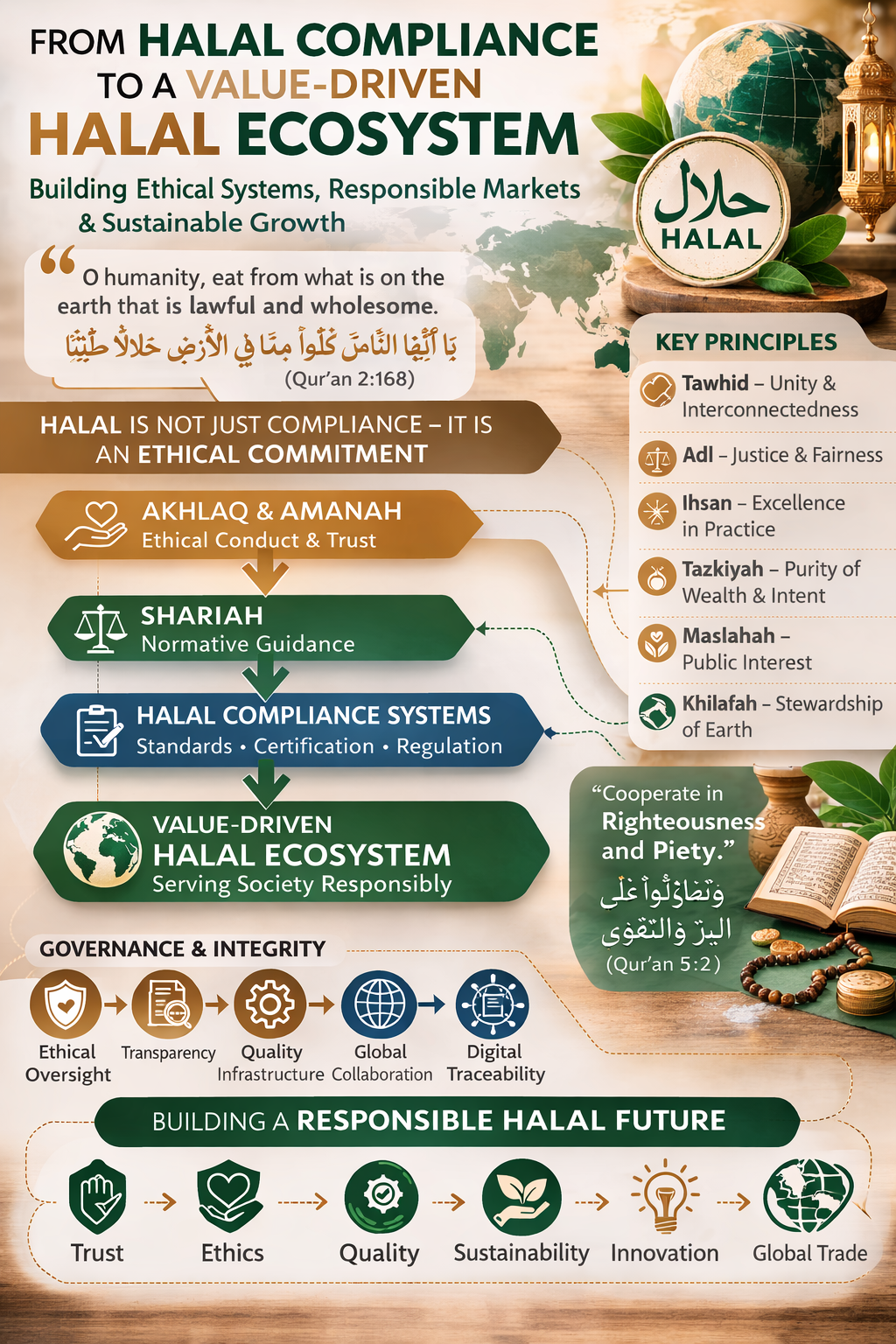
The phrase ḥalālan ṭayyiban highlights that Halal is not only about permissibility, but also about integrity, quality, and ethical responsibility. Understanding Halal in this broader context allows us to move beyond compliance toward the idea of a value-driven Halal ecosystem, where ethical values, normative guidance, and institutional mechanisms work together to serve society responsibly.
The Ethical Foundations of the Halal Ecosystem
At the foundation of any Halal ecosystem lies ethical conduct, known in Islam as Akhlaq (الأخلاق). Akhlaq refers to moral character and virtuous behavior in all aspects of life, including economic activity.
The Prophet Muhammad ﷺ emphasized the central role of ethics in human conduct when he said:
إِنَّمَا بُعِثْتُ لِأُتَمِّمَ مَكَارِمَ الْأَخْلَاقِ
Innamā buʿithtu li-utammima makārim al-akhlāq
“I was sent to perfect noble character.”
Closely linked to Akhlaq is the concept of Amanah (أمانة), which means trust, responsibility, and accountability. In Islamic thought, wealth, resources, and economic opportunities are viewed as trusts entrusted to human beings.
The Qur’an states:
إِنَّ اللَّهَ يَأْمُرُكُمْ أَنْ تُؤَدُّوا الْأَمَانَاتِ إِلَى أَهْلِهَا
Inna Allāha yaʾmurukum an tuʾaddū al-amānāti ilā ahlihā
“Indeed, Allah commands you to render trusts to whom they are due.”
(Qur’an 4:58)
Within a Halal ecosystem, Akhlaq and Amanah create the ethical culture that guides businesses, regulators, institutions, and consumers. Without these values, Halal certification risks becoming merely a procedural requirement rather than an authentic reflection of ethical responsibility.
Shariah as the Normative Framework
The second layer of the Halal ecosystem consists of Shariah (الشريعة), the normative framework that provides guidance on lawful and ethical conduct.
Shariah encompasses principles governing many aspects of economic life, including:
lawful food and consumption
commercial transactions
financial contracts
labor relations
consumer protection
environmental responsibility
A core value within Shariah is justice (عدل – ʿadl). Justice ensures fairness in economic exchange and protects the rights of all participants in the marketplace.
The Qur’an declares:
إِنَّ اللَّهَ يَأْمُرُ بِالْعَدْلِ وَالإِحْسَانِ
Inna Allāha yaʾmuru bil-ʿadli wal-iḥsān
“Indeed, Allah commands justice and excellence.”
(Qur’an 16:90)
This command applies directly to economic life. Islamic teachings strongly condemn deception, exploitation, and unfair practices in trade.
The Prophet ﷺ warned:
مَنْ غَشَّنَا فَلَيْسَ مِنَّا
Man ghashshanā falaysa minnā
“Whoever deceives us is not one of us.”
(Sahih Muslim)
Thus Shariah establishes normative principles that shape Halal systems, ensuring that economic activities reflect justice, transparency, and responsibility.
Halal Compliance Systems: Operational Mechanisms
The third layer of the Halal ecosystem consists of operational compliance systems. These mechanisms translate Shariah principles into procedures that can function within modern supply chains and global markets.
These systems typically include:
Halal standards
certification bodies
regulatory authorities
inspection and audit processes
supply chain traceability systems
Through these mechanisms, businesses demonstrate that their products and services comply with Halal requirements. Certification helps consumers make informed choices and strengthens confidence in Halal markets.
However, compliance mechanisms should not be mistaken for the entire Halal system. Rather, they represent the operational tools through which ethical and legal principles are implemented in practice.
When compliance systems operate without ethical foundations, they risk becoming bureaucratic processes detached from the values they are meant to uphold.
Governance and Integrity in the Halal Ecosystem
A robust Halal ecosystem requires governance structures that go beyond technical compliance. Ethical oversight, transparency, and institutional integrity are essential to maintaining trust.
Strong governance frameworks should incorporate:
Ethical oversight
Shariah advisory boards and scholars help ensure that Halal systems remain aligned with Islamic principles.
Transparent governance structures
Transparency strengthens public confidence and supports accountability within certification systems.
Systemic integrity
Safeguards against conflicts of interest and corruption help protect the credibility of Halal governance institutions.
The Qur’an encourages honesty and accountability in all dealings:
وَلَا تَكْتُمُوا الشَّهَادَةَ
Wa lā taktumu ash-shahādah
“Do not conceal testimony.”
(Qur’an 2:283)
This emphasis on transparency reflects the ethical expectations that should guide Halal governance systems.
Building a Responsible and Sustainable Halal Ecosystem
As the global Halal economy expands, Halal systems must evolve to address new challenges and opportunities. A value-driven Halal ecosystem requires cooperation between governments, scholars, industry leaders, and international organizations.
Key priorities include:
strengthening quality infrastructure and accreditation systems
encouraging global expert collaboration
developing responsible digital technologies for traceability
investing in education and competence development
improving risk monitoring and intelligence systems
facilitating international trade cooperation and market access
Islam encourages collaboration for the common good:
وَتَعَاوَنُوا عَلَى الْبِرِّ وَالتَّقْوَى
Wa taʿāwanū ʿala al-birri wat-taqwā
“Cooperate in righteousness and piety.”
(Qur’an 5:2)
This principle provides an important ethical foundation for global collaboration within the Halal ecosystem.
Conclusion
The Halal system should not be understood merely as a regulatory framework for certification and compliance. While standards and certification mechanisms are important, they represent only one dimension of a broader ethical ecosystem.
At its foundation lies Akhlaq and Amanah, which shape ethical conduct and institutional responsibility. Shariah provides the normative guidance that defines lawful and ethical economic behavior. Halal compliance systems then translate these principles into operational processes within modern markets and institutions.
When these elements function together, the Halal ecosystem becomes more than a system of rules. It becomes a values-based framework capable of promoting ethical governance, responsible markets, and social well-being.
Ultimately, Halal is not only about compliance.
It is about ensuring that ethical values are effectively translated into institutions, economic practices, and governance systems that serve society responsibly and contribute positively to the global community.
For full article, please read here:
Yours sister,
Dr. Thamina Anwar
CEO and Founder
Global Halal Shura Hub
please Join the Global Halal Shura Hub Community
📱 WhatsApp Community
👉 https://chat.whatsapp.com/CZJshg7AycWFJd3CyhSWj3
🌐 Website
https://globalhalalshurahub.com
📧 Email
thaminaanwar11@gmail.com; globalhalalshurahubsocialmedia@gmail.com
📘 Facebook
https://www.facebook.com/profile.php?id=61588247732733
https://www.facebook.com/profile.php?id=61588077462429
📷 Instagram
https://www.instagram.com/globalhalalshurahub/
🔗 LinkedIn
https://www.linkedin.com/in/dr-thamina-anwar-806124145/
https://www.linkedin.com/in/global-halal-shura-hub-dr-thamina-samina-anwar-05418b398/
📺 YouTube Channel
https://www.youtube.com/@GlobalHalalShuraHub