Governance of the Halal Supply Chain: Institutional Frameworks, Challenges, and Future Directions
The rapid growth of the global halal economy has intensified the need for robust governance mechanisms across halal supply chains. With the global Muslim population exceeding 1.9 billion and halal markets extending beyond food into sectors such as pharmaceuticals, cosmetics, logistics, and tourism, ensuring halal integrity throughout the supply chain has become a significant regulatory and operational concern. This article examines the governance of halal supply chains by exploring institutional frameworks, certification systems, regulatory challenges, and technological innovations. The paper analyses how governance structures function across multiple stakeholders including governments, certification bodies, industry actors, and consumers. It also highlights the challenges arising from fragmented standards, globalized supply networks, and risks of contamination or fraud. Finally, the article discusses emerging technological solutions such as blockchain and digital traceability systems that could enhance transparency and accountability in halal supply chains. The paper argues that stronger international coordination and standardized governance frameworks are essential to ensure the sustainability and credibility of the global halal industry.
1. Introduction
The global halal economy has experienced remarkable growth over the past two decades, driven primarily by the expanding Muslim population and increasing demand for halal-certified products across global markets. According to recent market reports, the halal food sector alone is valued at over USD 2 trillion and is expected to continue growing rapidly in the coming decades. Beyond food, halal markets now encompass sectors such as pharmaceuticals, cosmetics, finance, fashion, logistics, and tourism.
In this context, the governance of halal supply chains has become increasingly important. Halal governance refers to the institutional arrangements, regulatory frameworks, certification systems, and monitoring mechanisms that ensure compliance with Islamic dietary and ethical standards throughout the entire supply chain.
Unlike conventional supply chains, halal supply chains require strict adherence to religious principles derived from Islamic law (Shariah). This includes ensuring that products are free from prohibited substances (haram), that production processes follow halal requirements, and that halal products remain segregated from non-halal products throughout transportation, storage, and distribution.
However, the globalization of food production and trade has made halal governance increasingly complex. Products often pass through multiple countries, regulatory systems, and supply chain actors before reaching consumers. As a result, maintaining halal integrity throughout the supply chain requires coordinated governance mechanisms across different jurisdictions and institutions.
This paper examines the governance of halal supply chains by exploring institutional frameworks, certification systems, regulatory challenges, and technological innovations. The aim is to provide a comprehensive understanding of how governance structures shape halal supply chain integrity and what reforms may be necessary to strengthen the global halal industry.
2. Conceptualizing the Halal Supply Chain
The concept of the halal supply chain extends beyond the final product to encompass all processes involved in producing, handling, transporting, and distributing halal goods. Tieman (2011) defines a halal supply chain as a supply chain that ensures halal integrity from the source of raw materials to the point of consumption.
In a conventional supply chain, the primary objectives often revolve around efficiency, cost reduction, and customer satisfaction. In contrast, halal supply chains incorporate an additional dimension—religious compliance. This means that the supply chain must ensure not only product quality and safety but also adherence to Islamic principles.
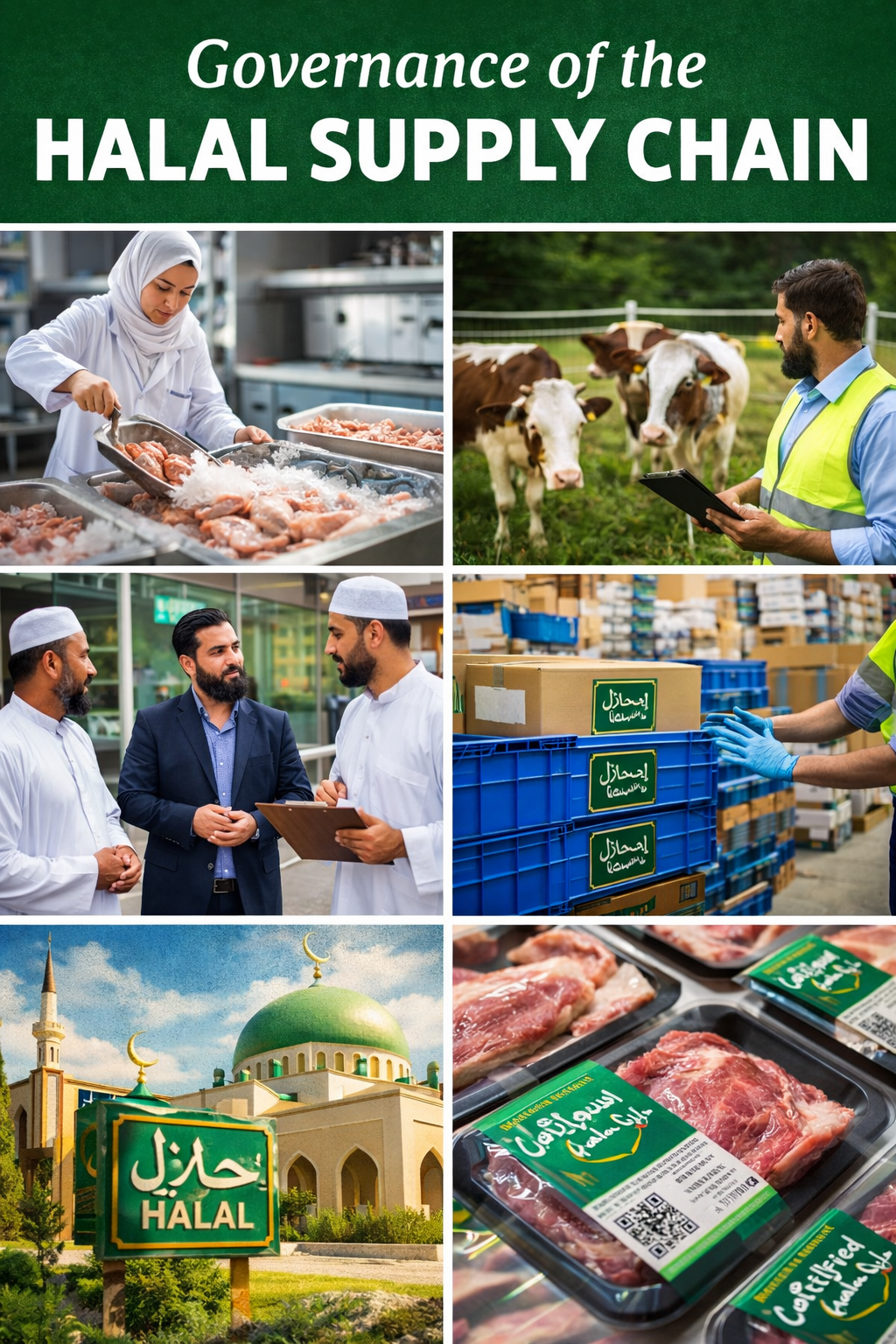
The halal supply chain can generally be divided into several key stages:
Raw material sourcing
Processing and manufacturing
Packaging and labeling
Storage and warehousing
Transportation and logistics
Retail and distribution
At each stage, governance mechanisms are required to prevent contamination with non-halal materials and to ensure compliance with halal standards.
Another important concept is halal integrity, which refers to maintaining the halal status of products throughout the entire supply chain. Any breach in halal integrity—such as cross-contamination with non-halal substances—can invalidate halal certification and undermine consumer trust.
3. Institutional Frameworks in Halal Supply Chain Governance
Governance of halal supply chains involves multiple institutional actors operating at national and international levels. These include governments, halal certification bodies, accreditation agencies, industry organizations, and religious authorities.
Government Regulators
In many countries, governments play a central role in regulating halal certification and ensuring compliance with halal standards. For example, Malaysia has developed one of the most comprehensive halal governance frameworks through institutions such as the Department of Islamic Development Malaysia (JAKIM) and the Halal Development Corporation (HDC).
Similarly, Indonesia introduced the Halal Product Assurance Law, which requires mandatory halal certification for many products sold within the country. The law established the Halal Product Assurance Organizing Agency (BPJPH), which oversees halal certification and compliance.
These regulatory frameworks aim to standardize halal certification processes and strengthen consumer protection.
Halal Certification Bodies
Halal certification bodies are responsible for auditing production facilities, verifying ingredients, and issuing halal certificates to compliant businesses. These organizations serve as intermediaries between religious authorities and commercial enterprises.
Certification bodies typically conduct several types of inspections, including:
Ingredient verification
Production facility audits
Supply chain monitoring
Periodic compliance reviews
Examples of well-known halal certification authorities include:
JAKIM (Malaysia)
MUIS (Singapore)
Halal Food Authority (United Kingdom)
Islamic Food and Nutrition Council of America (IFANCA)
However, the proliferation of certification bodies worldwide has also created governance challenges, particularly regarding mutual recognition of certifications across countries.
4. Halal Logistics and Supply Chain Integrity
Logistics plays a critical role in maintaining halal integrity throughout the supply chain. Halal logistics refers to the processes involved in transporting, storing, and handling halal products in ways that prevent contamination with non-halal goods.
Key principles of halal logistics include:
Physical segregation of halal and non-halal products
Dedicated transportation and storage facilities
Cleanliness and sanitation protocols
Halal-compliant packaging and labeling
For example, transportation vehicles that carry both halal and non-halal products may require strict cleaning procedures to avoid contamination.
Similarly, warehouses storing halal products must ensure that these products are kept separate from non-halal goods such as pork or alcohol-based items.
The development of halal logistics standards has been particularly advanced in Malaysia and the Gulf Cooperation Council (GCC) countries, where halal logistics certification programs have been introduced to strengthen supply chain governance.
5. Challenges in Halal Supply Chain Governance
Despite significant progress, several challenges continue to affect the governance of halal supply chains.
Fragmented Certification Standards
One of the most significant challenges is the lack of global standardization in halal certification. Different countries and certification bodies often apply different interpretations of halal requirements, leading to inconsistencies in certification processes.
For example, a product certified halal in one country may not necessarily be recognized as halal in another country due to differences in certification criteria.
Globalized Supply Chains
Modern food supply chains often involve complex international networks. Raw materials may originate in one country, be processed in another, and distributed through multiple markets.
This complexity makes it difficult to ensure consistent halal compliance throughout the supply chain.
Risk of Fraud and Mislabeling
Instances of halal fraud have occasionally been reported, where products are falsely labeled as halal without proper certification. Such incidents can significantly undermine consumer confidence in halal certification systems.
Cross-Contamination Risks
Shared facilities, transportation systems, and storage warehouses increase the risk of cross-contamination between halal and non-halal products.
Ensuring segregation in large-scale industrial supply chains remains a major governance challenge.
6. The Role of Technology in Halal Supply Chain Governance
Technological innovation is increasingly being used to strengthen governance mechanisms in halal supply chains.
Blockchain Technology
Blockchain systems can provide transparent and tamper-proof records of product movements throughout the supply chain. By recording transactions in decentralized digital ledgers, blockchain technology can enhance traceability and reduce the risk of fraud.
Internet of Things (IoT)
IoT sensors can monitor storage conditions, transportation routes, and product handling processes in real time. This helps ensure that halal products are handled according to established protocols.
Digital Halal Certification
Online certification platforms allow consumers to verify halal certification using QR codes or mobile applications. These systems increase transparency and help prevent counterfeit halal labels.
Artificial Intelligence
Artificial intelligence systems can analyze supply chain data to identify potential risks, detect anomalies, and improve compliance monitoring.
The integration of these technologies could significantly strengthen halal supply chain governance in the future.
7. Toward Global Harmonization of Halal Standards
Given the global nature of the halal market, many scholars and policymakers have emphasized the need for greater harmonization of halal standards across countries.
International organizations such as the Standards and Metrology Institute for Islamic Countries (SMIIC) and the Organization of Islamic Cooperation (OIC) have attempted to develop standardized halal guidelines.
Greater international cooperation could facilitate mutual recognition of halal certifications and reduce trade barriers in halal markets.
However, achieving full harmonization remains challenging due to differences in religious interpretations, national regulations, and commercial interests.
8. Conclusion
The governance of halal supply chains is essential for maintaining halal integrity, consumer trust, and the credibility of the global halal economy. As halal markets expand globally, governance mechanisms must evolve to address the increasing complexity of international supply networks.
This article has examined the institutional frameworks, certification systems, logistical requirements, and technological innovations that shape halal supply chain governance. While significant progress has been made in developing halal governance systems, challenges such as fragmented standards, globalized supply chains, and risks of contamination remain.
Future improvements in halal supply chain governance will likely depend on stronger international coordination, greater standardization of certification frameworks, and the integration of advanced digital technologies.
Ultimately, effective governance is critical to ensuring that halal products remain authentic, transparent, and compliant with Islamic principles from production to consumption.
Yours sister,
Dr. Thamina Anwar
CEO and Founder
Global Halal Shura Hub
please Join the Global Halal Shura Hub Community
📱 WhatsApp Community
👉 https://chat.whatsapp.com/CZJshg7AycWFJd3CyhSWj3
🌐 Website
https://globalhalalshurahub.com
📧 Email
thaminaanwar11@gmail.com; globalhalalshurahubsocialmedia@gmail.com
📘 Facebook
https://www.facebook.com/profile.php?id=61588247732733
https://www.facebook.com/profile.php?id=61588077462429
📷 Instagram
https://www.instagram.com/globalhalalshurahub/
🔗 LinkedIn
https://www.linkedin.com/in/dr-thamina-anwar-806124145/
https://www.linkedin.com/in/global-halal-shura-hub-dr-thamina-samina-anwar-05418b398/
📺 YouTube Channel
https://www.youtube.com/@GlobalHalalShuraHub