
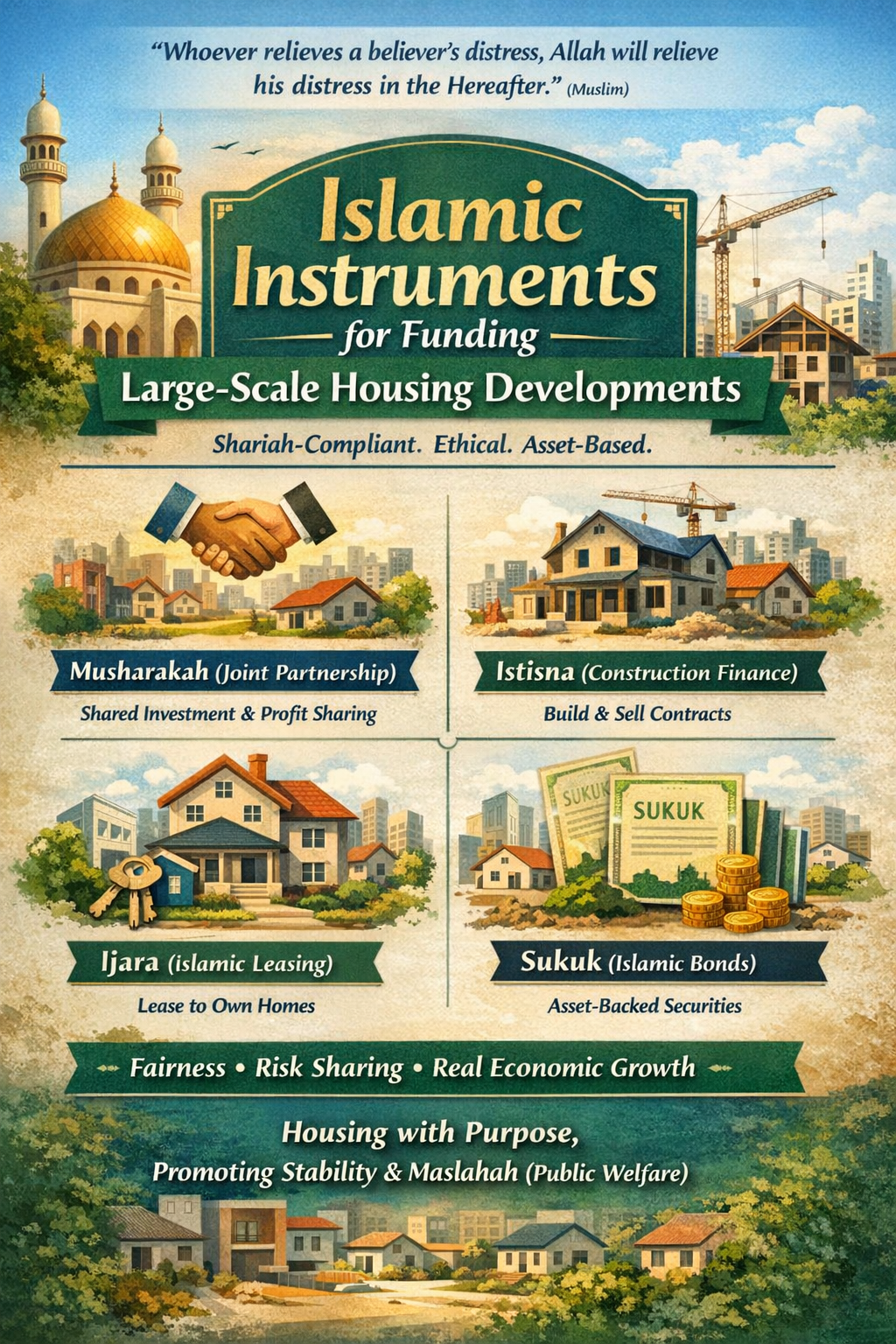
Islamic Instruments for Funding Large-Scale Housing Developments
Providing housing is not only an economic activity in Islam but also a social responsibility. Islam encourages the creation of stable communities where families can live with dignity and security. The Prophet Muhammad ﷺ said:
“Whoever relieves a believer’s distress of the distressful aspects of this world, Allah will rescue him from a difficulty of the difficulties of the Hereafter.” (Muslim)
Housing development therefore aligns with the broader Islamic objective of maslahah (public welfare). However, financing such projects must comply with Shariah principles, which prohibit riba (interest), excessive uncertainty (gharar), and unjust exploitation.
Islamic finance provides a comprehensive framework for funding large-scale housing developments without relying on interest-based systems. Through instruments such as Musharakah, Istisna, Ijara, Murabaha, and Sukuk, housing projects can be financed in ways that promote fairness, risk sharing, and real economic activity.
From an Islamic perspective, housing initiatives are not merely financial investments but contributions to the well-being of society, fulfilling the broader objectives of Shariah by promoting stability, justice, and human welfare.
The Ethical Foundation of Islamic Financing
Islamic economic principles are built on fairness, risk sharing, and real economic activity. Wealth should be generated through productive assets and trade, not through interest-based lending. In housing development, this means that financing must be connected to tangible assets such as land, construction materials, and completed homes.
The goal is not merely profit but the creation of balanced economic growth and social stability.
Key Islamic Financing Instruments for Housing Development
Musharakah (Partnership Financing)
One of the most fundamental Islamic financing models is Musharakah, a partnership where two or more parties contribute capital to a project.
In a housing development context, a developer and an Islamic financial institution may jointly fund the project. The developer may contribute land, expertise, and management, while the financial partner provides capital.
Profits from the sale or rental of housing units are shared according to an agreed ratio, while losses are shared in proportion to the capital invested. This arrangement embodies the Islamic principle of shared risk and shared reward.
A common form used in real estate is Diminishing Musharakah, where one partner gradually buys out the other’s share over time.
Istisna (Construction Financing)
Istisna is particularly suitable for large-scale housing projects because it is designed for manufacturing or construction contracts.
In this structure, an Islamic bank or investor commissions a developer to build housing units according to agreed specifications. Payment can be made in stages during construction. Once the project is completed, the bank may sell the houses to buyers or lease them through other Islamic financing contracts.
Istisna reflects the Islamic principle that financing should be tied to real production and asset creation.
Ijara (Lease Financing)
Ijara is an Islamic leasing contract where an institution purchases an asset and leases it to another party.
For housing developments, the financial institution may own the property and lease it to occupants. The residents make periodic lease payments, and ownership may eventually transfer to them under a structure known as Ijara wa Iqtina (lease-to-own).
This model is widely used in Islamic home financing because it replaces interest payments with rent derived from a real asset.
Murabaha (Cost-Plus Financing)
Murabaha is a trade-based contract where a financier purchases goods and sells them to a buyer at a disclosed markup.
In housing development, Murabaha is often used to finance construction materials, equipment, or infrastructure. The Islamic bank buys these items and sells them to the developer at an agreed price payable over time.
Unlike conventional loans, Murabaha transactions are based on actual trade rather than lending money with interest.
Sukuk (Islamic Bonds)
For very large housing developments, capital may be raised through Sukuk, often referred to as Islamic investment certificates.
Unlike conventional bonds, Sukuk represent ownership in underlying assets or projects. Investors earn returns from the revenue generated by the housing project, such as rental income or property sales.
Different Sukuk structures can be used in housing development, including:
Sukuk al-Ijara (lease-based)
Sukuk al-Istisna (construction-based)
Sukuk al-Musharakah (partnership-based)
Sukuk enable governments and developers to mobilize large pools of capital while remaining within Shariah guidelines.
Integrating Islamic Instruments in Housing Projects
Large housing developments often combine several Islamic financing structures to create a complete funding model.
For example:
Land acquisition: Musharakah partnership
Construction financing: Istisna contract
Material procurement: Murabaha financing
End-buyer housing finance: Ijara or Diminishing Musharakah
Capital market funding: Sukuk issuance
This layered approach ensures that every stage of the project remains Shariah-compliant and asset-based.
Housing as a Social Responsibility in Islam
Islamic finance does not view housing solely as a commercial venture. It is also linked to social justice and human dignity. Providing affordable and accessible housing helps strengthen families and communities.
Governments and Islamic financial institutions are therefore encouraged to support housing initiatives that serve low-income families, growing populations, and urban development while maintaining ethical financial practices.
Yours sister,
Dr. Thamina Anwar
CEO and Founder
Global Halal Shura Hub
please Join the Global Halal Shura Hub Community
📱 WhatsApp Community
👉 https://chat.whatsapp.com/CZJshg7AycWFJd3CyhSWj3
🌐 Website
https://globalhalalshurahub.com
📧 Email
thaminaanwar11@gmail.com; globalhalalshurahubsocialmedia@gmail.com
📘 Facebook
https://www.facebook.com/profile.php?id=61588247732733
https://www.facebook.com/profile.php?id=61588077462429
📷 Instagram
https://www.instagram.com/globalhalalshurahub/
🔗 LinkedIn
https://www.linkedin.com/in/dr-thamina-anwar-806124145/
https://www.linkedin.com/in/global-halal-shura-hub-dr-thamina-samina-anwar-05418b398/
📺 YouTube Channel
https://www.youtube.com/@GlobalHalalShuraHub