
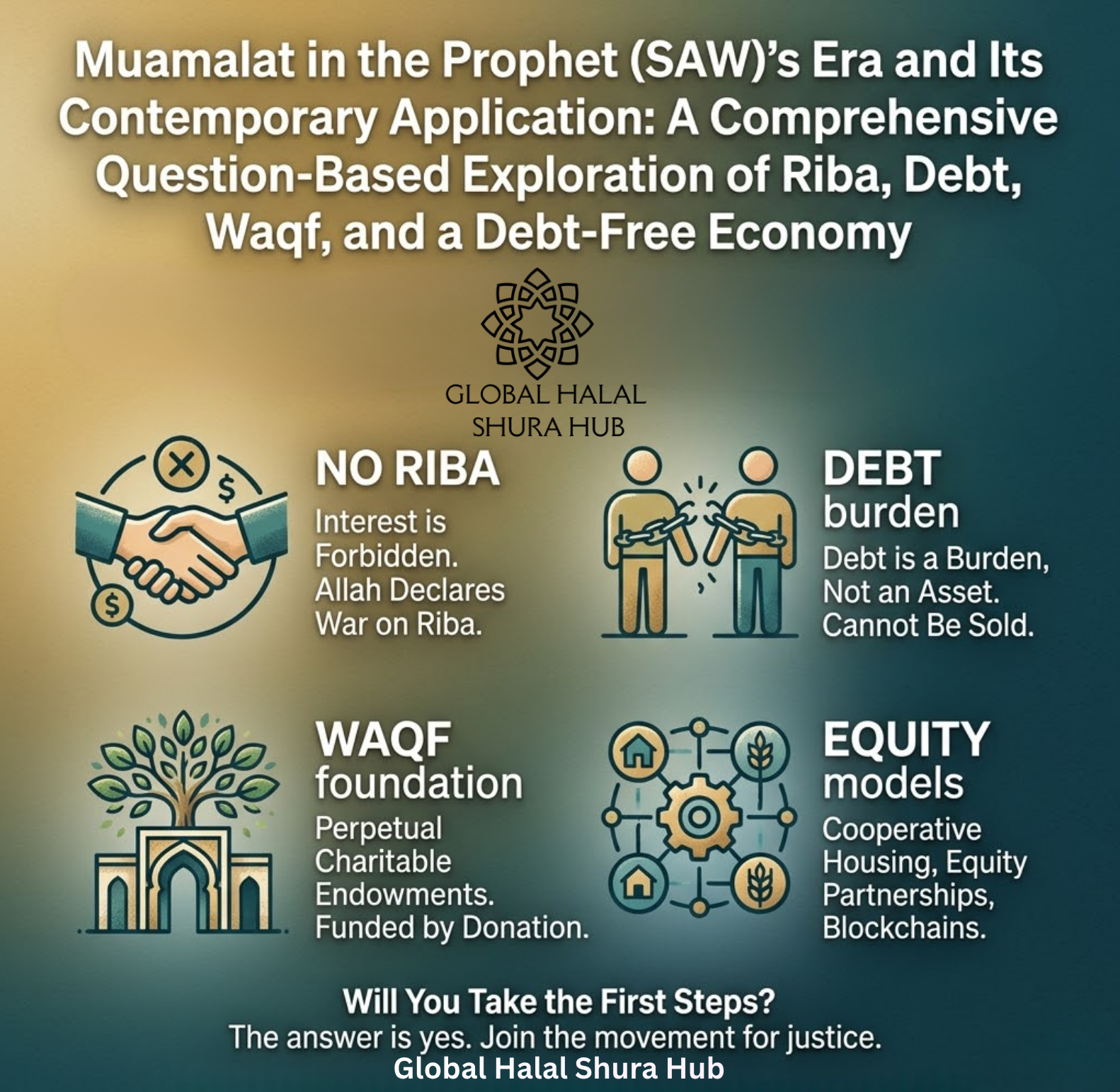
Muamalat in the Prophet (SAW)’s Era and Its Contemporary Application: A Comprehensive Question-Based Exploration of Riba, Debt, Waqf, and a Debt-Free Economy
This article is dedicated to the memory of the Prophet Muhammad (SAW), who taught us that the best of people are those most beneficial to others, and who showed that a just economy is possible without riba, without debt trading, and without banks. And to every person who has ever asked: “Is there another way?” The answer, from the 7th century to the blockchain, is yes.
Abstract
What would an economy look like if debt could never be sold, if interest was not just discouraged but forbidden as an act of war against Allah (SWT), and if the most powerful institution was a perpetual charitable endowment? This article poses these and dozens of other questions as it examines muamalat—the Islamic law of human transactions—from the Prophet Muhammad (SAW)’s time to today. It reconstructs the commercial and social institutions of 7th‑century Medina, focusing on the absolute prohibition of riba (usury/interest), the treatment of debt as a personal burden (not a tradable asset), and the establishment of waqf (endowment) as a vehicle for perpetual charity. The article then asks: can we revive these principles today without commercial banks, without selling debt, and without interest? It answers affirmatively, presenting detailed models for cooperative housing, equity partnerships, tokenized waqf, blockchain muḍārabah, and community‑based agriculture. By constantly interrogating assumptions—What is riba really? Why can’t we sell a debt? How does waqf avoid the debt trap?—this article reclaims prophetic muamalat as a living, questioning, and transformative tradition. The discussion spans classical contracts (bayʻ, salam, ijarah, mushārakah, muḍārabah), the detailed jurisprudence of riba, the prohibition of selling debt (bayʻ al‑dayn), the revival of waqf for public goods, and emerging digital applications such as tokenized waqf and smart contract partnerships. The article deliberately excludes any reference to commercial banking, Islamic or otherwise, because the prophetic model was a community‑based, equity‑driven system, not a banking system.
1. Introduction: Why Ask Questions About Muamalat?
Let us begin with a question. Why does the Qur’an declare war on those who practice riba (Q. 2:279), but permit trade as a noble activity? What is it about a predetermined increase on a loan that makes it more dangerous than outright theft or even idolatry? And if riba is so severe, why do so many Muslims today engage in interest‑based transactions without a second thought? These are not merely academic queries. They cut to the heart of how we organize our economies, our families, and our souls.
This article is built on questions—dozens of them. Each section will pose a central question and then answer it through the Qur’an, the Sunnah, classical jurisprudence, and contemporary application. The reason for this interrogative method is simple: muamalat was never meant to be a set of dead rules memorized in a classroom. It was meant to be a living inquiry into justice, risk, and mutual responsibility. The Prophet (SAW) himself constantly asked his companions: “Do you know what riba is?” and then explained it. He asked the poor man who came begging: “Do you have an axe?” He asked the community: “Who will guarantee this debt?” So the author will follow his method.
The scope of this article is broad but focused. We will explore:
-
What muamalat meant in the Prophet (SAW)’s time and how it was practiced.
-
What riba is, why it is prohibited, and how it relates to debt.
-
Why debt in Islamic law is a burden, not an asset, and why selling debt is forbidden.
-
How waqf emerged as a debt‑free, perpetual institution for public good.
-
Whether these principles can be applied today without banks, without interest, and without securitizing obligations.
The article deliberately excludes any reference to commercial banking, Islamic or otherwise, because the prophetic model was a community‑based, equity‑driven system. Can we reimagine finance without banks? That is the overarching question.
2. Defining Muamalat: What Makes Human Transactions “Islamic”?
2.1 What Is Muamalat, and Why Does It Matter?
Let us start with a basic question: What distinguishes a mere contract from a muamalat that pleases Allah (SWT)? The word comes from the Arabic root ʻ‑m‑l, meaning action or dealing. In Islamic jurisprudence, fiqh al‑muamalat governs all bilateral transactions—sales, leases, partnerships, loans, guarantees, endowments—as opposed to ʻibadat (ritual worship). But why this division? Because acts of worship are fixed: you cannot invent a new prayer. But human transactions are adaptable: what was permissible in 7th‑century Mekkah may need reinterpretation in 21st‑century Tokyo. The great juristic maxim says: al‑aṣl fī al‑muʻāmalāt al‑ibāḥah — the fundamental presumption is permissibility, unless a clear text forbids something.
This leads to a crucial question: If permissibility is the default, why are so many modern transactions considered forbidden? Because they violate explicit prohibitions: riba (interest), gharar (excessive uncertainty), maysir (gambling), hoarding, fraud, and the selling of debt. So the framework is permissive, but the red lines are few and absolute.
2.2 The Distinction Between Debt and Trade
A foundational misunderstanding in many modern discussions is the conflation of “Islamic finance” with “interest‑free banking.” In truth, the prophetic sunnah draws a sharp line between trade (bayʻ) and debt (dayn). Trade involves the exchange of existing goods or services for a price, with immediate or deferred payment. Debt arises when a person owes a sum of money or a specific commodity. While deferred payment in a sale is permissible (that is a debt owed to the seller), that debt cannot be sold to a third party at a discount or premium. The Prophet (SAW) explicitly forbade bayʻ al‑dayn bi al‑dayn (selling debt for debt) and bayʻ al‑kalīʼ bil‑kalīʼ (sale of debt for debt). The prohibition of ribā al‑nasiʼah also makes any guaranteed increase on a loan unlawful, but even more fundamentally, Islamic law rejects the commodification of debt obligations. Thus, a cornerstone of authentic muamalat is that debt is a burden, not an asset. It cannot be traded, securitized, or used as a medium of speculation. This principle alone dismantles the entire edifice of conventional bond markets, collateralized debt obligations, and much of modern banking.
2.3 The Three Great Prohibitions: Riba, Gharar, Maysir
Question: Is riba just “interest,” or is it something deeper? Let us examine.
Riba – The Qur’an states: “Those who consume riba will not stand except as one whom Satan has touched with madness” (Q. 2:275). Then: “Allah has permitted trade and forbidden riba” (2:275). Then: “If you do not give up riba, then be informed of a war from Allah and His Messenger” (2:279). War? Over a financial transaction? Yes. Because riba is not a technical error; it is a systemic injustice that concentrates wealth, transfers risk unfairly, and destroys social solidarity. Classical jurists defined two types:
-
Ribā al‑nasiʼah – a predetermined increase on a loan or deferred exchange of monetary commodities. This is modern interest.
-
Ribā al‑faḍl – unequal exchange of the same commodity (e.g., 1 kg of gold for 2 kg of gold). This closes the door to any backdoor interest.
Question: Why is ribā al‑faḍl prohibited if there is no time delay? Because the Prophet (SAW) wanted to block every possible path to usury. If unequal exchange of gold were allowed, someone could say, “Give me 1 kg of gold today, and I will give you 2 kg of gold tomorrow” — that is interest disguised as a commodity exchange. By forbidding even spot unequal exchange, Islamic law forces all exchanges to be fair and immediate when the commodity is the same.
Gharar – Excessive uncertainty. The Prophet (SAW) forbade selling “what you do not have” and “the fish in the water.” Question: Is all uncertainty forbidden? No. Minor uncertainty inherent in any business (e.g., whether a customer will buy) is tolerated. But selling a debt owed by an unknown debtor is gharar because you don’t know if you will be paid.
Maysir – Gambling. Question: Is speculation in the stock market maysir? It depends. If you buy shares in a company hoping for profit based on its performance, that is risk‑sharing. If you buy a derivative that expires worthless unless a specific event occurs, that is gambling. The line is fine but the principle is clear: any zero‑sum game where wealth is created from luck rather than productive work is maysir.
2.4 The Principle of Mutual Consent
Question: Can a contract be valid if both parties agree but one is exploited? The Qur’an says: “Do not consume one another’s wealth unjustly, but only in trade by mutual consent” (4:29). Mutual consent is necessary but not sufficient. A consent extracted from a desperate person (e.g., a poor man forced to borrow at usury) is not truly free. This is why Islamic law invalidates ghabn fāḥish (gross exploitation) even if the victim agreed. So we must ask: Does our modern economy ever produce “consent” that is really coercion?
2.5 The Primacy of Asset‑Backed Transactions
Every legitimate contract in muamalat must have an identifiable, existing (or at least specifically described and deliverable) asset or service at its core. Whether it is a sale (bayʻ), lease (ijarah), partnership (mushārakah), or reward contract (juʻālah), there is no “money for more money” without an intermediate productive or usufruct‑based activity. This asset‑backed nature is what distinguishes trade from riba. A fourth, often overlooked prohibition is relevant here: bayʻ al‑ʻīnah (a sale that is functionally a loan with interest, often involving a buy‑back arrangement). The Prophet (SAW) cursed the parties involved in ʻīnah transactions because they circumvent the spirit of the law while maintaining formal compliance. Similarly, tawarruq (monetization of a commodity through a sale to a third party) has been heavily criticized by many classical and contemporary scholars as a subterfuge to obtain cash with a predetermined mark‑up — effectively disguised debt. A true muamalat system avoids all such debt‑generating structures.
3. Muamalat During the Prophet (SAW)’s Era (610–632 CE)
3.1 What Was the Economic Reality of Pre‑Islamic Arabia?
Question: Was pre‑Islamic Arabia a primitive barter economy? Not at all. Mekkah was a sophisticated trading hub, with caravans to Syria, Yemen, and Ethiopia. The Quraysh used money (gold, silver, and later coins). They had credit, debt, and even a rudimentary exchange system (the ṣayārifah or money changers). But they also had ribā al‑jāhiliyyah – when a debt was due, the creditor would say “pay or increase” – the deferred amount doubled. This led to debt slavery and extreme inequality. Question: Could this happen today? Absolutely. Payday loans, credit card late fees, and predatory lending are its modern equivalents.
3.2 How Did the Prophet (SAW) Himself Engage in Commerce?
Question: Was the Prophet (SAW) an experienced businessman? Yes. Before prophethood, Muhammad (SAW) worked as a trader for Khadījah, managing caravans to Syria. He refused to take interest, gave fair measure, and was known as al‑Amīn (the Trustworthy). His commercial acumen meant his reforms were practical, not utopian. Question: Why is this important? Because sometimes religious people think commerce is dirty. The Prophet (SAW) showed that trade can be an act of worship when done honestly.
3.3 The Constitution of Medina: A Charter for Debt‑Free Commerce
In 622 CE, the Prophet (SAW) established the Constitution of Medina, which, among other things, created a unified legal framework for trade. It recognized the inviolability of property, prohibited the hoarding of food, and established a system of mutual responsibility. Importantly, it did not create any institution for interest‑bearing loans or debt trading. Instead, it encouraged direct exchange and mutual aid. Question: Can a modern state have such a pluralistic yet riba‑free economy? Possibly, if the state provides a legal framework for contracts without enforcing interest.
3.4 The Medina Market: What Questions Did It Answer?
When the Prophet (SAW) migrated to Medina, he faced a fragmented market – each tribe had its own market. Question: How do you create a fair market from scratch? He ordered all traders to move to a single central market near the mosque. He appointed inspectors (muḥtasib) to enforce honest weights, measures, and fair pricing. He prohibited:
-
Iḥtikār (hoarding) – Question: Is storing grain for future sale hoarding? Only if it is essential food and you withhold it to drive up prices. Normal storage for price stability is allowed.
-
Najash – fake bidding. Question: Is online auction sniping najash? Possibly, if it’s deceptive. The principle is transparency.
-
Talqī al‑rukbān – intercepting caravans before they reach the market. Question: Why is that bad? Because it deprives local residents of fair prices. It’s a form of information asymmetry.
The Medina market did not have a bank, did not charge interest, and did not trade debts. Question: Could a modern city run its main market without debt? Yes, many farmers’ markets and bazaars still operate on cash and spot trade.
3.5 The Prohibited Transactions: Asking “Why?”
The Prophet (SAW) forbade specific sales:
-
Muzābanah – selling fresh dates on the tree for dried dates by estimate. Question: Why? Because the exact measure is unknown (gharar).
-
Muḥāqalah – selling unharvested crops for harvested wheat. Question: Isn’t that futures trading? Yes, and futures contracts are controversial. Salam (forward sale) is allowed only if the commodity is fully described and price prepaid.
-
Bayʻ al‑gharar – any sale with excessive uncertainty.
But he allowed ʻarāyā – a concession where fresh dates could be sold for dried dates in small amounts for household consumption. Question: Why this exception? Because poor families needed fresh dates and couldn’t wait for the trees to ripen. The concession recognizes human need without abandoning the principle.
3.6 The Prophet (SAW)’s Stance on Debt and Its Repayment
The Prophet (SAW) emphasized the seriousness of debt. He said: “The soul of a believer is suspended due to his debt until it is paid off for him.” He refused to perform funeral prayer for a man who died with unpaid debt until another person agreed to pay it. At the same time, he encouraged lenders to be lenient and to forgive debts. He said: “There was a merchant who used to lend to people. If he saw a poor person, he would tell his servants: ‘Let him off, perhaps Allah will let us off.’ So Allah let him off.” Question: Why so severe? Because unpaid debt harms the creditor. The debtor has a moral and legal obligation to repay. However, if the debtor is genuinely unable, the creditor is urged to forgive or reschedule without extra charges.
Question: Can a debtor be imprisoned? Classical law allowed imprisonment for a solvent debtor who refuses to pay (as a coercive measure), but not for an insolvent one. The Qur’an says: “If someone is in hardship, then let there be postponement until ease” (2:280). Question: How different is that from modern bankruptcy laws? Quite similar, except modern bankruptcy often discharges debt entirely, which classical law generally did not allow except by the creditor’s forgiveness.
3.7 The Birth of Waqf: The Prophet (SAW)’s Enduring Charity
Among the most profound institutional innovations of the Prophet (SAW)’s era — one that explicitly avoids any debt or interest — is the waqf. Although the formal legal structure was elaborated later, the prophetic practice of endowing assets for perpetual public benefit began in his lifetime. The most famous example is the endowment of the orchard of Mikhraf by the Companion ʻUmar ibn al‑Khaṭṭāb. When ʻUmar acquired land in Khaybar, he asked the Prophet (SAW): “O Messenger of Allah, I have acquired land that I have never acquired more precious. What do you command me with it?” The Prophet (SAW) replied: “If you wish, you may give the land itself as a ḥabs (endowment) and give its produce in charity, not selling the land itself, not giving it as a gift, and not inheriting it.” ʻUmar then endowed the land to feed the poor, relatives, slaves, travelers, and guests, with the administrator allowed to eat from it “in a reasonable manner.” This became the model for countless waqfs that supported mosques, schools, hospitals, and public fountains for centuries.
Other early waqfs include the well of Rumah (purchased by ʻUthmān and endowed for public use), and the endowments of the Prophet (SAW)’s wives who donated their properties for the poor. Waqf is inherently debt‑free: it is funded by donation, not loans. Its perpetual nature creates a steady stream of charitable income without any interest‑bearing instrument. This is a direct alternative to modern debt‑financed public works. Question: What is the difference between ordinary charity (sadaqah) and waqf? Charity is consumed. Waqf is an endowment – the principal is frozen, the usufruct is spent. The famous hadith: “When a son of Adam dies, his deeds cease except three: ongoing charity (ṣadaqah jāriyah), beneficial knowledge, or a righteous child who prays for him.” Waqf is the classic example of ṣadaqah jāriyah – a charity that keeps giving forever.
3.8 Charity, Agency, and Inclusion: What Would the Prophet (SAW) Ask the Poor?
Here is a powerful story. A man came to the Prophet (SAW) begging. The Prophet (SAW) asked: “Do you have an axe?” The man said yes. The Prophet (SAW) said: “Then chop wood and sell it.” Another man came, weak and without tools. The Prophet (SAW) asked: “Do you have family?” He said yes. The Prophet (SAW) said: “Then ask them to help you start a small business selling cheese.” Question: What does this teach us about poverty relief? That charity should enable agency, not create dependency. The Prophet (SAW) did not just give money; he gave a means of earning. This is a profound question for modern welfare systems: Are we treating the poor as passive recipients or as entrepreneurs?
3.9 The Prophet (SAW) ’s Final Sermon: A Lasting Prohibition of Riba
In his Farewell Sermon (632 CE), the Prophet (SAW) declared: “Every amount of riba owed from the time of jāhiliyyah is annulled. The first riba I annul is our own riba—that of ‘Abbās ibn ‘Abd al‑Muttalib—it is all annulled.” This was a powerful statement: even his own uncle’s interest claims were voided. He then commanded: “Do not wrong and you will not be wronged.” The prohibition of riba was thus sealed as a permanent cornerstone of Islamic economy.
4. Classical Muamalat Contracts: Debt‑Free Structures
Building on the prophetic foundations, Muslim jurists developed a rich taxonomy of contracts. Each contract avoids riba and the selling of debt, instead relying on asset exchange, leasing, partnership, or gratuitous loans.
4.1 Sales Contracts (Bayʻ, Salam, Istisnāʻ)
-
Bayʻ (General Sale) – Exchange of a commodity for a price. The commodity must exist, be owned, deliverable, and of known value. A deferred payment sale (bayʻ bi thaman muʼajjal) is permitted, but the debt created cannot be sold.
-
Salam (Forward Sale) – Full payment upfront for goods to be delivered later. The Prophet (SAW) permitted salam to help farmers and traders, with conditions: the commodity is precisely described, delivery date fixed, and price paid immediately. Salam is a sale, not a loan. The purchaser cannot sell the salam obligation before taking delivery, because that would be selling a debt.
-
Istisnāʻ (Manufacturing Contract) – Contract for manufacturing a specific good (e.g., a ship, custom machinery). Price may be paid in installments, but it remains a sale of a future asset. The manufacturer uses payments to produce. No interest is involved.
-
-
4.2 Partnership Contracts (Muḍārabah and Mushārakah)
-
-
-
These are the ideal debt‑free financing structures.
-
Muḍārabah – Capital provider (rabb al‑māl) gives funds to an entrepreneur (muḍārib) to invest in a venture. Profits shared by pre‑agreed ratio; losses borne solely by capital provider (unless negligence). No guaranteed return. The capital is equity, not debt. The entrepreneur’s labor is the contribution. This contract is pure risk‑sharing.
-
Mushārakah – Two or more parties contribute capital to a joint enterprise. Profits shared as agreed; losses in proportion to capital. This can be permanent or diminishing (where one partner buys out the other over time). Diminishing mushārakah is often used for housing: the house is co‑owned by the resident and a partner; the resident pays rent on the partner’s share while gradually purchasing it. The rent is not interest; it is a lease payment for use of an asset that the partner still owns.
Both contracts create no debt. They involve equity ownership, not loans.
4.3 Lease and Service Contracts (Ijarah, Juʻālah, Wakālah)
-
Ijarah – Transfer of usufruct of an asset for a specified rent. The lessor owns the asset, bears its risks, and receives rental income. This is not a loan; it is a service contract. The lessee pays rent, not interest.
-
Juʻālah – Unilateral promise to pay a reward to anyone who performs a specified service (e.g., finding a lost camel). The performer need not be known at the outset. This is flexible and debt‑free.
-
Wakālah – Agency contract. The agent acts on behalf of the principal. The agent may charge a fee, but the fee is for service, not interest.
4.4 Qarḍ Ḥasan: The Benevolent Loan
The qarḍ ḥasan (beautiful loan) is a gratuitous loan extended without any profit or benefit to the lender. The lender expects only the return of principal. This is a recommended act of charity, not a commercial transaction. The Prophet (SAW) said: “Whoever gives a loan to a Muslim twice, it is like giving charity once.” Qarḍ ḥasan cannot be sold or transferred for profit. It is a personal obligation that can be forgiven. Community‑based rotating savings and credit associations (ROSCAs) can operate on this principle, as long as no extra payment is demanded.
4.5 Waqf: The Perpetual Endowment (Detailed)
4.5.1 Definition and Conditions
Waqf (also called ḥabs or taḥbīs) is the permanent dedication of a property for charitable or pious purposes. The donor (wāqif) relinquishes ownership and the property becomes inalienable. The usufruct (income or produce) is used for the beneficiaries. Classical conditions:
-
The donor must be of sound mind and ownership.
-
The asset must be valuable, legally owned, and capable of being perpetually used.
-
The purpose must be lawful and beneficial.
-
The waqf must be declared clearly, often in writing.
4.5.2 Types of Waqf
-
Waqf khayrī (public) – Benefit to the general public, e.g., mosques, hospitals, roads.
-
Waqf dhurrī (family) – First benefit to the donor’s descendants, then to charity. This was common and legally accepted by most schools, though some prefer pure charity.
4.5.3 Historical Role
Waqfs funded education for centuries. Al‑Azhar University in Cairo, the Qarawiyyin in Fez, and many madrasas were waqf‑supported. The income came from rents on shops, agricultural land, or baths. There was no debt, no interest, no government bailout. The system was decentralized but durable. In the Ottoman Empire, the majority of urban real estate was held as waqf.
4.5.4 How Does Waqf Avoid Debt and Riba?
Question: Can a waqf take out a loan? Classical jurists generally prohibited waqf from incurring debt because the waqf asset is inalienable and cannot be used as collateral in a way that would risk its sale. Some scholars allow temporary borrowing for maintenance if repaid, but without interest. Question: How does a waqf fund its activities? From the income of its endowed assets – rent, agricultural produce, dividends. If more capital is needed, additional donors can create a new waqf or contribute to a cash waqf.
Question: What is cash waqf? Instead of endowing land, you endow money. The cash is invested (in Shariah‑compliant, debt‑free ventures) and the profit is spent. This was historically practiced by Ottoman cash waqfs (they lent money without interest to artisans – i.e., qarḍ ḥasan – and used service fees to cover administration). Question: Is cash waqf permissible? Yes, according to the Hanafi and later scholars. It has been revived in Malaysia and Turkey.
5. The Prohibition of Selling Debt (Bayʻ al‑Dayn): A Detailed Analysis
5.1 Definition and Scope
Selling debt (bayʻ al‑dayn) means transferring a debt obligation from the original creditor to a third party in exchange for a price. The price may be equal to the face value, less (discount), or more (premium). In modern finance, this is called debt trading, factoring, or securitization. Islamic law prohibits almost all forms of selling debt to an outsider. Question: What is bayʻ al‑dayn in simple terms? Example: Ali owes Bilal $100. Bilal sells this $100 debt to Chuloo for $90 cash. Bilal gets $90 now, Chuloo will collect $100 from Ali later. Why is this forbidden? Several reasons:
-
Riba – $90 cash for $100 of future cash is riba al‑nasiʼah (time‑based interest).
-
Gharar – Ali might not pay. Chuloo is gambling.
-
The hadith – The Prophet (SAW) forbade “selling what you do not have.” Until Ali pays, Bilal does not possess the $100.
-
Exploitation – The discount often exploits the original creditor’s need for immediate cash.
-
5.2 Evidences from Qur’an and Sunnah
While the Qur’an does not explicitly say “do not sell debt,” the prohibition is derived from several principles:
-
Riba – Selling a debt for less than its face value is the exchange of money for money with an excess, which is riba al‑nasiʼah. Selling it for more is also riba. Selling it for exactly face value yields no benefit, so it is pointless.
-
Gharar – The debtor’s ability to pay is uncertain. The third party buyer assumes risk that cannot be quantified. The Prophet (SAW) forbade the sale of “what is not present” and “the fish in the water.”
-
The hadith on prohibition of selling debt for debt – The Prophet (SAW) explicitly forbade bayʻ al‑kalīʼ bil‑kalīʼ (sale of a debt for a debt). This covers exchanging one deferred obligation for another.
-
The hadith: “Do not sell what you do not have.” – A debt is an intangible right. Until the debtor pays, the creditor does not possess the money. Selling a debt before collection is selling what you do not physically possess.
5.3 Juristic Positions
-
Hanafi school: Sale of a debt to a third party is invalid if the debt is not in the form of a tangible asset. If the debt is secured by a pledge, some allowed it, but the majority held it as unlawful because of riba and gharar.
-
Maliki school: Absolutely prohibits selling a debt owed by an absent or unknown person. Only a debt that is secured by a tangible asset and the debtor agrees may be transferred via ḥiwālah, not a sale.
-
Shafiʻi school: Forbids the sale of a debt unless it is part of a ḥiwālah where the new creditor takes the debt at face value and the debtor consents.
-
Hanbali school: Similar to Shafiʻi: only assignment (ḥiwālah) is permitted, not a sale for profit.
The author strongly condemn the securitization of debt (e.g., conventional bonds, discounted bills of exchange) as a violation of the Shariah.
5.4 Exception: Ḥiwālah (Assignment)
Ḥiwālah is a contract where a debtor transfers his debt to a third party (the muḥāl ʻalayh) who then becomes the new debtor. The original creditor accepts the transfer. This is not a sale; it is a substitution of debtors. The amount remains the same, and there is no discount or premium. The new debtor must have the ability to pay. Ḥiwālah is permitted because it is a service to facilitate payment, not a profit‑making transaction.
Question: Can a debt be used as collateral? Yes, rahn (pledge). Ali can give an asset as security for the debt. But he cannot sell the debt itself.
5.5 Contemporary Violations to Avoid
-
Factoring: Selling company invoices to a factor at a discount. This is clear riba and selling debt.
-
Secondary bond market: Bonds represent debt; trading them at a discount is riba.
-
Securitization of mortgages: A bundle of home loans sold as securities involves selling debt.
-
“Islamic” bonds (sukūk) that represent pure receivables: Some sukūk structures have been criticized because they involve selling of debt. Only asset‑based sukūk (where the sukuk holder owns a pro‑rata share of a tangible asset) are permissible.
5.6 Why This Matters Today
The global economy runs on debt trading. Central banks buy government bonds (debt). Corporations issue commercial paper (debt). Hedge funds trade credit default swaps (derivatives on debt). All of this is incompatible with muamalat. A genuine Islamic economy would have to replace these instruments with equity financing, direct leasing, and partnerships. That might seem impossible, but the historical Islamic economy functioned without them for over a thousand years. The challenge is rebuilding such a system from the ground up.
Question: So can a company ever issue a tradable security? Yes, if it issues equity shares (ownership in the company). Those can be traded because they represent ownership of assets and profits, not debt. But share trading must avoid gharar (e.g., short selling) and riba (e.g., margin borrowing).
5.7 Positive Alternative: Equity and Trade
Instead of selling debt, Islamic law encourages the conversion of debt into equity through ṣulḥ (compromise) or mushārakah. If a debtor cannot repay, the creditor can become a partner in the debtor’s business, sharing profits and losses. This transforms a problematic debt into a productive risk‑sharing relationship. It is a far more just outcome than selling the debt to a collection agency or speculator.
6. Waqf as the Cornerstone of a Debt‑Free Economy
Given the centrality of waqf, we expand it into a comprehensive system for contemporary application.
6.1 The Economic Logic of Waqf
Waqf is a third sector between private ownership and state ownership. Assets are “frozen” but productive. The income flows to beneficiaries without the need for continuous fundraising. Once established, a well‑managed waqf can operate in perpetuity. This is analogous to university endowments in the West, but with a religious and legal framework that prohibits the endowment from ever being sold.
6.2 Types of Waqf Assets for Today
-
Real estate: Land, buildings, orchards, shops, apartments.
-
Cash: Money deposited in a trust, then invested in Shariah‑compliant, debt‑free ventures (e.g., leasing real estate, equity partnerships). The profit is used for charity.
-
Shares: Shares of halal companies can be endowed. The dividends go to beneficiaries. The shares cannot be sold.
-
Intellectual property: A book, software, or patent can be endowed, with royalties funding charity.
6.3 Waqf vs. Conventional Debt Finance
|
Feature |
Conventional Bond/ Loan |
Waqf |
|
Source of funds |
Debt issuance, interest |
Donations (cash, property, shares) |
|
Return to provider |
Fixed interest |
Spiritual reward, social benefit (no financial return to donor) |
|
Risk allocation |
Borrower bears risk of default; lender insulated |
No lender; risk borne by waqf management (loss of income if asset underperforms) |
|
Perpetuity |
No; loans mature |
Yes; asset is perpetually immobilized |
|
Purpose |
Profit or public finance (e.g., infrastructure bonds) |
Pure charity / public good |
|
Asset status |
Encumbered by debt |
Free from debt, cannot be seized |
6.4 Contemporary Waqf Applications
6.4.1 Waqf for Housing
A community could establish a housing waqf. Donors contribute land and building funds. The waqf builds affordable rental housing. Tenants pay rent that covers maintenance and provides a surplus for expanding the housing stock. No mortgage, no interest. The rent is lower than market because there is no profit motive. Over time, the waqf can house hundreds of families.
6.4.2 Waqf for Education
A cash waqf can be created to run a school. The capital is invested in a halal business (e.g., a commercial real estate property). The rental income pays teachers’ salaries, buys books, and maintains the building. The school charges no fees or low fees. This model has been successfully used in Malaysia by the Majlis Agama Islam Selangor (MAIS) which operates several waqf‑funded schools.
6.4.3 Waqf for Healthcare
The Prophet (SAW)’s endowment of the well of Rumah was a healthcare waqf (providing clean water). Today, waqf hospitals are being revived. A donor endows a building; another endows medical equipment; a third endows a cash fund for operating costs. The hospital treats patients at low cost or free. This is not charity that runs out; it is a perpetual social enterprise.
6.4.4 Waqf for Agriculture
A large landowner could endow a portion of his land for small farmers to use under ijarah (lease) or muḍārabah (profit‑sharing). The waqf provides land; the farmer provides labor. The crop is shared. The waqf’s share can be sold to fund village development. This avoids debt‑financed land purchases.
6.4.5 Waqf for Public Infrastructure
In many Muslim countries, roads, bridges, and water systems were historically funded by waqf. A wealthy donor endows a bridge and a small adjacent waqf property whose income maintains the bridge. This could be replicated today for solar power plants, internet infrastructure, or public parks. The key is to attract donors who see the perpetual reward.
6.5 Governance and Legal Framework
Modern waqf faces several challenges: lack of skilled managers, unclear legal status, and sometimes fraud. Solutions include:
-
Waqf management companies: Professional non‑profit entities that manage multiple waqf assets, investing in diversified halal, debt‑free assets. They take a fixed fee, not a share of profits (to avoid conflict of interest).
-
Digital waqf registry: A blockchain‑based database where every waqf asset is recorded, including donor, location, purpose, and annual income reports. This ensures transparency and prevents unauthorized sale.
-
Waqf crowdfunding: Small donors can pool funds to purchase an asset (e.g., a rental apartment). The asset is then endowed as a waqf. The donors receive a token (non‑transferable) representing their share of the reward (not financial return). This democratizes waqf.
-
Waqf court or tribunal: A specialized court to resolve disputes over waqf administration, ensuring that assets remain inalienable.
6.6 Waqf and Zakah Integration
Zakah (obligatory alms) can be channeled to waqf beneficiaries. For example, a cash waqf for poverty alleviation could receive zakah contributions annually, which are then distributed to the poor. The waqf itself does not consume the zakah; it simply facilitates distribution according to the donor’s intention. This creates a sustainable poverty alleviation system that does not rely on government debt.
6.7 Waqf as a Replacement for Sovereign Debt
Currently, governments issue bonds (debt with interest) to build infrastructure. A debt‑free alternative is to create a national waqf fund where citizens donate to the fund, and the fund invests in productive assets (land, utilities, enterprises). The income from these assets is used to build roads, schools, hospitals, and other public goods. Over time, the fund grows, and the government can reduce taxation and borrowing. Several Muslim‑majority countries have discussed such models, but implementation remains limited. The potential is enormous. Question: Why would a government choose waqf over bonds? Bonds create interest‑bearing debt, which is riba and leads to intergenerational burden. Waqf requires upfront donation but then operates perpetually with no debt. A government that promotes waqf can reduce its fiscal deficit.
7. Classical Contracts Revisited: Asking Which Ones Create Debt
Let us systematically review the classical muamalat contracts with a single question for each: Does this contract create debt? And if so, can that debt be sold?
|
Contract |
Creates Debt? |
Can the Debt Be Sold? |
|
Bayʻ (spot sale) |
No (if immediate exchange) |
Not applicable |
|
Bayʻ bi thaman ajil (deferred sale) |
Yes, a debt owed by buyer to seller |
No – selling that debt is prohibited |
|
Salam (forward prepaid sale) |
No – it is a sale, not a loan. Buyer pays upfront, seller delivers later. The seller’s obligation is not a debt of money but a debt of commodity. |
The buyer cannot sell the salam obligation before delivery. Some scholars allow after delivery, but that is just selling a commodity. |
|
Istisnāʻ |
No (like salam, it’s a manufacturing contract) |
Not applicable |
|
Ijarah |
No – rent is due periodically, but it is not a debt until it falls due. Even when due, the debt (unpaid rent) cannot be sold to a third party. |
No |
|
Muḍārabah |
No – it is equity. The capital provider owns a share of the venture. Losses reduce capital. |
No debt to sell |
|
Mushārakah |
No – equity partnership |
No |
|
Qarḍ (loan) |
Yes – a debt of money. |
Selling this debt is absolutely prohibited (riba and gharar). |
|
Qarḍ ḥasan |
Yes – same as qarḍ, but interest‑free. Still cannot be sold. |
No |
|
Rahn (pledge) |
No – it is security for a debt, not a debt itself. |
Not applicable |
|
Kafālah (guarantee) |
The guarantor becomes a co‑debtor. That debt cannot be sold. |
No |
|
Ḥiwālah (assignment) |
Transfers a debt at face value – not a sale, so allowed. |
Not a sale. |
|
Waqf |
No. |
No debt |
Question: Why is the deferred sale debt different from a loan debt? In a deferred sale, the seller originally owned a commodity and transferred it to the buyer. The profit is justified because the seller bore the risk of ownership. In a loan, the lender never owned a commodity – they gave money that was not backed by an asset (except possibly collateral). Therefore, the Prophet (SAW) allowed deferred sale but not interest‑bearing loans. However, the debt created by a deferred sale still cannot be sold. This is crucial: even a halal debt cannot become a tradable commodity.
8. Contemporary Applications Without Banks
Now we ask the most practical questions. How can an individual, family, or community organize their economic lives today without riba, without selling debt, and without banks? The following models are not theoretical; they exist in various forms around the world.
8.1 Cooperative and Community Finance Models
8.1.1 Rotating Savings and Credit Associations (ROSCAs) with Qarḍ Ḥasan
In many developing countries, ROSCAs are community‑based savings groups. Members contribute fixed amounts periodically, and each member takes the lump sum in turn. If the group agrees that the lump sum is a qarḍ ḥasan (no extra payment), and the member returns principal through subsequent contributions, this is permissible. There is no interest, no debt selling. The main risk is default, which is managed through social pressure.
8.1.2 Mushārakah Housing Cooperatives
A group of families forms a housing cooperative. Each family contributes equity. The cooperative buys land and builds homes. Families occupy homes and pay a monthly usage fee that covers maintenance and returns capital to the cooperative. When all capital is returned, the home may be transferred to the family (diminishing partnership). No mortgage, no bank. This has been implemented successfully in Turkey under the name İslami kooperatif. Question: Where can a family get a $300,000 interest‑free home loan if banks are excluded? They cannot get a loan because any loan with a benefit is riba. But they can use diminishing mushārakah through a housing cooperative.
8.1.3 Muḍārabah for Small Business
A community investment club collects funds from members. Each member is a rabb al‑māl. The club appoints an investment committee as muḍārib. The committee invests in local small businesses (e.g., a bakery, a carpentry workshop) on a profit‑sharing basis. Losses are distributed among members proportionally. The club takes no interest. This is a form of equity crowdfunding without a bank. Question: What if the business fails? Investors lose their capital. That is the risk of equity. But they also gain potentially higher returns than any interest.
8.1.4 Waqf‑Supported Agriculture Cooperatives
Farmers can form a cooperative and establish a waqf of land (donated by a philanthropist). The cooperative farms the land under muḍārabah: the waqf provides land, the cooperative provides labor and management. The harvest is divided: part to the waqf (which may be sold to fund other projects), part to the cooperative members. The waqf ensures the land is never sold or mortgaged, protecting farmers from land grabbing and debt.
8.2 Agriculture: Asking “How Do Farmers Avoid Interest‑Based Loans?”
Question: Farmers need seeds and fertilizer before harvest. A bank loan with interest is riba. What is the alternative? Salam contract. A buyer (e.g., a food processing company, a cooperative, a community fund) pays the farmer the full price for a specified quantity of wheat, dates, or other crop to be delivered at harvest. The farmer uses the funds for inputs. The buyer gets the crop at a predetermined price, which is usually lower than the spot price at harvest (because the buyer took risk). This is not interest; it is a sale. Question: Can the buyer resell the salam obligation before delivery? No – that would be selling a debt (the obligation to deliver). The buyer must wait until taking delivery, then sell the physical crop. Question: What about livestock? Salam can also be used for animals, with detailed descriptions.
8.3 Education and Healthcare: Asking “Who Pays Without Debt?”
Question: Schools and hospitals cost money. How to fund them without government bonds or bank loans? Through waqf and zakah. A community establishes a cash waqf for education. Donors contribute $1 million. The waqf invests this in a halal, debt‑free real estate fund that generates 5% annual rent – $50,000 per year. That rent pays for a teacher, books, and utilities for a small school. The principal remains intact. After 20 years, the same $1 million still generates $50,000. With multiple donors, a network of waqf‑funded schools can be built. Question: What about startup costs for buildings? That can come from separate donations or from the income accumulated over a few years. Or a donor could directly endow a building as waqf. Question: Can waqf fund a university? Al‑Azhar in Cairo was funded by waqf for centuries. Today, the University of Sharjah in the UAE has a waqf fund. The model is sound.
8.4 Daily Transactions: Asking “How Do I Avoid Riba in Daily Life?”
Question: What about credit cards? Most credit cards charge interest if you carry a balance. Using a card and paying the full amount before the due date avoids interest, but the card agreement may still include a contract that allows interest. Some scholars say this is permissible because you avoid the forbidden act. Others say it’s not allowed because the contract itself contains a riba clause. The safe answer: use a debit card or a prepaid card.
Question: Can I take a mortgage from a conventional bank if I plan to pay it off quickly? No. The contract is riba from the start. Even if you avoid paying interest by early repayment, you have signed a riba contract. That is like saying “I will commit adultery but only once.” The prohibition is on the contract itself.
Question: What about inflation‑linked savings? Some governments issue inflation‑protected bonds. The principal increases with inflation, paid at maturity. That is still riba because any predetermined increase on a loan is forbidden, even if it only tracks inflation. Better to invest in a halal equity fund or real estate.
Question: How do I save for retirement? Through a muḍārabah investment account with a cooperative that invests in halal businesses, or by buying shares of companies that do not deal in riba. Or by owning rental real estate directly (ijarah). All without debt.
9. Digital Muʿāmalāt: Asking New Questions for New Technologies
The digital age introduces new financial instruments that challenge classical categories in muʿāmalāt, particularly through technologies such as blockchain, cryptocurrencies, and tokenised assets. These developments raise important questions about how Islamic commercial law should be applied in contemporary contexts, especially whether such tools can support debt-free, asset-based economic systems, or whether they introduce new forms of uncertainty, speculation, and financial risk.
The discussion surrounding Bitcoin and other cryptocurrencies reflects a broader principle in digital muʿāmalāt: Islamic law must carefully distinguish between emerging forms of money, commodities, and speculative instruments. Despite technological change, the core objective remains consistent—ensuring that all financial activity is grounded in justice, real value exchange, transparency, and the avoidance of riba and excessive uncertainty (gharar).
9.1 Cryptocurrencies: Is Bitcoin Halal?
A key debate in contemporary Islamic finance is whether Bitcoin should be treated as a currency (thaman) or a commodity (ʿurūḍ). This classification is crucial because the rulings on riba (interest) differ depending on the nature of the asset.
If Bitcoin is considered a currency, then it falls under the rules of money exchange. In this case, trading Bitcoin for Bitcoin at unequal amounts (for example, 1 BTC for 1.1 BTC) would be classified as riba al-faḍl, because it is an unequal exchange of the same monetary unit. Similarly, exchanges must be conducted spot-to-spot (hand-to-hand) without delay to avoid riba al-nasī’ah.
However, if Bitcoin is classified as a commodity, then it is treated like a tradable asset rather than money itself. In this case, exchanging Bitcoin for another asset (such as fiat currency or goods) would be permissible at any mutually agreed price, as long as the transaction is immediate and free from deception or uncertainty.
9.1.1 Deferred Payments and Lending
Another question concerns whether Bitcoin can be used in deferred obligations. In principle, lending Bitcoin is permissible if the repayment is equal in amount—for example, lending 1 Bitcoin and receiving 1 Bitcoin later. However, any agreement that involves an increase upon repayment (such as returning 1.1 Bitcoin) would constitute riba and is therefore prohibited.
It is also generally not permissible to sell or trade debt denominated in Bitcoin, as this raises issues of riba and contractual transfer of debt (bayʿ al-dayn).
9.1.2 Gharar (Uncertainty) and Market Volatility
Bitcoin and other cryptocurrencies are often criticised for high price volatility. In Islamic legal terms, this raises questions of gharar (excessive uncertainty). However, many scholars distinguish between:
-
Contractual ambiguity (prohibited gharar)
-
Market price volatility (acceptable market risk)
From this perspective, volatility alone does not necessarily invalidate trade, as long as the contract itself is clear, transparent, and free from deception.
9.1.3 Ongoing Scholarly Debate
There is no full consensus among scholars. Some permit trading cryptocurrencies under strict conditions, while others reject them due to concerns about:
-
Lack of intrinsic value
-
Speculative trading behaviour
-
Potential resemblance to gambling (maysir)
Permissible use is generally limited to spot trading and real exchange, while practices such as margin trading, futures contracts, and interest-based lending mechanisms are widely considered impermissible.
9.2 Tokenized Waqf: How Does It Work?
Question: Can a waqf be represented by digital tokens? Yes. Imagine a commercial building endowed as waqf. The waqf issues tokens to donors. Each token represents a share of the reward (not ownership, because the building is inalienable). The tokens can be non‑transferable, or transferable only at face value to another donor (to avoid speculation). The token holder receives no financial return, only the spiritual benefit. However, some projects have issued “waqf certificates” that pay a share of the rental income – that is not necessarily prohibited if the usufruct is a tangible asset. Actually, owning a share of a building’s rental income is permissible and can be traded, but the building itself must remain inalienable. This is similar to real estate investment trusts (REITs), but with a charitable twist.
Question: Can blockchain ensure waqf perpetuity? A smart contract could be programmed to prevent the sale of the underlying asset. No private key can unlock it. The waqf is coded into the blockchain. This could solve the historical problem of waqf assets being illegally sold by corrupt officials. Question: Is that legally enforceable? Not yet, but it is promising.
9.3 Smart Contract Muḍārabah: Asking “Who Needs a Bank?”
Question: Can two people enter a profit‑sharing agreement without lawyers and banks? Yes, via a smart contract on Ethereum or similar. The contract code defines the profit ratio, the investment amount, and the business rules. When the entrepreneur makes a sale, they deposit revenue into the contract, which automatically distributes profits. Losses are reflected when the contract’s balance is below the initial capital. No intermediary, no interest, no debt. Question: What about disputes? Smart contracts are deterministic, but bugs or disputes require arbitration. A future system could include a decentralized arbitration panel.
Question: Can a smart contract enforce the prohibition of selling debt? Yes, it can be coded to reject any transaction that attempts to assign a debt obligation. For example, a salam contract could be programmed so that the buyer’s position is non‑transferable until delivery.
9.4 Peer‑to‑Peer Qarḍ Ḥasan Platforms
Question: Is there a platform that matches lenders and borrowers for interest‑free loans? Yes, several. For example, “Qarḍ Hasan” in the UK and “LaunchGood” for crowdfunding. But the challenge is funding defaults. Without interest, lenders have no incentive to lend except religious reward. One model is a takaful (mutual guarantee) pool where each lender contributes a small amount to cover defaults. The pool is a waqf, and payouts are made if a borrower cannot pay. This is not insurance (which involves gharar) but a mutual assistance agreement. Question: Is takaful permissible? Yes, it is Shariah‑compliant.
Question: Can a platform charge a fee? Yes, a fixed fee per loan for the platform’s services (matching, verification, collection). But it cannot be a percentage of the loan because that would approximate interest.
9.5 Digital Salam for Agriculture
A digital platform connects buyers (restaurants, supermarkets) with farmers. Buyers pay full price upfront for a specified quantity of wheat, dates, or other crops to be delivered at harvest. The farmer uses the funds to buy seeds, fertilizer, and equipment. This is salam, a permitted sale. The platform does not lend; it facilitates a sale. The buyer cannot resell the salam obligation before delivery. This provides farmers with working capital without interest.
9.6 Avoiding Fintech Riba
Many online lending platforms charge interest disguised as “service fees.” A debt‑free platform must avoid any extra amount beyond the principal. Even a late fee that exceeds the actual administrative cost is riba. Some platforms use a “charitable donation” model: if a borrower is late, they are encouraged to give charity, but it cannot be a contractual requirement. The only lawful approach is to forgive delays or to take a refundable deposit (which is returned if paid on time, deducted if late, but the deducted amount must be actual costs, not a profit).
9.7 Community Currencies and LETS Systems
Local Exchange Trading Systems (LETS) are mutual credit systems where members exchange goods and services using a community currency. No interest is charged, no debt is sold, and the currency is not a debt obligation. This aligns with muamalat principles because each transaction is a spot exchange of value. LETS can be integrated with waqf: a waqf could issue community currency to fund a local project, redeemable in goods produced by the waqf. This is a debt‑free monetary innovation.
9.8 Crowdfunding for Waqf
Platforms like LaunchGood have run successful campaigns for masjids and community centers. These can be structured as waqf funding campaigns. Donors are told that their money will be used to purchase an asset that will be held as waqf, with the income used for the specified purpose. The donors receive no financial return; they are motivated by religious reward. This is a pure donation model, not investment. It avoids any debt.
9.9 Education and Training for Debt‑Free Economy
To scale these applications, communities need education. Workshops on muḍārabah, mushārakah, and waqf management should be offered in mosques and community centers. Online courses can teach people how to start a housing cooperative or a waqf. Without awareness, the default will remain bank loans. The revival of prophetic muamalat requires a grassroots movement.
10. Riba and Debt in the Modern World: A Critical Assessment
Having detailed the prophetic model and contemporary applications, we now critically assess how riba and debt have shaped the modern economy and why returning to a debt‑free paradigm is urgent.
10.1 The Universality of Riba Today
Almost every conventional financial transaction involves riba. Bank loans charge interest. Government bonds pay interest. Corporate debt instruments trade on markets. Credit cards charge compound interest. Mortgage loans are interest‑based. Even many “Islamic” banking products have been criticized for replicating interest through legal stratagems (ḥiyal). The result is a global debt bubble: according to the International Monetary Fund, global debt reached a record $235 trillion in 2021, and has since grown. This debt fuels inequality, environmental destruction, and financial instability.
10.2 The Social and Economic Harms of Riba
-
Concentration of wealth: Interest transfers wealth from borrowers (often poor) to lenders (often rich). The rich get richer without effort.
-
Systemic risk: The 2008 financial crisis was triggered by subprime mortgage debt and complex debt derivatives. Interest‑based fractional reserve banking creates boom‑bust cycles.
-
Inflation: Central banks manipulate interest rates, which affects the value of money, harming savers and benefiting debtors unpredictably.
-
Debt slavery: Individuals and nations become trapped in debt repayment, unable to invest in education, health, or infrastructure.
10.3 The Psychological and Spiritual Dimension
The Qur’an describes those who devour riba as “not standing except as one whom Satan has touched with madness” (Q. 2:275). Riba is not merely an economic mistake; it is a spiritual disease. It fosters greed, impatience, and disregard for others’ suffering. The Prophet (SAW)’s prohibition was meant to cultivate a society where mutual help and risk‑sharing replace exploitation and indifference.
10.4 The Possibility of a Debt‑Free Economy
Critics argue that a modern economy cannot function without credit. They point to the need for working capital, home purchases, and government deficits. However, the prophetically inspired model offers alternatives:
-
Working capital → Salam and istisnāʻ (prepaid purchases) and muḍārabah (equity).
-
Home purchase → Diminishing mushārakah (co‑ownership and rental) funded by cooperative equity, not debt.
-
Government spending → Waqf and zakah funds, as well as voluntary charity, can finance public goods. Governments can also issue equity shares (not debt) to raise funds, though this requires a different financial culture.
The main obstacle is not technical but cultural. People are accustomed to debt. A transition would require grassroots institution‑building, legal reforms, and perhaps a gradual approach.
10.5 Riba and International Trade
International trade often involves letters of credit, discounted bills, and interest‑based currency swaps. Debt‑free alternatives include:
-
Barter or commodity exchange using salam and ijarah.
-
Islamic letters of credit based on wakālah (agency) with a fixed fee.
-
Currency exchange on a spot basis, avoiding forward contracts that include riba.
These alternatives exist but are not widely practiced. There is a need for Shariah‑compliant trade finance solutions that avoid selling debt.
10.6 The Problem of Inflation
Question: If I lend $1000 qarḍ ḥasan for 5 years and get back $1000, but inflation has reduced its value by 20%, have I been wronged? The lender has given a charitable loan. They should not expect to maintain purchasing power; that is the sacrifice for reward in the hereafter. However, some scholars allow index‑linking if both parties agree, as long as it is not predetermined as a percentage but based on a real price index. Others say that would still be riba because any increase on a loan is prohibited, regardless of economic justification. This remains a live debate.
11. Challenges and Open Questions
No article on muamalat would be complete without acknowledging the hard questions.
11.1 Is a Full Debt‑Free Economy Realistic?
Question: Can a modern industrial economy function without any debt at all? Possibly not entirely, because deferrals in trade (e.g., a company receiving goods today and paying in 60 days) create debt. But that debt is manageable and does not need to be sold. The real problem is systemic reliance on interest‑bearing credit for consumption, housing, and government spending. A transition would require massive cultural change. Question: Could it happen gradually? Yes. Start with community‑level cooperatives for housing and business. Then scale up. There is no need to abolish all debt overnight – only riba and debt trading.
11.2 What About Macroeconomic Management Without Interest?
Question: How would a central bank control inflation without interest rates? In a 100% equity‑based system, the central bank would use other tools: reserve requirements, equity requirements, and direct controls. Islamic economists have proposed frameworks based on mushārakah financing. Question: Has any country tried? Iran and Sudan have attempted to implement full Islamic banking, but they still rely on interest‑like mechanisms. A true debt‑free economy remains a theoretical ideal.
11.3 How Do We Deal with Global Trade Where Others Use Interest?
Question: If I import goods from a country where interest is legal, am I assisting in riba? Indirectly, maybe. But the majority view is that you are not accountable for the seller’s financing choices as long as your contract is halal (e.g., a spot purchase with cash). Question: What about currency exchange? Spot exchange is fine. Forward exchange contracts (selling dollars for euros at a future date) involve riba unless they are done as a muḍārabah (which is complex). Safer to use spot.
11.4 What Questions Should a Modern Waqf Manager Ask?
-
How do we ensure the waqf asset is never sold? Legal registration with a waqf authority, blockchain notarization, and a perpetual trust structure.
-
How do we generate income without riba? By leasing real estate (ijarah), entering into profit‑sharing partnerships (muḍārabah), or investing in halal equities.
-
What if the asset depreciates? The waqf can maintain it from income. If the asset becomes useless, some scholars allow its sale and replacement with a similar asset (istibdāl), but this is highly restricted.
-
Can a waqf have multiple beneficiaries? Yes. A family waqf can support descendants first, then the poor. A public waqf can support a school, a hospital, and a mosque simultaneously.
12. Conclusion: The Final Questions
We have traveled from the markets of 7th‑century Medina to the blockchain of the 21st century, and we have asked dozens of questions along the way. Let us end with a few that each reader must answer for themselves.
Will you continue to participate in an economy built on riba, or will you take the first steps toward a debt‑free alternative? The prohibition of riba is not a suggestion; the Qur’an calls it a declaration of war from Allah (SWT) and His Messenger. Yet many Muslims ignore it, rationalizing that “there is no choice.” But we have shown that choices exist: housing cooperatives, equity partnerships, waqf endowments, salam contracts for agriculture, and a host of digital tools. They require sacrifice, patience, and community organization. But the reward, both spiritual and social, is immense.
Will you sell a debt or treat a debt as a tradeable commodity? The Prophet (SAW) forbade it. Do we have the courage to tell our governments, our corporations, and our financial institutions that we will not buy bonds, we will not trade invoices, we will not securitize mortgages? Can we imagine a world where every obligation is a personal relationship, not a piece of paper to be discounted?
Will you establish a waqf? The Prophet (SAW)’s most enduring legacy is not a building but an institution that could support buildings forever. Every Muslim who has a spare piece of land, a rental property, or even a few thousand dollars can create a waqf. A small waqf for a well in a dry village, a waqf for a teacher’s salary, a waqf for a science prize – these are within reach. And they will yield reward for centuries, long after our bank accounts are forgotten.
The final question is the most personal: What is your relationship with debt? Do you carry credit card balances? Do you have a mortgage? Do you lend money expecting interest? Do you sell debts (even indirectly through pension funds that hold bonds)? The prophetic tradition calls us to a radical simplicity: do not be a lender or borrower of riba; be a partner, a trader, a giver of qarḍ ḥasan, or an endower of waqf.
The road is hard, but the destination is justice. As the Qur’an says: “Allah destroys riba and increases charities” (2:276). The destruction of riba is not a loss; it is a liberation. Let us begin.
References
-
The Holy Qur’an (Sahih International translation).
-
Al‑Bukhari, Sahih – Book of Sales, Book of Loans, Book of Waqf.
-
Muslim, Sahih – Book of Musaqat, Book of Sales.
-
Ibn Rushd, Bidayat al‑Mujtahid (The Distinguished Jurist’s Primer).
-
Al‑Kasani, Badaʼiʻ al‑Sanaʼiʻ (Hanafi jurisprudential encyclopedia).
-
Al‑Sarkhasi, Al‑Mabsut.
-
Ibn Qudamah, Al‑Mughni (Hanbali fiqh).
-
Al‑Nawawi, Rawdat al‑Talibin (Shafiʻi fiqh).
-
Al‑Shafiʻi, Al‑Umm.
-
Çizakça, Murat. A History of Philanthropic Foundations: The Islamic World from the Seventh Century to the Present. Boğaziçi University Press, 2000.
-
Chapra, M. Umer. Islam and the Economic Challenge. Islamic Foundation, 1992.
-
Zarqa, Mustafa Ahmad. Al‑Madkhal al‑Fiqhi al‑ʻAmm.
-
El‑Gamal, Mahmoud A. Islamic Finance: Law, Economics, and Practice. Cambridge University Press, 2006 (for critical engagement).
-
Kuran, Timur. The Long Divergence: How Islamic Law Held Back the Middle East. Princeton University Press, 2011.
-
AAOIFI Shari’ah Standards – relevant standards on debt, trading, and waqf.
-
Islamic Fiqh Academy (OIC) resolutions on riba and debt trading.
Yours Sister,
Dr. Thamina (Samina) Anwar
CEO & Founder
Global Halal Shura Hub
🌐 Connect With Us
📱 WhatsApp Community:
👉 https://chat.whatsapp.com/KrWXFhHBuy6BkA3s4LYKQ2
🌐 Website: https://globalhalalshurahub.com
📧 Email: globalhalalshurahubsocialmedia@gmail.com
📷 Instagram: https://www.instagram.com/globalhalalshurahub/
🔗 LinkedIn:
https://www.linkedin.com/in/dr-thamina-anwar-806124145/
https://www.linkedin.com/in/global-halal-shura-hub-dr-thamina-samina-anwar-05418b398/
📺 YouTube: https://www.youtube.com/@GlobalHalalShuraHub