-
📝 Registration
👉 https://docs.google.com/forms/d/e/1FAIpQLSdE_nXEaatMXzPmvEySeZO8sW3PFKzRggZ-PD81O_7Q9TmVDw/viewform
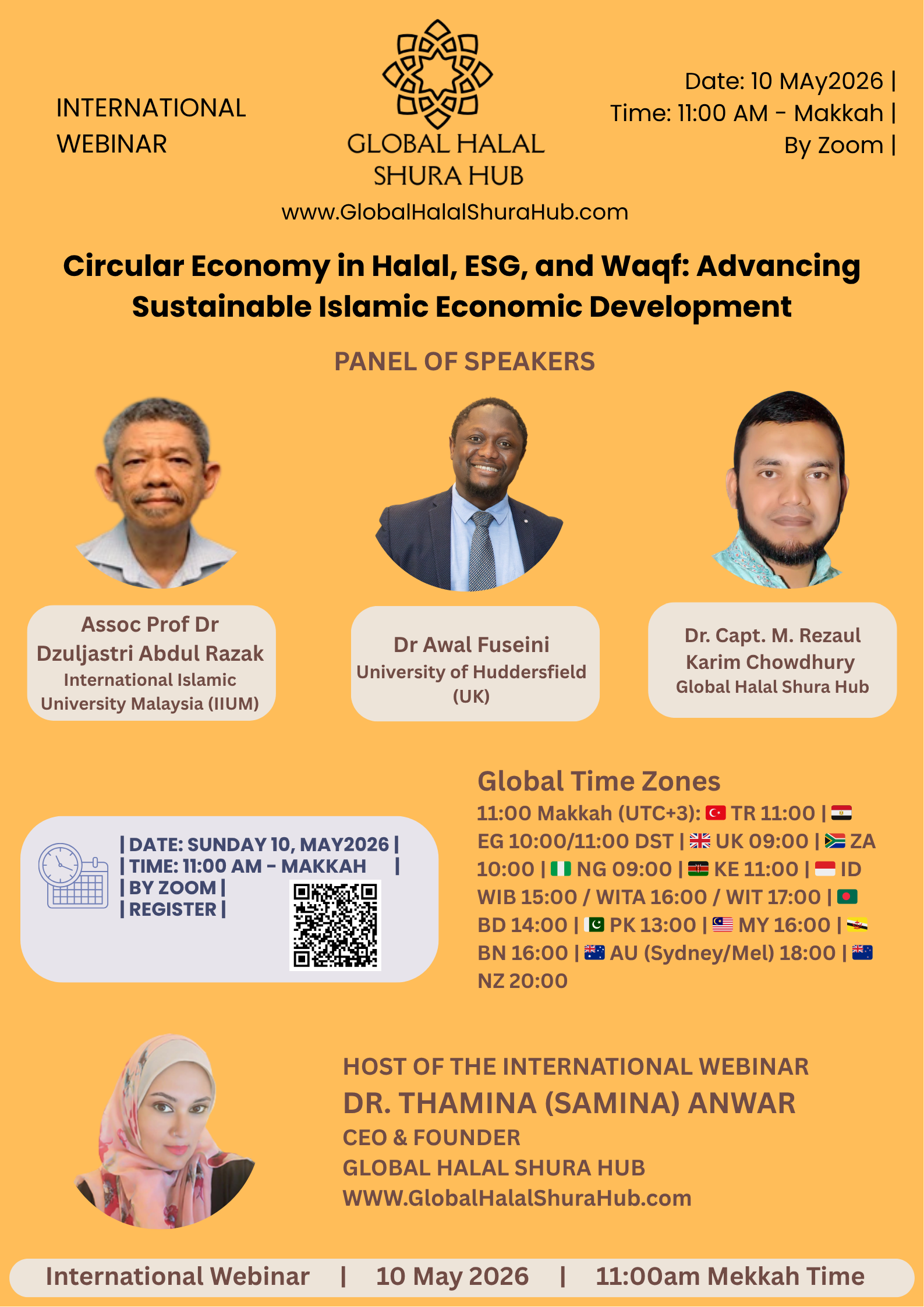
📅 Sunday, 10 May 2026
🕙 11:00 AM (Makkah Time / UTC+3)
🌍 Global Time Zones
 Turkey (TRT, UTC+3): 11:00 AM
 Egypt (EET, UTC+2 / DST UTC+3): 10:00 AM (or 11:00 AM DST)
 United Kingdom (BST, UTC+1): 09:00 AM
 South Africa (SAST, UTC+2): 10:00 AM
 Nigeria (WAT, UTC+1): 09:00 AM
 Kenya (EAT, UTC+3): 11:00 AM
 Indonesia:
• WIB (Western): 03:00 PM
• WITA (Central): 04:00 PM
• WIT (Eastern): 05:00 PM
 Bangladesh (BST, UTC+6): 02:00 PM
 Pakistan (PKT, UTC+5): 01:00 PM
 Malaysia (MYT, UTC+8): 04:00 PM
 Brunei (BNT, UTC+8): 04:00 PM
 Australia (Sydney/Melbourne, AEST UTC+10): 06:00 PM
 Aotearoa New Zealand (NZST, UTC+12): 08:00 PM
Circular Economy in Halal, ESG, and Waqf: Advancing Sustainable Islamic Economic Development
This high-level international webinar brings together leading scholars and practitioners to explore how Islamic economic principles, ESG frameworks, halal governance, and circular economy models can be integrated to build a more sustainable, ethical, and resilient global economic system. The webinar focuses on three interconnected themes: halal trade transformation, halal certification systems, and waqf revitalisation through circular economy innovation.
Theme 1: Circular Economy Integration in Halal Trade and ESG: Advancing Sustainable, Ethical, and Shariah-Compliant Business Practices
This theme explores how halal trade systems can be restructured through circular economy principles and ESG integration to enhance sustainability, ethical compliance, and global competitiveness. It examines the transformation of halal supply chains from linear models to regenerative systems grounded in Maqasid al-Shariah, ESG standards, and Islamic finance innovation.
Key discussions include halal supply chain redesign, waste reduction, ESG-driven transparency, regulatory reform, and the role of Islamic finance instruments such as green sukuk and waqf in financing sustainable halal industry transformation.
Speaker: Associate Professor Dr. Dzuljastri Abdul Razak (INHART, IIUM)
Theme 2: Integrating Halal Certification with Circular Economy Principles for Sustainable Ethical Consumption
This theme focuses on strengthening halal certification systems by embedding circular economy principles such as waste minimisation, lifecycle management, and sustainable sourcing. It highlights how certification frameworks can evolve beyond compliance to become drivers of ethical consumption, environmental responsibility, and sustainable innovation.
Discussions will address governance reforms, ESG alignment, halal supply chain efficiency, waste-to-value innovation, and the role of certification bodies in promoting circular halal production systems across food, cosmetics, pharmaceuticals, and manufacturing sectors.
Speaker: Dr. Awal Fuseini (University of Huddersfield (UK)
Theme 3: Revitalising Waqf Assets through Circular Economy Principles for Sustainable Socioeconomic Development
This theme examines the transformative role of waqf institutions in advancing sustainable development through circular economy strategies. It explores how waqf assets can be revitalised using regeneration, reuse, and resource optimisation principles to generate long-term social and economic value.
Key areas include waqf governance reform, sustainable asset development, green infrastructure, digitalisation, ESG integration, and the role of waqf in financing Islamic social finance ecosystems, halal industries, and community development initiatives.
It also highlights how Islamic circular economy models can strengthen poverty alleviation, social equity, environmental sustainability, and resilient economic systems.
Speaker: Dr. Capt. M. Rezaul Karim Chowdhury
Global Halal Shura Hub
I look forward to your participation and valuable insights, in shaa Allah. Please share this opportunity widely within your networks so that others may benefit.
Yours Sister,
Dr. Thamina (Samina) Anwar
CEO & Founder
Global Halal Shura Hub
🌐 Connect With Us
📱 WhatsApp Community:
👉 https://chat.whatsapp.com/KrWXFhHBuy6BkA3s4LYKQ2
🌐 Website: https://globalhalalshurahub.com
📧 Email: globalhalalshurahubsocialmedia@gmail.com
📷 Instagram: https://www.instagram.com/globalhalalshurahub/
🔗 LinkedIn:
https://www.linkedin.com/in/dr-thamina-anwar-806124145/
https://www.linkedin.com/in/global-halal-shura-hub-dr-thamina-samina-anwar-05418b398/
📺 YouTube: https://www.youtube.com/@GlobalHalalShuraHub