
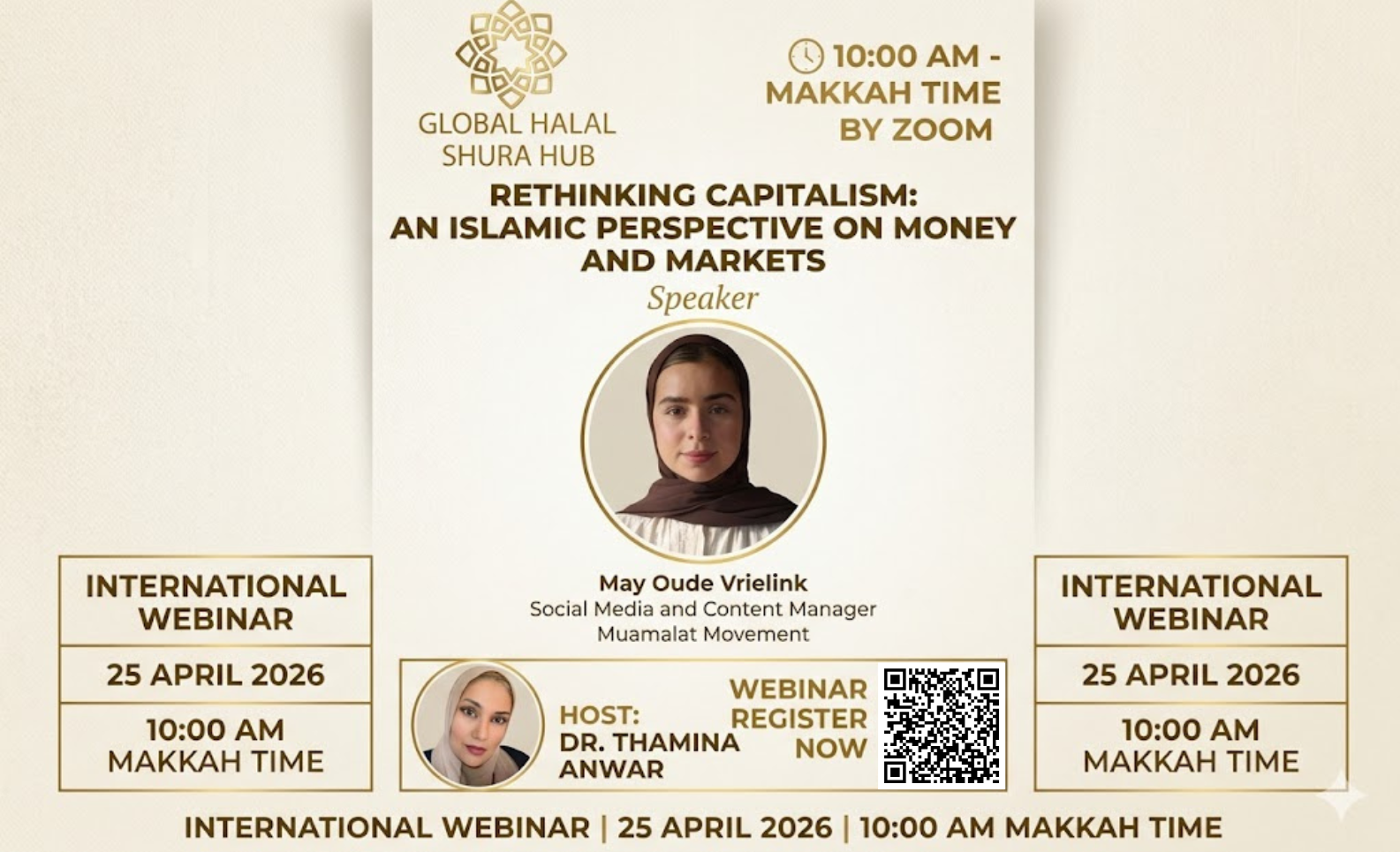
🌐 Global Time Zones
 Turkey — 10:00 AM
 Egypt — 9:00 AM
 United Kingdom — 8:00 AM
 South Africa — 9:00 AM
 Nigeria — 8:00 AM
 Pakistan — 12:00 PM
 Bangladesh — 1:00 PM
 Indonesia (Jakarta) — 2:00 PM
 Malaysia — 3:00 PM
 Australia (Sydney/Melbourne) — 5:00 PM
 Aotearoa New Zealand — 7:00 PM
Theme1: How Capitalism Made Debt Function as Payment
About Profile of Panelist 1: May Oude Vrielink
May Oude Vrielink is a creative strategist and digital architect whose work focuses on advancing muʿāmalāt—the principles of ethical trade, fairness, and responsible economic exchange—through innovative digital storytelling and strategic communication. With a background spanning luxury fashion at Iris van Herpen in Paris and digital transformation in European finance, she brings a distinctive ability to translate complex ethical and institutional ideas into clear, compelling narratives. As Social Media Manager for the Muamalat Movement, she plays a key role in articulating and amplifying its mission, developing a cohesive content ecosystem that blends creative direction with data-driven insight. Her work supports both audience growth and a deeper public understanding of ethical commerce in a contemporary context. Alongside this, she explores AI-driven visual storytelling in documentary media, extending her impact across cultures and platforms. With a Master’s degree in Fashion, Design, and Luxury Management from Grenoble Ecole de Management, multilingual fluency, and strong technical expertise, she is well positioned to present muʿāmalāt as both a timeless ethical framework and a relevant force in today’s digital economy.
Honoured to welcome May Oude Vrielink as our first panellist and would particularly value her insights on the theme, “How Capitalism Made Debt Function as Payment,” especially her reflections on how digital media and narrative shape public understanding of economic systems, and how muʿāmalāt can be effectively communicated and applied in response to these structures.
1. What is capitalism?
Capitalism is more than trade or private ownership. It is an economic system organised around:
banking
credit
national debt
Its defining feature is that debt circulates as if it were money. This shapes everyday life through inflation, loans, mortgages, public debt, and widespread dependence on financial institutions.
2. Which institutions make debt function as payment?
This system is sustained by a network of institutions, including:
central banks
fractional reserve banking
fiat currency
national debt and bond markets
legal systems that enforce debt contracts
Together, these structures enable debt to operate as the foundation of money and exchange.
3. How did this system develop historically?
Banking expanded across Europe, particularly in regions such as Italy.
Banks moved from safeguarding deposits to issuing more claims than they held.
This practice evolved into fractional reserve banking.
States later reinforced the system through legal frameworks, fiat currency, and central banking.
A major turning point came in 1971, when the United States ended gold convertibility under Nixon, fully detaching money from physical backing.
4. Why does this system produce inflation and dependence on debt?
New money primarily enters the economy through lending.
As a result, money is created as debt.
As debt expands, prices tend to rise.
Individuals, businesses, and governments become increasingly reliant on borrowing.
Over time, debt becomes normalised and difficult to avoid.
5. How was this system made to seem normal?
Through intellectual and political developments such as liberalism, constitutionalism, and the modern state.
Debt-based finance was presented as rational, modern, and progressive.
It gained wider acceptance in the Christian world as Church authority declined.
European powers spread these financial structures globally through colonisation.
Eventually, the underlying question faded from view:
Should debt be allowed to function as money at all?
—-
I look forward to your participation and valuable insights, in shaa Allah. Please share this opportunity widely within your networks so that others may benefit.