📝 Registration
👉 https://docs.google.com/forms/d/e/1FAIpQLSdE_nXEaatMXzPmvEySeZO8sW3PFKzRggZ-PD81O_7Q9TmVDw/viewform
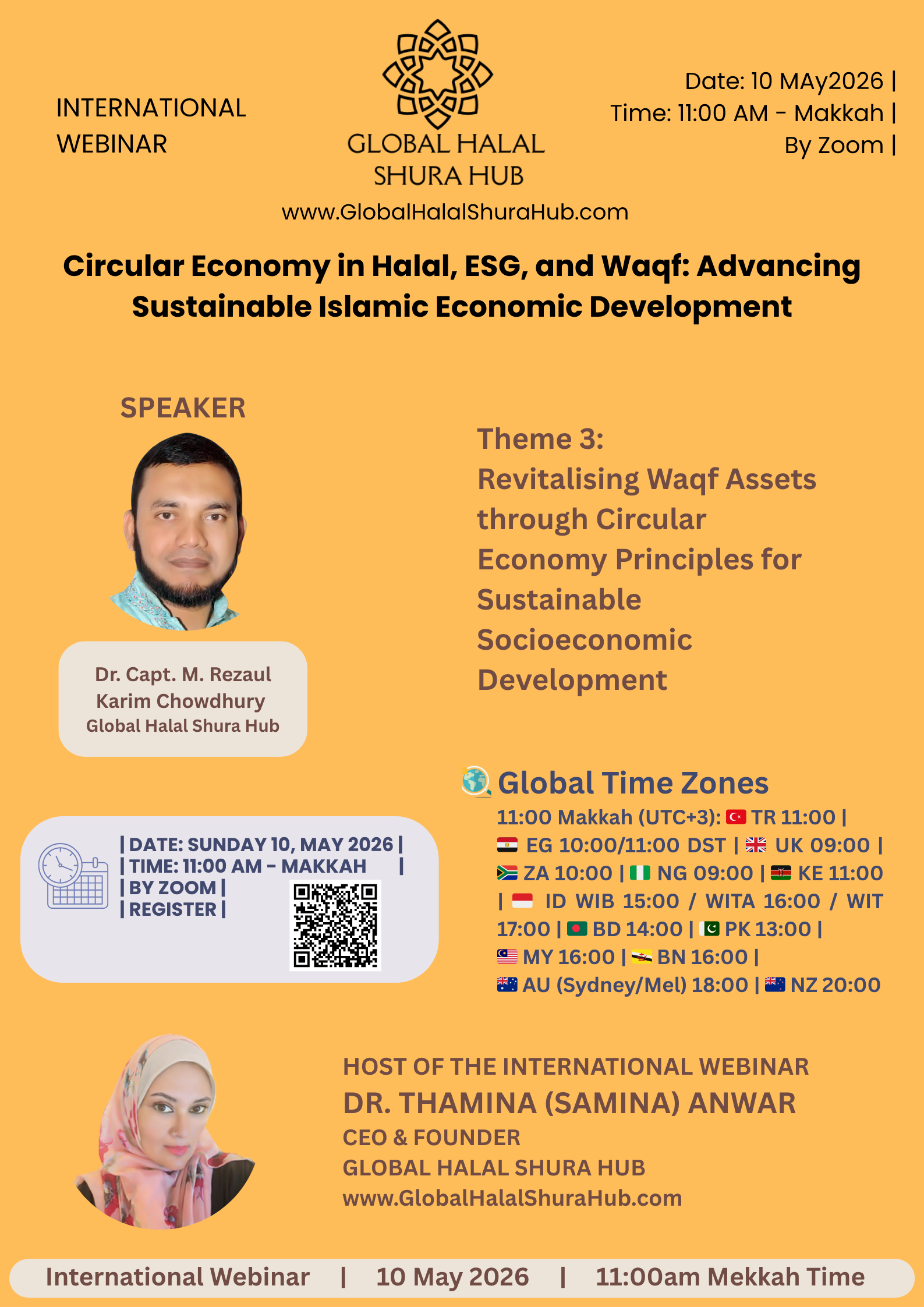
📅 Sunday, 10 May 2026
🕙 11:00 AM (Makkah Time / UTC+3)
🌍 Global Time Zones
 Turkey (TRT, UTC+3): 11:00 AM
 Egypt (EET, UTC+2 / DST UTC+3): 10:00 AM (or 11:00 AM DST)
 United Kingdom (BST, UTC+1): 09:00 AM
 South Africa (SAST, UTC+2): 10:00 AM
 Nigeria (WAT, UTC+1): 09:00 AM
 Kenya (EAT, UTC+3): 11:00 AM
 Indonesia:
• WIB (Western): 03:00 PM
• WITA (Central): 04:00 PM
• WIT (Eastern): 05:00 PM
 Bangladesh (BST, UTC+6): 02:00 PM
 Pakistan (PKT, UTC+5): 01:00 PM
 Malaysia (MYT, UTC+8): 04:00 PM
 Brunei (BNT, UTC+8): 04:00 PM
 Australia (Sydney/Melbourne, AEST UTC+10): 06:00 PM
 Aotearoa New Zealand (NZST, UTC+12): 08:00 PM
Our third panel speaker is Dr. Capt. M. Rezaul Karim Chowdhury , and he will focus on theme 3: “Revitalising Waqf Assets through Circular Economy Principles for Sustainable Socioeconomic Development”
About Dr. Capt. M. Rezaul Karim Chowdhury :
Dr. Capt. M. Rezaul Karim Chowdhury is a distinguished maritime academic, legal professional, strategic policy researcher, Director of Islamic Social Finance at the Global Halal Shura Hub, and global sustainability advocate whose work integrates maritime governance, ocean management, legal scholarship, Islamic economics, waqf development, halal industry advancement, and sustainable development. Based at the Faculty of Maritime Studies at Universiti Malaysia Terengganu (UMT), he contributes significantly to advancing academic excellence and policy innovation across maritime affairs, ocean governance, blue economy frameworks, and Islamic economic systems, with a strong focus on sustainability and ethical development.
In his leadership role at the Global Halal Shura Hub, Dr. Capt. Chowdhury plays a key role in advancing Islamic social finance, halal governance, global halal collaboration, waqf innovation, and Shariah-compliant development initiatives. His work strengthens halal business ecosystems and ethical trade systems by integrating Islamic circular economy principles, social finance instruments, and sustainable governance frameworks that promote inclusive socioeconomic growth and long-term resilience across Muslim and global communities.
His expertise spans maritime management, multimodal transportation, maritime supply chain risk management, strategic maritime operations, ocean governance, and legal-regulatory frameworks. As a legal professional, he brings a strong governance and policy perspective that enhances his interdisciplinary work in Islamic circular economy models, halal business systems, waqf development, Islamic social financing, and sustainable socioeconomic transformation.
Dr. Capt. Chowdhury’s research strongly emphasizes the integration of Islamic circular economy principles with sustainable development, focusing on resource optimization, environmental stewardship, social justice, and inclusive resilience. His work on waqf and Islamic social finance explores productive waqf, zakat, sadaqah, halal ecosystems, and socially responsible investment instruments to support poverty alleviation, community empowerment, and institutional sustainability. In particular, he highlights waqf as a powerful long-term mechanism for financing education, healthcare, infrastructure, and social welfare within Islamic economic systems.
By connecting Islamic economic principles, waqf innovation, halal governance, and social finance with modern sustainability strategies, he advances holistic development models aligned with global sustainability goals. His work supports the modernization of waqf institutions and Islamic social finance frameworks as key drivers of circular resource use, ethical finance, and resilient halal ecosystems.
Dr. Capt. Chowdhury is also widely recognised for promoting sustainable maritime ecosystems through innovative ocean governance, blue economy policy, and regional cooperation, while simultaneously exploring how Islamic economic systems and waqf-based structures can strengthen sustainable business and social welfare systems. This unique convergence of maritime strategy, legal scholarship, Islamic circular economy, halal governance, and waqf innovation positions him as a leading multidisciplinary thinker in global sustainable development.
Through his roles at UMT and the Global Halal Shura Hub, he continues to contribute to educating future leaders, strengthening halal and maritime governance, advancing waqf innovation, and promoting Islamic social finance systems that support ethical, resilient, and transformative global development.
We are very honoured that Dr. Capt. M. Rezaul Karim Chowdhury is our third panel speaker, where he will educate us on the critical theme: “Revitalising Waqf Assets through Circular Economy Principles for Sustainable Socioeconomic Development.” This essential discussion addresses one of the most strategic dimensions of halal trade, Islamic social finance, and sustainable development, and he will be taking the following questions:
1. How can circular economy principles such as reuse, regeneration, and resource efficiency be systematically applied to revitalise underutilised waqf assets for sustainable development?
2. What role can waqf institutions play in promoting sustainable resource management and waste reduction within the broader Islamic social finance ecosystem?
3. How can waqf property development projects integrate sustainable design principles such as recycling, renewable energy, and green infrastructure?
4. What are the key economic benefits of applying circular economy models to waqf asset management, including revenue generation and cost efficiency?
5. How can circular economy frameworks enhance the social impact of waqf in addressing poverty, inequality, and community development needs?
6. What governance, legal, and institutional challenges hinder the implementation of circular economy strategies in waqf management systems?
7. How can digital technologies and ESG frameworks improve transparency, efficiency, and sustainability in waqf asset revitalisation?
8. What policy reforms are necessary to align waqf asset development with national circular economy strategies and sustainable development goals?
9. How can waqf-based investment models support the growth of green entrepreneurship and sustainable halal industries?
10. What are the long-term environmental, economic, and social outcomes of integrating circular economy frameworks into waqf governance and asset management?
Yours Sister,
Dr. Thamina (Samina) Anwar
CEO & Founder
Global Halal Shura Hub
🌐 Connect With Us
📱 WhatsApp Community:
👉 https://chat.whatsapp.com/KrWXFhHBuy6BkA3s4LYKQ2
🌐 Website: https://globalhalalshurahub.com
📧 Email: globalhalalshurahubsocialmedia@gmail.com
📷 Instagram: https://www.instagram.com/globalhalalshurahub/
🔗 LinkedIn:
https://www.linkedin.com/in/dr-thamina-anwar-806124145/
https://www.linkedin.com/in/global-halal-shura-hub-dr-thamina-samina-anwar-05418b398/
📺 YouTube: https://www.youtube.com/@GlobalHalalShuraHub