
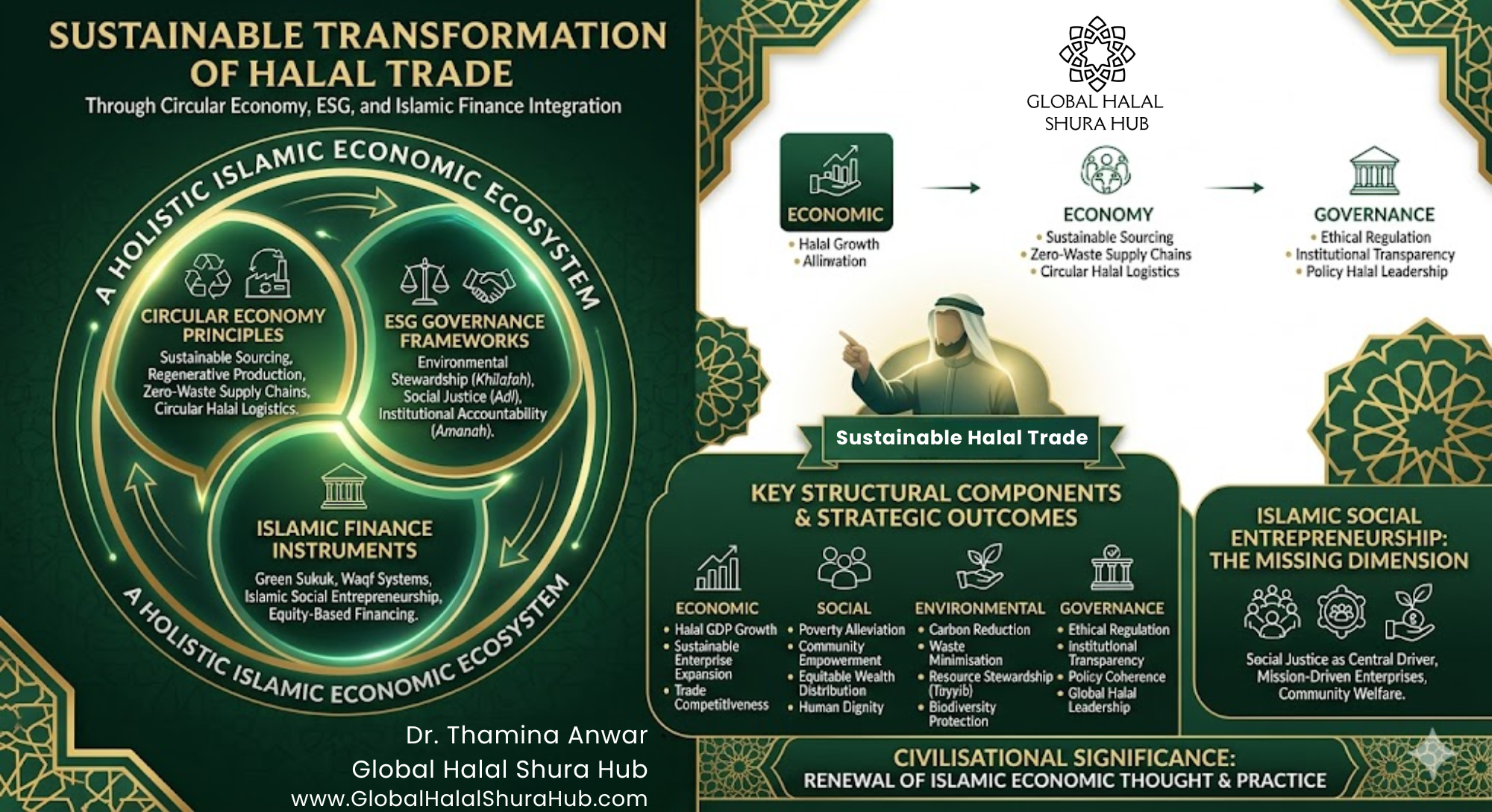
Sustainable Transformation of Halal Trade through Circular Economy, ESG, and Islamic Finance Integration
Abstract
The global halal economy is experiencing unprecedented growth, emerging as one of the world’s most dynamic economic sectors across food, finance, pharmaceuticals, cosmetics, logistics, tourism, fashion, and broader lifestyle industries. With Muslim consumer markets expanding rapidly and halal-certified products increasingly appealing to ethical and quality-conscious consumers beyond Muslim populations, halal trade now represents a major force in international commerce.
However, despite its strong foundations in Islamic ethical principles, much of the halal economy continues to function within conventional linear production systems characterized by excessive resource extraction, waste generation, environmental degradation, and fragmented governance structures. These systems often fail to fully reflect the broader Islamic economic values of stewardship (khilafah), balance (mizan), justice (adl), and wholesome sustainability (tayyib), while also becoming increasingly incompatible with modern global sustainability standards.
As climate change, biodiversity loss, carbon reduction policies, ESG compliance, and sustainable investment frameworks increasingly shape international markets, halal industries face a critical strategic turning point. To remain globally competitive and morally relevant, halal trade must evolve beyond traditional compliance models focused primarily on permissibility, toward comprehensive systems that integrate circular economy principles, ESG governance, and Islamic financial innovation. This transformation requires rethinking halal not merely as a certification standard, but as a broader regenerative economic model capable of promoting sustainable production, responsible consumption, ethical governance, social equity, and long-term resilience.
This article explores how halal trade can be fundamentally restructured through the strategic convergence of circular economy models, Environmental, Social, and Governance (ESG) frameworks, and Islamic finance instruments. Circular economy models offer halal industries practical pathways for redesigning production and supply chains around resource efficiency, waste minimisation, product lifecycle management, recycling, renewable resource utilisation, and regenerative industrial systems. ESG frameworks provide measurable governance tools that enhance transparency, investor confidence, sustainability performance, and institutional accountability. Meanwhile, Islamic finance instruments—including green sukuk, waqf, zakat, sadaqah, qard al-hasan, and ESG-linked Shariah-compliant investments—offer unique ethical financing mechanisms that can mobilise capital for sustainable halal infrastructure, green industrial innovation, and socially responsible enterprise development.
The article argues that halal trade possesses distinctive civilisational potential to become a global leader in ethical, regenerative, and socially responsible commerce because Islamic economics inherently supports principles that align with sustainability. Through strategic integration, halal industries can move from conventional market participation to leadership in shaping future sustainable economies. This includes redesigning halal certification systems to incorporate environmental standards, circular economy requirements, and broader tayyib principles; modernising halal supply chains through technological innovation and sustainable logistics; embedding ESG governance into halal business ecosystems; and mobilising Islamic social finance institutions to support inclusive and environmentally responsible development.
Special emphasis is placed on the leadership role of Muslim-majority economies, which are uniquely positioned to pioneer policy reform, regulatory innovation, halal standardisation, and institutional frameworks that align halal trade with national sustainability agendas and global development goals. Malaysia’s advanced halal infrastructure, Islamic finance leadership, and ESG policy evolution provide a strategic model for demonstrating how Muslim economies can drive sustainable halal transformation on a global scale.
The article also critically examines key barriers to implementation, including fragmented certification systems, regulatory limitations, technological constraints, limited sustainable financing access, consumer awareness gaps, governance inefficiencies, and resistance from traditional business models. It explores how policy reform, public-private collaboration, technological innovation, institutional restructuring, and education can overcome these challenges while fostering sustainable consumer behaviour and circular halal entrepreneurship.
Ultimately, this work proposes that the sustainable transformation of halal trade is not simply an economic modernization strategy, but a broader framework for Islamic economic renewal in the twenty-first century. By integrating circular economy principles, ESG governance, Islamic finance, and halal ethics, Muslim economies can establish resilient, regenerative, and globally competitive halal ecosystems that simultaneously advance economic growth, environmental sustainability, social justice, and spiritual accountability. In this vision, halal trade becomes not only a commercial enterprise, but a transformative model for ethical global development rooted in Islamic values and aligned with humanity’s urgent sustainability needs.
.Introduction
The halal economy has traditionally been understood primarily through the lens of religious permissibility (halal), focusing on lawful consumption, certification standards, and Shariah-compliant commercial conduct. Over the past few decades, however, it has expanded far beyond a niche religious market into a multi-trillion-dollar global industry encompassing food, finance, pharmaceuticals, cosmetics, logistics, and tourism. While this expansion demonstrates significant economic potential, it also exposes a critical limitation: much of the contemporary halal economy remains embedded within conventional linear production and consumption systems that are increasingly misaligned with global sustainability imperatives.
Environmental degradation, resource inefficiency, unethical supply chains, wasteful consumption patterns, and widening socio-economic inequalities continue to challenge the long-term viability of current industrial and trade structures. In many cases, halal certification ensures compliance with lawful (halal) inputs and processes but does not sufficiently address broader systemic concerns such as environmental impact, circularity, labour justice, or equitable wealth distribution. This creates a growing tension between the ethical aspirations of Islamic economics and the operational realities of modern global markets.
At its core, Islamic economics is not merely a regulatory or compliance-based framework but a comprehensive civilisational system grounded in the principles of tawhid (unity), khilafah (stewardship), mizan (balance), adl (justice), ihsan (excellence), and maslahah (public welfare). These principles establish that economic activity is a moral trust, not simply a mechanism for profit generation. The Qur’an explicitly discourages wastefulness and corruption, stating: “Eat and drink, but do not waste. Indeed, He does not like the wasteful” (Qur’an 7:31), and “Do not commit abuse on the earth, spreading corruption” (Qur’an 2:60). Such guidance extends halal beyond technical permissibility toward the broader concept of tayyib—wholesome, ethical, sustainable, and socially beneficial production and consumption.
In contemporary global conditions shaped by climate change, biodiversity loss, resource scarcity, and rising inequality, the need to realign halal trade with these higher Islamic objectives has become increasingly urgent. This article therefore argues that halal trade must be reimagined as a dynamic and integrated system that advances not only compliance, but also sustainability, justice, and regeneration.
In response to these challenges, this study proposes a transformative framework that integrates circular economy principles, Environmental, Social, and Governance (ESG) standards, Islamic finance, and Islamic social entrepreneurship into the structure of halal trade. The circular economy provides a practical model for shifting from linear extraction-based systems to regenerative cycles that prioritize waste reduction, resource efficiency, product life extension, and environmental restoration. These principles strongly resonate with Islamic values of stewardship (amanah), balance (mizan), and responsibility toward future generations.
ESG frameworks complement this transition by offering structured mechanisms for transparency, accountability, and ethical governance across industries. While ESG has largely emerged within secular financial and corporate systems, its core dimensions closely align with Islamic teachings: environmental stewardship reflects the preservation of creation, social responsibility reflects justice and welfare, and governance reflects amanah and ethical leadership. When interpreted through an Islamic lens, ESG becomes a powerful instrument for strengthening institutional integrity and enhancing the global competitiveness of halal industries.
A critical dimension of this transformation is Islamic social entrepreneurship, which serves as the operational bridge between ethical principles and real economic impact. Islamic social entrepreneurs address market failures, social exclusion, and environmental degradation through mission-driven enterprises rooted in maqasid al-shariah (the higher objectives of Islamic law). These enterprises prioritize community welfare, equitable wealth distribution, and sustainable value creation while embedding circular economy practices and ESG-aligned governance into their operational models. In doing so, Islamic social entrepreneurship transforms abstract ethical values into practical, scalable, and impact-driven economic systems.
Islamic finance further reinforces this integrated framework by providing ethically grounded, asset-backed, and socially responsible financial instruments. Tools such as green sukuk, waqf-based investment structures, zakat redistribution systems, qard al-hasan financing, and ESG-aligned Shariah investments enable capital mobilisation for sustainable infrastructure, inclusive development, and regenerative economic activity. Despite their potential, these instruments remain underutilized in driving systemic sustainability transformation within halal trade ecosystems.
However, the transition toward a sustainable halal economy is constrained by several structural barriers. These include limited access to sustainability-oriented Islamic capital, fragmented certification systems, technological gaps in supply chain monitoring, institutional inertia, weak policy coordination, and low consumer awareness regarding sustainable halal consumption. Without addressing these constraints, efforts at transformation risk remaining fragmented and largely conceptual.
Against this backdrop, the article advances a comprehensive proposition: the development of an integrated Islamic circular economic ecosystem. This system unifies circular production and consumption models, ESG governance frameworks, Islamic finance instruments, halal certification reform, and Islamic social entrepreneurship platforms into a coherent and mutually reinforcing structure. Its objective is not only efficiency and competitiveness but also alignment with the higher objectives of Shariah (Maqasid al-Shariah), which emphasize justice, welfare, human dignity, and the preservation of environmental balance.
This framework holds particular strategic significance for Muslim-majority economies such as Malaysia, Indonesia, Turkey, Pakistan, Bangladesh, Saudi Arabia, and other Gulf states, where halal industries can serve as engines of sustainable development, ESG innovation, and global economic leadership. At the same time, the model is adaptable beyond Muslim contexts, offering universal principles of ethical governance, social justice, and environmental stewardship that can strengthen global sustainability agendas.
Ultimately, this article argues that halal trade should no longer be viewed merely as a religiously regulated market segment, but as a comprehensive Islamic economic framework capable of addressing some of the most pressing global challenges of the twenty-first century. Through the integration of circular economy systems, ESG governance, Islamic finance, and Islamic social entrepreneurship, halal trade can evolve into a living expression of Maqasid al-Shariah—reconciling economic development with environmental regeneration, social equity, and ethical governance. In this vision, the transformation of halal trade represents not only an economic transition but also a broader revival of Islamic civilisational values in the modern global economy.
Reimagining Halal Trade through Circular Economy Principles
A circular economy represents a profound shift away from conventional linear economic systems built on the unsustainable model of “take, make, and dispose,” where natural resources are extracted, consumed, and discarded with little regard for long-term environmental consequences. In contrast, circular economy models prioritise regenerative production systems that maximise resource efficiency, minimise waste, extend product lifecycles, and continuously restore environmental and economic value. This framework strongly aligns with Islamic economic principles of khilafah (stewardship), mizan (balance), amanah (trust), and the Qur’anic prohibition against wastefulness (israf) and corruption (fasad). From an Islamic perspective, circular economy principles are not foreign concepts but rather contemporary operational expressions of deeply rooted Shariah objectives.
For halal trade, adopting circular economy models means fundamentally redesigning production systems, supply chains, certification structures, and business practices so that halal compliance is preserved while environmental sustainability, social responsibility, and long-term economic resilience are significantly strengthened. This reimagining shifts halal trade from being primarily a compliance-based market segment into a regenerative Islamic economic ecosystem where lawful production is harmonised with sustainable development and ethical stewardship.
Sustainable and Ethical Sourcing
The transformation begins at the sourcing stage, where halal industries must move beyond simply ensuring permissible ingredients toward prioritising ethically sourced, environmentally sustainable, and socially responsible raw materials that meet both Shariah and sustainability standards. This includes:
-
Sustainable agricultural systems
-
Biodiversity-conscious procurement
-
Renewable resource utilisation
-
Water conservation
-
Ethical labour practices
-
Carbon-conscious supply chain planning
In this modern Islamic framework, halal sourcing must increasingly reflect tayyib principles—ensuring that products are not only lawful but wholesome, safe, environmentally responsible, and socially beneficial.
For example, halal livestock production can incorporate regenerative grazing systems, sustainable feed sourcing, humane animal welfare practices, and low-emission farming models. Similarly, halal cosmetics, pharmaceuticals, and manufacturing sectors can prioritise renewable ingredients, eco-friendly materials, and sustainable extraction systems.
Circular Production Systems
Beyond sourcing, halal industries must redesign manufacturing and production systems to minimise environmental burdens through:
-
Waste reduction strategies
-
Water and energy optimisation
-
Renewable energy integration
-
Sustainable packaging innovation
-
Recycling and reuse systems
-
Product lifecycle extension
-
By-product valorisation
This is particularly important because many halal industries currently operate within resource-intensive production systems that generate significant waste. Circular production encourages halal businesses to view waste not as an unavoidable by-product, but as a recoverable economic resource.
For instance, within halal food systems:
-
Slaughter by-products can be converted into pharmaceuticals, collagen, leather alternatives, animal feed, or bioenergy
-
Agricultural waste can be transformed into organic fertilisers, compost, or renewable industrial materials
-
Food waste can be redirected into secondary processing systems
Such innovations not only reduce landfill burdens and emissions but also create new halal-certified economic value streams, increasing profitability while improving sustainability performance.
Circular Halal Logistics and Distribution
A key pillar of halal circular transformation lies in redesigning logistics and distribution systems. Traditional halal logistics focuses heavily on segregation and contamination prevention, which remains essential. However, circular halal logistics expands this by incorporating:
-
Recyclable and biodegradable packaging
-
Reverse logistics systems
-
Sustainable cold chain management
-
Carbon-efficient transportation
-
Digital supply chain optimisation
-
Blockchain-enabled traceability
Advanced technologies such as blockchain, IoT systems, and AI-driven supply chain analytics can enhance halal integrity by ensuring:
-
Full end-to-end traceability
-
Real-time sustainability monitoring
-
Carbon footprint analysis
-
ESG compliance integration
-
Transparent certification verification
This technological integration strengthens both consumer trust and regulatory confidence while reducing inefficiencies, emissions, and waste.
Halal Certification Reform and Circular Governance
Importantly, circular transformation within halal systems must preserve strict Shariah compliance, including:
-
Segregation from non-halal materials
-
Prevention of contamination
-
Full supply chain integrity
-
Religious governance standards
Therefore, halal certification systems themselves must evolve to incorporate circular economy requirements alongside traditional halal standards. This may include expanding certification criteria to cover:
-
Sustainable sourcing requirements
-
Zero-waste benchmarks
-
Environmental impact disclosures
-
ESG performance indicators
-
Resource efficiency standards
-
Ethical labor compliance
Such reforms would transform halal certification from a narrow permissibility framework into a broader global ethical sustainability standard, aligning halal more closely with the Islamic concept of halalan tayyiban.
Economic and Strategic Benefits
The adoption of circular economy principles within halal trade offers substantial strategic advantages:
-
Reduced production costs through efficiency gains
-
Increased profitability through by-product markets
-
Enhanced global competitiveness
-
Stronger ESG investment appeal
-
Improved consumer trust
-
Greater resilience against supply chain disruptions
-
Alignment with international sustainability regulations
-
Expanded access to ethical and sustainability-conscious markets
By integrating circular systems, halal industries can become leaders not only in religious compliance but also in sustainable ethical commerce.
Islamic Economic Significance
From an Islamic perspective, this transformation represents far more than operational modernization. It reflects a revival of the higher objectives of Shariah (Maqasid al-Shariah), which seek to preserve:
-
Faith
-
Life
-
Wealth
-
Intellect
-
Future generations
By embedding circular economy principles into halal trade, Muslim economies can establish systems that embody justice, stewardship, and sustainability while contributing meaningfully to global environmental and social challenges.
Therefore, reimagining halal trade through circular economy principles offers a historic opportunity to transform halal industries into regenerative, resilient, and globally competitive systems that reflect the full ethical scope of Islamic economics. Through sustainable sourcing, circular production, modernised logistics, certification reform, and governance innovation, halal trade can evolve into a comprehensive model of Islamic sustainable development.
In this vision, halal becomes more than lawful commerce—it becomes a practical framework for preserving creation, reducing harm, generating prosperity, and fulfilling humanity’s Divine responsibility as stewards of the Earth.
Structural Barriers to Circular Halal Transformation
While the integration of circular economy principles into halal trade presents extraordinary opportunities for sustainable development, ethical commerce, and Islamic economic renewal, the practical implementation of circular halal systems remains significantly constrained by a range of structural, financial, regulatory, technological, and institutional barriers. These obstacles not only slow transformation but also reveal the gap between the aspirational vision of halalan tayyiban and the current operational realities of many halal industries worldwide.
For halal sectors to evolve into regenerative, ESG-aligned, and globally competitive economic ecosystems, these barriers must be systematically addressed through coordinated reforms grounded in both modern sustainability strategies and Islamic economic principles.
a). Financial Constraints and Limited Access to Islamic Sustainability Capital
One of the most significant barriers is financial. Many halal businesses—particularly small and medium-sized enterprises (SMEs), which form the backbone of halal economies in many Muslim-majority countries—often lack sufficient capital to invest in:
-
Sustainable infrastructure upgrades
-
Renewable energy systems
-
Circular production technologies
-
Waste recovery and recycling systems
-
ESG compliance frameworks
-
Digital traceability systems
-
Sustainable certification enhancements
Traditional financing mechanisms frequently prioritize short-term profitability over long-term sustainability, while conventional debt-based funding may conflict with Shariah principles. Additionally, many Islamic finance institutions have yet to fully scale sustainability-focused financing models that specifically support circular halal transformation.
This creates a critical financing gap where halal enterprises may recognize the need for sustainability transformation but lack affordable, accessible, and Shariah-compliant capital solutions to implement change.
To overcome this barrier, there is a pressing need for broader mobilisation of Islamic financial instruments, including:
-
Green Sukuk (asset-backed and based on real assets rather than debt structures)
-
Waqf-based sustainability funds
-
Qard al-hasan for halal SMEs
-
Zakat and sadaqah-supported enterprise development
-
Islamic social entrepreneurship models
-
ESG-linked Islamic investment platforms
Without large-scale development of these financing ecosystems, circular halal transformation risks remaining inaccessible to many businesses.
b). Regulatory Fragmentation and Certification Limitations
Another major challenge lies in the fragmented nature of global halal governance systems. Halal certification standards currently vary significantly across countries, regions, and certifying bodies, creating inconsistencies in:
-
Certification criteria
-
Governance structures
-
Supply chain requirements
-
Market recognition
-
Export competitiveness
Most existing halal certification frameworks remain heavily focused on technical permissibility—such as ingredient compliance, slaughter procedures, and contamination prevention—while giving comparatively limited attention to broader sustainability dimensions such as:
-
Environmental stewardship
-
Circular production systems
-
Waste reduction
-
Carbon emissions
-
Ethical sourcing
-
ESG governance
This narrow approach restricts halal certification from evolving into a broader tayyib-oriented sustainability standard.
The absence of internationally harmonised frameworks that integrate:
-
Halal standards
-
Circular economy principles
-
ESG metrics
-
Sustainable governance systems
creates operational complexity for halal businesses seeking to compete in increasingly sustainability-conscious global markets.
Without regulatory harmonisation, businesses may face:
-
Increased compliance costs
-
Cross-border certification barriers
-
Consumer trust challenges
-
Reduced international scalability
-
ESG investment limitations
Therefore, policy reform is essential to modernise halal certification into a unified, globally credible framework that reflects both Islamic ethical principles and modern sustainability standards.
c). Technological Gaps and Infrastructure Deficiencies
Technological limitations present another major obstacle to implementing circular halal systems at scale. Many halal industries—especially in developing economies—lack access to advanced technological systems required for modern sustainability transformation, including:
-
Blockchain-enabled halal traceability
-
AI-powered supply chain monitoring
-
Circular manufacturing technologies
-
Smart waste recovery systems
-
Renewable energy infrastructure
-
ESG reporting tools
-
Sustainable logistics optimization
-
Digital certification platforms
Without these systems, halal businesses struggle to:
-
Track sustainability performance
-
Monitor resource efficiency
-
Ensure transparent supply chain integrity
-
Reduce waste systematically
-
Scale circular production models
For example, maintaining halal integrity while introducing circular systems requires sophisticated contamination prevention, segregation monitoring, and traceability systems. In the absence of advanced technology, businesses may fear sustainability integration could compromise halal standards.
This technological gap disproportionately affects SMEs, which may lack both the expertise and capital to adopt emerging sustainability innovations.
Addressing this challenge requires:
-
Public-private investment partnerships
-
Government innovation incentives
-
Islamic fintech development
-
Halal sustainability incubators
-
Cross-border technological collaboration
d). Institutional Inertia and Mindset Challenges
Institutional resistance remains one of the most deeply entrenched barriers. In many contexts, halal industries continue to prioritise immediate market expansion, conventional profit-driven models, short-term commercial gains, and minimal compliance approaches, rather than pursuing long-term systemic transformation toward sustainability, innovation, and circular economic integration.
This institutional inertia is often reinforced by:
-
Limited sustainability literacy
-
Weak policy incentives
-
Resistance to innovation
-
Fragmented leadership
-
Traditional business culture
-
Lack of ESG strategic planning
As a result, sustainability is frequently treated as an optional branding strategy rather than a core Islamic economic obligation.
From an Islamic perspective, this represents a failure to fully operationalize the principles of:
-
Khilafah (stewardship)
-
Mizan (balance)
-
Maslahah (public benefit)
-
Maqasid al-Shariah
Transformative change therefore requires not only technical reform but also ideological and educational reform that reframes circular halal transformation as both an economic necessity and a religious imperative.
e). Consumer Awareness and Market Demand Limitations
Consumer behavior also influences structural barriers. While demand for halal products continues to rise globally, many Muslim consumers may still prioritize halal permissibility without fully considering broader sustainability or tayyib dimensions.
This creates limited market pressure for businesses to adopt:
-
Sustainable sourcing
-
Zero-waste systems
-
Circular packaging
-
ESG governance
-
Ethical production
Without stronger consumer awareness around Islamic environmental ethics and sustainable consumption, circular halal transformation may face slower adoption.
Educational initiatives, public campaigns, and faith-based sustainability discourse are essential to strengthen consumer demand for halal products that are both lawful and environmentally regenerative.
f). Policy and Governance Gaps
National policy frameworks in many Muslim-majority economies often lack fully integrated strategies that align:
-
Halal trade
-
Circular economy development
-
ESG governance
-
Islamic finance
-
Industrial sustainability goals
This policy fragmentation weakens national competitiveness and limits the ability of halal sectors to become global sustainability leaders.
Governments must therefore introduce:
-
Circular halal policy roadmaps
-
ESG-integrated halal regulations
-
Sustainable industrial incentives
-
Green Islamic finance frameworks
-
Halal sustainability research institutions
-
Cross-sector strategic alliances
Hence , despite the immense potential of circular halal systems, meaningful transformation requires overcoming deeply interconnected barriers across finance, regulation, technology, institutions, consumer behavior, and policy governance.
Addressing these structural constraints will require:
-
Islamic financial innovation
-
Regulatory harmonisation
-
Technological modernization
-
Institutional reform
-
Consumer education
-
Policy leadership
Ultimately, overcoming these barriers is not simply a commercial challenge—it is a broader project of Islamic economic renewal. By dismantling these obstacles, halal industries can transition from fragmented compliance systems into globally leading models of regenerative, ethical, and sustainable economic development that fulfill both modern market demands and Divine responsibilities.
ESG Integration as a Strategic Halal Imperative
In the contemporary global economy, Environmental, Social, and Governance (ESG) frameworks have emerged as central pillars of international trade, investment flows, corporate governance, institutional credibility, and regulatory compliance. Governments, multinational corporations, sovereign wealth funds, investors, and consumers increasingly evaluate economic systems not solely by profitability, but by their measurable contributions to environmental sustainability, social responsibility, and governance integrity.
For halal industries, the rise of ESG frameworks is not merely a market trend or external regulatory challenge—it represents a profound strategic opportunity. In reality, Islamic economic philosophy has long embodied the very principles that ESG now seeks to operationalise. Islam’s foundational economic values of khilafah (stewardship), mizan (balance), adl (justice), amanah (trust), ihsan (ethical excellence), and maslahah (public welfare) inherently align with the environmental, social, and governance priorities that underpin ESG systems.
Therefore, ESG integration should not be viewed as an imported Western framework imposed upon halal industries, but rather as a globally recognised institutional mechanism through which Islamic ethical economics can be modernised, quantified, strengthened, and scaled.
Islamic Foundations of ESG
Islamic economics is deeply rooted in ethical obligations that correspond directly to ESG principles.
Environmental (E): Stewardship, Balance, and Preservation
Environmental sustainability is central to Islamic teachings. Humanity is entrusted as khalifah (vicegerent) on Earth, responsible for preserving creation and avoiding ecological destruction.
The Qur’an states:
“Indeed, I will make upon the earth a steward.” (Qur’an 2:30)
“And do not waste, for Allah does not love the wasteful.” (Qur’an 7:31)
“And do not cause corruption upon the earth after its reformation.” (Qur’an 7:56)
These principles establish that sustainable resource management, biodiversity protection, climate responsibility, waste minimisation, and environmental regeneration are not optional concerns, but religious obligations.
For halal industries, this means ESG environmental integration may include:
-
Sustainable sourcing
-
Renewable energy use
-
Carbon reduction
-
Water conservation
-
Circular production systems
-
Sustainable packaging
-
Waste-to-value systems
-
Resource efficiency
Through ESG, halal sectors can operationalise Islamic environmental ethics in measurable and globally credible ways.
Social (S): Justice, Equity, and Human Welfare
Islamic economics strongly emphasizes social justice, equitable wealth circulation, labour rights, poverty alleviation, and community welfare.
The Qur’an repeatedly advocates:
-
Fair trade
-
Honest labour
-
Economic inclusion
-
Protection of the vulnerable
-
Responsible wealth distribution
Mechanisms such as:
-
Zakat
-
Sadaqah
-
Waqf
-
Qard al-hasan
-
Islamic social entrepreneurship
already reflect sophisticated Islamic social governance systems.
By integrating ESG social standards, halal industries can strengthen:
-
Fair labour practices
-
Supply chain ethics
-
Worker welfare
-
Community development
-
Gender equity
-
Social inclusion
-
Consumer safety
-
Poverty reduction
This ensures halal businesses evolve from simple compliance systems into socially transformative economic institutions.
Governance (G): Amanah, Accountability, and Ethical Leadership
Governance is one of the strongest areas of compatibility between Islamic economics and ESG.
Islam places immense emphasis on:
-
Transparency
-
Accountability
-
Ethical conduct
-
Contractual integrity
-
Anti-corruption
-
Responsible leadership
The concept of amanah (trust) requires businesses, institutions, and leaders to operate with honesty and moral responsibility.
For halal industries, ESG governance integration strengthens:
-
Corporate transparency
-
Certification integrity
-
Regulatory accountability
-
Anti-fraud mechanisms
-
Ethical supply chain oversight
-
Shariah governance systems
-
Investor confidence
-
Digital traceability
This is particularly important given growing global concerns regarding halal fraud, inconsistent certification standards, and fragmented governance systems.
Strategic Advantages of ESG for Halal Industries
Embedding ESG metrics into halal industries creates substantial strategic benefits:
a). Global Investment Access
ESG integration allows halal businesses to access:
-
Sustainability-linked Islamic finance
-
Green sukuk markets
-
Sovereign wealth funds
-
ESG-linked investment capital
-
Ethical private equity
-
Responsible international finance networks
-
Islamic Social Entreprenueship platforms
This dramatically expands capital availability while preserving Shariah compliance.
b). Enhanced Consumer Trust
Modern consumers increasingly demand:
-
Transparency
-
Ethical sourcing
-
Carbon accountability
-
Sustainability
-
Social justice
-
Community Empowerment
-
Poverty allivaition
ESG integration strengthens halal credibility by aligning halal certification with broader global ethical expectations.
c). Competitive Trade Advantage
As international regulations increasingly emphasize sustainability, halal sectors with ESG alignment gain stronger access to:
-
International export markets
-
Ethical trade agreements
-
ESG-conscious retail systems
-
Sustainable procurement contracts
d). Institutional Resilience
ESG systems improve long-term resilience through:
-
Risk management
-
Governance stability
-
Climate adaptation
-
Regulatory preparedness
-
Operational efficiency
e). Alignment with Maqasid al-Shariah
Perhaps most importantly, ESG supports the higher objectives of Islamic law by preserving:
-
Wealth
-
Life
-
Society
-
Environment
-
Future generations
Islamic Social Entrepreneurship: The Missing Dimension in Expanding ESG and the Circular Economy Framework within Islamic Economic Transformation
The Islamic Social Entrepreneurship model developed by Dr. Thamina Anwar gains significantly greater strategic depth and transformative potential when integrated with ESG frameworks and circular economy systems. While the model already provides a powerful foundation for combining faith-based entrepreneurship with social impact, its alignment with these contemporary sustainability structures expands it from a socially responsible enterprise framework into a comprehensive system for ethical economic transformation.
At its core, Islamic social entrepreneurship is designed to generate both financial sustainability and measurable societal benefit while remaining firmly rooted in Qur’anic ethics, Prophetic trade principles, and the broader objectives of Islamic economics. It prioritises justice, public welfare, stewardship, and responsible wealth generation, distinguishing itself from purely profit-driven business models. However, when this model is strategically connected to ESG governance and circular economy principles, it evolves into a far more sophisticated ecosystem capable of driving systemic reform across halal industries, policy development, finance, and community resilience.
From an Environmental (E) perspective, the integration of circular economy systems allows Islamic social enterprises to move beyond ethical commerce into regenerative production. Enterprises can actively promote sustainable sourcing, resource efficiency, zero-waste manufacturing, circular supply chains, renewable energy adoption, and environmentally restorative business practices while preserving halal and tayyib standards. This strengthens the Islamic imperative of stewardship (khilafah), ensuring that economic activity protects both people and planet. As a result, Islamic social entrepreneurship becomes a mechanism not only for social development but also for environmental sustainability and ecological responsibility.
Within the Social (S) dimension, Dr. Thamina Anwar’s model becomes particularly powerful because social justice is already central to its design. Integration with ESG frameworks strengthens measurable outcomes in poverty alleviation, labour justice, community wealth-building, social inclusion, equitable opportunity creation, and public welfare. Islamic social enterprises can therefore function as institutional tools for reducing structural inequality while empowering underserved communities through halal economic participation. By embedding social justice more explicitly into ESG structures, the model ensures that entrepreneurship serves as a transformative mechanism for inclusive economic growth rather than narrow commercial expansion.
From a Governance (G) standpoint, ESG integration enhances transparency, accountability, impact measurement, and institutional legitimacy. Islamic social enterprises operating under this framework can implement rigorous governance structures that include ethical leadership standards, measurable social impact verification, transparent reporting, Shariah compliance oversight, and responsible decision-making systems. This institutional strengthening is critical for scaling Islamic social entrepreneurship beyond small community projects into nationally and globally recognised policy and economic systems.
When combined with circular economy models, the governance structure also extends into full supply chain accountability, ensuring that sustainability, ethical compliance, and halal integrity are maintained across all operational stages. Blockchain systems, sustainability certifications, ESG reporting mechanisms, and Shariah governance structures together create an advanced framework capable of supporting large-scale institutional trust and investor confidence.
The integration of Islamic social entrepreneurship with ESG and circular systems also dramatically enhances its role within halal industries. Halal businesses are no longer limited to certification-based compliance or isolated social responsibility initiatives. Instead, they can operate as interconnected components of a broader Islamic Circular Economic Ecosystem where production, finance, governance, social welfare, and environmental stewardship reinforce one another.
This expanded model supports:
-
Regenerative halal production systems
-
Sustainable halal supply chains
-
Ethical investment ecosystems
-
Waqf-backed enterprise development
-
ESG-aligned governance
-
Social justice-driven entrepreneurship
-
Community-based economic resilience
-
Policy-ready institutional scalability
Such integration positions Dr. Thamina Anwar’s framework not merely as a social enterprise model, but as a strategic engine for global halal economic renewal.
At the macroeconomic level, this model has the potential to influence:
-
National halal development strategies
-
Islamic Social Entreperneuship platforms
-
SME and entrepreneurship policy
-
Islamic finance frameworks
-
ESG investment markets
-
Waqf revitalisation programmes
-
Circular industrial policy
-
Social impact regulation
-
Global halal governance structures
This significantly expands its relevance from grassroots enterprise development into international policy and institutional reform.
Ultimately, the strategic integration of Dr. Thamina Anwar’s Islamic Social Entrepreneurship model with ESG and circular economy systems creates a uniquely comprehensive paradigm that aligns Islamic ethical economics with modern sustainability imperatives. It transforms halal industries into vehicles for sustainable development, social justice, environmental stewardship, and long-term Muslim economic resilience.
Rather than functioning solely as a business model, this integrated framework becomes a civilisational economic architecture—one capable of advancing Islamic economic renewal while positioning halal ecosystems as globally competitive leaders in ethical, regenerative, and socially transformative development.
ESG Framework with Social Justice Integration
Environmental (E): Environmental Stewardship with Justice
Islamic social enterprises can promote:
-
Sustainable production
-
Ethical sourcing
-
Circular manufacturing
-
Community environmental projects
-
Resource conservation
-
Environmental justice, ensuring vulnerable communities are not disproportionately harmed by environmental degradation
-
Equitable access to sustainable resources
Environmental sustainability becomes part of broader justice by protecting communities, future generations, and creation itself.
Social (S): Social Justice as the Central Driver
This is where social justice should be explicitly highlighted as a foundational pillar.
The Social dimension model directly strengthens:
-
Poverty alleviation
-
Social inclusion
-
Labour justice
-
Community development
-
Ethical entrepreneurship
-
Social justice and equitable wealth distribution
-
Reduction of systemic inequality
-
Economic empowerment of underserved populations
-
Fair opportunity creation
-
Community ownership and participatory development
-
Access to halal finance and productive assets
In fact Islamic social entrepreneurship is the vehicle for: “Social justice-driven economic transformation.”
Governance (G): Justice Through Ethical Institutions
By embedding measurable ethical standards, transparency, and accountability, her framework enhances:
-
Governance performance
-
Institutional trust
-
Responsible leadership
-
Impact verification
-
Justice-centred policy implementation
-
Equitable regulatory systems
-
Anti-exploitation safeguards
-
Transparent wealth distribution oversight
-
Shura-based participatory governance
Governance ensures that justice is institutionalised, measured, and protected.
A Comprehensive Islamic Circular Economic Ecosystem
The future of meaningful Islamic economic transformation does not lie in fragmented reforms, isolated halal certification systems, or partial financial adjustments. Rather, it depends upon the development of a fully integrated Islamic Circular Economic Ecosystem—a comprehensive, regenerative, and ethically grounded model that unites Islamic economic principles with sustainability, institutional resilience, social justice, and long-term civilisational renewal.
This ecosystem represents a strategic evolution beyond traditional understandings of halal industries or Islamic finance as separate sectors. Instead, it positions the Islamic economy as a holistic system in which production, trade, governance, finance, entrepreneurship, and public welfare function together as mutually reinforcing pillars of an ethically coherent civilisation-based economic architecture.
By strategically integrating:
-
Circular economy principles
-
ESG governance frameworks
-
Islamic social entrepreneurship platforms
-
Halal certification reform
-
Islamic finance instruments
-
Waqf systems
-
Social justice and equitable wealth distribution frameworks
a far more comprehensive and transformative model emerges—one capable of fundamentally reshaping economic systems through an Islamic ethical lens while directly responding to contemporary global challenges such as climate instability, inequality, unsustainable production, financial fragility, and governance crises.
Moving Beyond Fragmented Halal Systems
Conventional halal economic structures have often focused narrowly on compliance, certification, and sectoral market growth without fully addressing broader systemic concerns such as sustainability, social equity, ecological responsibility, or institutional reform. While these efforts have been valuable, they remain insufficient for the larger civilisational task of Islamic economic renewal.
The Islamic Circular Economic Ecosystem expands beyond these limitations by creating an integrated framework where:
-
Economic growth is linked to social justice
-
Halal compliance is linked to environmental stewardship
-
Finance is tied to real asset productivity and ethical capital circulation
-
Entrepreneurship serves both profitability and societal benefit
-
Governance ensures transparency, accountability, and maqasid alignment
-
Waqf serves as a long-term infrastructure and public welfare engine
-
Sustainability is embedded into all levels of economic operation
This creates a model where Islamic economic activity is no longer reactive or compartmentalised, but instead becomes a proactive system for comprehensive societal transformation.
Core Structural Pillars of the Ecosystem
Circular Economy Principles
Circularity introduces regenerative production, waste minimisation, resource efficiency, and environmental restoration into Islamic trade and industry. Within this model, halal and tayyib principles are operationalised not only through lawful production but also through sustainable sourcing, ethical manufacturing, circular logistics, and ecological stewardship.
This allows Islamic economies to:
-
Reduce waste
-
Preserve resources
-
Strengthen supply chain resilience
-
Lower environmental harm
-
Improve long-term productivity
ESG Governance Frameworks
Environmental, Social, and Governance frameworks provide measurable systems for institutional accountability, sustainability reporting, transparency, and investor confidence. When aligned with Islamic principles, ESG becomes a modern governance mechanism that operationalises:
-
Stewardship (khilafah)
-
Justice (‘adl)
-
Trust (amanah)
-
Public welfare (maslahah)
This strengthens halal sectors by ensuring sustainability is measurable, governable, and globally competitive.
Islamic Social Entrepreneurship Platforms
Islamic social entrepreneurship serves as a grassroots and institutional bridge between private enterprise and public welfare. These platforms create businesses designed not solely for profit maximisation, but for:
-
Poverty alleviation
-
Community wealth-building
-
Ethical innovation
-
Employment generation
-
Social justice
-
Sustainable local economies
When integrated into circular and ESG systems, Islamic social entrepreneurship becomes a transformative engine capable of scaling inclusive development across halal ecosystems.
Halal Certification Reform
Future halal systems must evolve beyond permissibility-focused models into broader frameworks that incorporate:
-
Sustainable sourcing
-
Environmental responsibility
-
Labour ethics
-
Circular production
-
Transparency
-
ESG standards
This transforms halal certification into a globally recognised ethical sustainability benchmark.
Islamic Finance Instruments
Islamic finance provides the capital infrastructure necessary to scale sustainable transformation through:
-
Green sukuk
-
Musharakah
-
Mudarabah
-
Waqf financing
-
Halal venture capital
-
ESG-linked Islamic investments
-
Asset-backed monetary systems
These instruments ensure that financial growth remains connected to real productivity, social benefit, and environmental responsibility.
Waqf Systems
Waqf serves as the long-term civilisational infrastructure backbone of the ecosystem by financing:
-
Education
-
Healthcare
-
Enterprise incubation
-
Public infrastructure
-
Social welfare
-
Sustainable development projects
Modern waqf revitalisation provides a debt-free alternative to conventional public development systems.
Social Justice Frameworks
Social justice is the moral centre of the entire model. Islamic economics fundamentally requires that economic systems serve:
-
Wealth circulation
-
Environmental safe guards
-
Poverty reduction
-
Human dignity
-
Fair opportunity
-
Anti-exploitation
-
Equitable participation
Without social justice, Islamic economic systems risk replicating the same inequalities found in conventional systems.
Strategic Outcomes
A fully operational Islamic Circular Economic Ecosystem can produce transformative outcomes across multiple dimensions:
Economic
-
Halal GDP growth
-
Sustainable enterprise expansion
-
Asset-backed financial resilience
-
Trade competitiveness
-
Reduced debt dependency
Social
-
Poverty alleviation
-
Community empowerment
-
Employment generation
-
Public welfare expansion
-
Social mobility
Environmental
-
Circular production systems
-
Reduced emissions
-
Waste minimisation
-
Resource regeneration
-
Sustainable infrastructure
Governance
-
Ethical regulation
-
Institutional transparency
-
Policy coherence
-
Global halal leadership
-
Shariah-compliant sustainability standards
Civilisational Significance
The Islamic Circular Economic Ecosystem represents far more than a technical reform of halal trade or an incremental improvement in sustainability practices. It constitutes a deeper civilisational framework aimed at the renewal of Islamic economic thought and practice in the modern global context. At its core, this model seeks to restore the integrated nature of Islamic civilisation, where economic activity is not isolated from ethics, governance, spirituality, or environmental responsibility, but is instead embedded within a unified moral and institutional order guided by divine principles.
Historically, Islamic civilisation developed highly sophisticated systems of commerce, finance, social welfare, and governance that were mutually reinforcing and grounded in values such as justice (adl), trust (amanah), balance (mizan), and public welfare (maslahah). Over time, however, modern economic structures—largely shaped by industrial capitalism and fragmented regulatory systems—have separated economic activity from its ethical foundations. The proposed Islamic Circular Economic Ecosystem seeks to reverse this fragmentation by re-establishing harmony between economic systems and Islamic moral philosophy, ensuring that development is both materially productive and ethically sound.
In this sense, the model revives a broader Islamic civilisational vision in which commerce, governance, finance, and social institutions operate in alignment with ecological balance and collective wellbeing. It redefines economic success not merely in terms of growth or efficiency, but in terms of justice, sustainability, and human flourishing. By embedding ethical responsibility into every layer of economic activity, the framework enables Muslim societies to develop systems that are simultaneously resilient, inclusive, and future-oriented.
One of the most important implications of this model is that it enables the construction of parallel systems of resilience that are ethically grounded, environmentally sustainable, financially stable, socially just, and globally scalable. Ethically grounded systems ensure that economic behaviour remains consistent with Islamic moral imperatives. Environmentally sustainable systems reduce ecological degradation and promote regeneration. Financially stable systems reduce reliance on speculative and debt-heavy structures by emphasising real-asset backing and risk-sharing. Socially just systems ensure equitable distribution of wealth and opportunity, while globally scalable systems position Islamic economic frameworks as viable contributors to international sustainability agendas.
The integration of circular sustainability principles, ESG governance frameworks, Islamic social entrepreneurship, halal certification reform, Islamic finance instruments, waqf systems, and social justice principles creates a unified and cohesive ecosystem. This integration is essential, as fragmentation has historically limited the effectiveness and global impact of Islamic economic initiatives. By bringing these components together under a single strategic framework, the Islamic Circular Economic Ecosystem transforms isolated sectoral efforts into a coordinated civilisational model.
Such integration enables a shift from fragmented halal industries toward a unified economic paradigm capable of shaping global participation in trade, finance, and sustainability. In doing so, Islamic economics transitions from being perceived as a niche or alternative system to becoming a fully developed framework for addressing contemporary global challenges. These include climate change, inequality, financial instability, unsustainable consumption, and governance failures—issues that increasingly demand ethical and holistic solutions.
Ultimately, this model positions Islamic economic systems not merely as compliant with religious standards or competitive within existing markets, but as transformative in nature. It reframes them as regenerative systems capable of restoring balance between humanity, the economy, and the environment. In this way, the Islamic Circular Economic Ecosystem offers a vision of justice-centred global economic development—one that is capable of contributing meaningfully to the creation of a more equitable, sustainable, and ethically grounded world order in the twenty-first century and beyond.
Foundations of the Islamic Circular Economic Model
At its core, the Islamic Circular Economic Ecosystem is grounded in a worldview that understands economic activity not as an autonomous or value-neutral system, but as a moral and accountable extension of human responsibility on earth. In this framework, economics is not separated from ethics, spirituality, or governance; rather, it is embedded within a comprehensive system of divine accountability and social obligation.
Unlike conventional economic models that prioritise efficiency, growth, and capital accumulation as primary objectives, the Islamic economic worldview situates all economic activity within a higher ethical order. Wealth, production, trade, and consumption are therefore viewed as trusts (amanah) that must be managed responsibly in accordance with divine guidance and societal welfare.
Islamic Accountability
A foundational principle of Islamic economics is the concept of faith based accountability (Islamic), where all economic actions are ultimately subject to moral and spiritual evaluation. This creates a system of internal ethical governance that extends beyond legal compliance or regulatory enforcement.
In practical terms, faith based (Islamic) accountability encourages:
-
Ethical business conduct
-
Honest trade practices
-
Fair contractual obligations
-
Avoidance of exploitation and corruption
-
Responsible use of wealth and resources
This principle ensures that economic systems are not driven solely by profit maximisation, but by a continuous awareness of moral responsibility and long-term consequences.
Human Dignity
Islamic economics places the preservation and protection of human dignity (karamah) at the centre of all economic activity. Individuals are not treated merely as labour units or consumption agents, but as honoured beings with intrinsic worth and rights.
This principle shapes economic systems by ensuring:
-
Fair wages and labour rights
-
Protection from exploitation
-
Access to basic needs such as food, education, and healthcare
-
Economic inclusion for marginalised populations
-
Empowerment through ownership and opportunity
Within a circular Islamic economic model, human dignity becomes a non-negotiable foundation for policy design, institutional governance, and market regulation.
Social Justice
Social justice (‘adl) is a central organising principle in Islamic economics, requiring that wealth and opportunity be distributed in a manner that prevents extreme inequality and systemic oppression.
This includes:
-
Equitable wealth circulation
-
Prevention of wealth hoarding
-
Redistribution through zakat and waqf systems
-
Fair access to economic participation
-
Protection of vulnerable communities
In a circular economic framework, social justice is not treated as a corrective mechanism but as a structural requirement embedded within the design of financial systems, markets, and institutions.
Resource Stewardship
The Islamic concept of khilafah (stewardship) establishes humanity as trustees of the natural world. This principle requires responsible management of environmental resources and prohibits waste, destruction, and ecological harm.
Applied to economic systems, resource stewardship promotes:
-
Sustainable production practices
-
Environmental protection policies
-
Renewable resource utilisation
-
Waste minimisation and circular design
-
Long-term ecological balance
When integrated with circular economy principles, this creates a powerful alignment between Islamic ethics and modern sustainability science.
Wealth Circulation
Islamic economics strongly emphasises the principle that wealth should not remain concentrated within a limited elite but must circulate throughout society to ensure broad-based prosperity.
This is reflected through mechanisms such as:
-
Zakat (obligatory redistribution)
-
Sadaqah (voluntary charity)
-
Waqf (endowment-based public welfare systems)
-
Ethical trade practices
-
Prohibition of hoarding and exploitative accumulation
Within a circular economic system, wealth circulation becomes a structural design principle that ensures continuous economic movement, inclusion, and shared prosperity.
Collective Prosperity
The ultimate objective of Islamic economics is not individual wealth maximisation but collective prosperity (falah)—a state in which society as a whole achieves material well-being, moral integrity, and social harmony.
This includes:
-
Poverty reduction
-
Economic stability
-
Community empowerment
-
Access to essential services
-
Balanced development across regions and sectors
Collective prosperity ensures that economic systems function as tools for societal upliftment rather than mechanisms of exclusion or inequality.
Integration with Modern Sustainability Frameworks
Historically, Islamic economics has already emphasised moderation, anti-exploitation, lawful production, public welfare, and responsible governance. These principles align closely with contemporary circular economy and sustainability frameworks.
When integrated, they create a unified system that combines:
-
Ethical economic governance
-
Environmental sustainability
-
Social equity
-
Financial resilience
-
Institutional accountability
This convergence enables the Islamic Circular Economic Model to address two critical global challenges simultaneously:
-
Modern systemic crises such as climate change, inequality, and financial instability
-
Long-term Muslim economic resilience, sovereignty, and institutional development
Strategic Significance
By embedding Islamic ethical principles into modern circular and ESG frameworks, this model transforms Islamic economics into a comprehensive civilisational system rather than a fragmented set of financial or trade practices.
It provides a structured foundation for:
-
Sustainable development policy
-
Ethical global trade systems
-
Regenerative industrial models
-
Inclusive financial ecosystems
-
Social justice-driven governance structures
In doing so, it positions Islamic economics as a forward-looking framework capable of contributing meaningfully to global debates on sustainability, equity, and economic reform, while remaining firmly grounded in its own ethical and spiritual tradition.
Key Structural Components
A fully developed Islamic Circular Economic Ecosystem is built upon a set of deeply interconnected structural components that transform Islamic ethical principles from abstract values into operational, institutional, and policy-driven systems. These components ensure that Islamic norms are embedded directly into the functioning of production, supply chains, finance, governance, entrepreneurship, and consumption.
Rather than operating in isolation, these structures form a unified and mutually reinforcing system in which economic activity is continuously guided by principles of justice, sustainability, and stewardship. Among the most critical components are regenerative production ecosystems, zero-waste halal supply chains, ethical investment platforms, socially inclusive enterprise networks, and environmentally restorative governance systems. Together, they redefine how value is created, financed, distributed, and sustained within an Islamic civilisational framework.
Regenerative Production Ecosystems
A comprehensive Islamic circular model prioritises the development of regenerative production systems—industrial frameworks that do not merely extract and consume resources, but actively restore, replenish, and enhance environmental and social systems over time.
Grounded in the Islamic principles of halal (lawful) and tayyib (pure, wholesome, ethical) production, these ecosystems extend beyond compliance to encompass ecological responsibility, social benefit, and long-term sustainability. Production is therefore evaluated not only by output and profit, but by its impact on ecosystems, communities, and intergenerational well-being.
Core features include ethical sourcing of halal-certified raw materials, renewable energy integration, sustainable agriculture, resource regeneration, waste minimisation, circular manufacturing systems, and carbon-conscious industrial policies.
This transforms production logic from a linear model of extraction and disposal into a circular system of continuous regeneration, shifting industries toward environmental restoration, economic resilience, and ethical stewardship.
Zero-Waste Halal Supply Chains
Traditional halal supply chains often focus primarily on certification and compliance, without fully addressing systemic inefficiencies such as waste generation, resource depletion, and environmental externalities.
The Islamic Circular Economic Model expands this framework through the development of zero-waste halal supply chains that integrate Shariah compliance with full lifecycle sustainability and resource optimisation.
These systems incorporate blockchain-based traceability, sustainable packaging, reverse logistics, waste recovery, circular product lifecycle management, halal-compliant recycling systems, and efficient use of water and energy resources.
By transforming linear supply chains into closed-loop circular ecosystems, materials are continuously reused, repurposed, or regenerated. This reduces environmental harm, strengthens supply chain resilience, improves operational efficiency, and enhances global competitiveness while preserving strict halal integrity throughout the entire lifecycle.
Ethical Investment Platforms
Islamic finance functions as the capital engine of the Islamic circular economy, mobilising Shariah-compliant financial systems to fund sustainable, ethical, and socially beneficial development.
Unlike conventional debt-based or speculative financial systems, Islamic ethical investment ensures that capital is directly linked to real economic activity and tangible value creation.
Key instruments include green sukuk, waqf financing structures, ESG-linked Islamic funds, musharakah and mudarabah partnerships, Islamic venture capital, halal fintech ecosystems, and community-based cooperative finance models.
These platforms channel capital toward renewable infrastructure, sustainable manufacturing, social enterprises, circular trade systems, and community development projects.
By aligning capital flows with ethical and productive outcomes, Islamic finance becomes a mechanism for long-term stability, environmental responsibility, and social justice rather than speculative accumulation.
Socially Inclusive Enterprise Networks
Islamic social entrepreneurship serves as the grassroots operational engine of the circular economy, enabling communities to participate directly in sustainable economic development.
These enterprise networks prioritise community ownership, social welfare, employment creation, ethical commerce, local resilience, and public benefit. They function as hybrid institutions where financial sustainability is balanced with measurable social impact.
Islamic social enterprises are designed not solely for profit generation but for poverty reduction, social equity, community empowerment, and ethical market participation.
When supported by waqf funding, Islamic finance instruments, and enabling policy frameworks, these networks create distributed economic resilience and reduce dependency on centralised or exploitative systems.
In this way, entrepreneurship becomes a tool for both economic empowerment and social transformation.
Environmentally Restorative Governance Systems
No Islamic circular economy can function effectively without robust governance structures capable of coordinating sustainability, finance, trade, and ethical oversight across multiple sectors.
Environmentally restorative governance systems integrate national policy reform, ESG reporting standards, halal sustainability certification, waqf governance mechanisms, Islamic market regulation, environmental legislation, and Shura-based decision-making structures.
These governance frameworks ensure that economic activity remains aligned with core Islamic principles, including justice (‘adl), trust (amanah), public welfare (maslahah), and stewardship (khilafah).
By institutionalising sustainability through law, policy, and governance, these systems ensure that environmental protection, social welfare, and economic prosperity are not competing priorities but mutually reinforcing objectives.
This creates a coherent regulatory environment in which Islamic economic systems can operate transparently, efficiently, and ethically at both national and global levels.
Integrated System Outcome
When regenerative production ecosystems, zero-waste halal supply chains, ethical investment platforms, socially inclusive enterprise networks, and environmentally restorative governance systems operate together, they form a unified and self-reinforcing Islamic Circular Economic System.
This system is:
-
Ethically grounded in Islamic principles
-
Environmentally regenerative and sustainable
-
Financially stable and asset-backed
-
Socially inclusive and justice-oriented
-
Institutionally coordinated and policy-ready
-
Globally scalable and competitive
Ultimately, this represents a decisive shift away from fragmented halal industries toward a comprehensive civilisational economic model—one in which production, finance, governance, entrepreneurship, and sustainability operate as an integrated and coherent system of Islamic economic renewal.
Strategic Outcomes of the Islamic Circular Economy
A successfully implemented Islamic Circular Economic Ecosystem has the potential to generate far-reaching and transformative outcomes across economic, social, environmental, and governance dimensions. Unlike conventional growth models that often prioritise short-term profitability, this integrated framework is designed to align material progress with ethical responsibility, sustainability, and the higher objectives of Shariah (Maqasid al-Shariah). The result is not only economic expansion but also structural resilience, social equity, and ecological regeneration.
Economic Outcomes
From an economic perspective, the Islamic Circular Economy is expected to significantly enhance halal GDP growth by expanding value-added activities within sustainable and ethical industries. By shifting away from linear production models toward regenerative and resource-efficient systems, halal industries can unlock new sources of productivity and long-term economic value. This includes the development of circular supply chains, green manufacturing, and ethical consumption markets that are increasingly demanded in global trade.
In addition, this model strengthens trade competitiveness by positioning halal products and services within the broader global sustainability agenda. Countries and firms that adopt circular and ESG-aligned halal systems are more likely to attract international partnerships, investment flows, and export opportunities. At the same time, the ecosystem reduces dependency on debt-based financial systems by promoting asset-backed Islamic finance instruments such as sukuk, waqf-based investment structures, and equity-based financing models. This contributes to more stable and risk-sharing economic structures.
The expansion of sustainable small and medium-sized enterprises (SMEs) is another key outcome, as Islamic social entrepreneurship and circular business models create new entry points for innovation and inclusive growth. These enterprises are expected to play a central role in job creation, particularly in green industries, halal manufacturing, sustainable agriculture, and ethical digital services. Overall, the economic system becomes more resilient due to its emphasis on real assets, productive investment, and long-term value creation rather than speculative financial activities.
Social Outcomes
Socially, the Islamic Circular Economy provides a strong foundation for poverty alleviation and inclusive wealth distribution. By embedding mechanisms such as zakat, waqf, and socially responsible investment into economic structures, wealth circulation becomes more equitable and directly linked to community welfare. This reduces structural inequalities and ensures that economic growth translates into tangible improvements in living standards for marginalised populations.
The framework also supports community wealth-building by strengthening local production systems, cooperative enterprises, and socially embedded financial institutions. This decentralised approach empowers communities to participate more actively in economic development rather than remaining passive recipients of growth. Improved access to healthcare and education is also expected through waqf-driven public welfare systems, which have historically played a vital role in funding social infrastructure in Islamic civilisation.
Furthermore, the model fosters youth entrepreneurship development by creating opportunities for innovation in Islamic social enterprises, green technologies, and digital halal platforms. This not only reduces unemployment but also cultivates a new generation of ethically grounded entrepreneurs. Ultimately, the social dimension of the Islamic Circular Economy is characterised by greater justice, inclusion, and human dignity, ensuring that economic systems serve people rather than exclude them.
Environmental Outcomes
Environmentally, the Islamic Circular Economy offers a comprehensive response to pressing global ecological challenges. One of its primary outcomes is the reduction of carbon emissions through cleaner production systems, renewable energy integration, and more efficient logistics networks. By prioritising resource optimisation and circular supply chains, industries significantly reduce their environmental footprint.
Waste minimisation is another critical outcome, achieved through recycling, reuse, and regenerative production systems that eliminate the traditional “take–make–dispose” model. Instead, materials are continuously cycled back into production processes, reducing pressure on natural resources. This is closely aligned with Islamic teachings that prohibit wastefulness (israf) and encourage responsible consumption.
The framework also promotes resource regeneration, where economic activities contribute positively to environmental restoration rather than degradation. This includes sustainable agricultural systems that improve soil health, conserve water, and enhance food security. Biodiversity protection is strengthened through responsible land use practices and reduced ecological disruption. Collectively, these measures contribute to greater climate resilience, enabling societies to better withstand environmental shocks and long-term climate risks.
Governance Outcomes
In terms of governance, the Islamic Circular Economy strengthens transparency, accountability, and institutional integrity across all levels of economic activity. ESG-aligned frameworks ensure that decision-making processes are guided by clear ethical standards and measurable sustainability indicators, reducing opportunities for corruption and inefficiency.
Ethical institutional leadership is reinforced through the integration of Islamic values such as amanah (trust) and adl (justice), which emphasise responsibility in governance and public service. This leads to stronger public trust in both financial and regulatory institutions, as stakeholders perceive systems to be more transparent and ethically grounded.
For investors, improved governance structures increase confidence by reducing uncertainty and enhancing the credibility of halal certification, ESG reporting, and Islamic financial compliance. Policy coherence is also strengthened as governments align halal regulation, sustainability strategies, and economic planning within a unified framework. Over time, this positions participating countries as global leaders in halal governance, capable of setting international standards for ethical and sustainable trade systems.
Collectively, these outcomes demonstrate that the Islamic Circular Economy is not merely an incremental improvement to existing halal systems but a comprehensive structural transformation. It integrates economic efficiency with social justice, environmental stewardship, and ethical governance in a way that reflects the holistic nature of Islamic economic thought. If implemented effectively, it has the potential to reposition halal trade as a global model of sustainable development, offering a viable alternative to conventional economic systems that often prioritise growth at the expense of equity and ecological balance.
Strategic Role for Muslim-Majority Economies
Muslim-majority economies occupy a uniquely strategic position in the global transformation of halal trade and Islamic economic systems. Countries such as Malaysia, Indonesia, Bangladesh, Pakistan, Turkey, Saudi Arabia, and the broader Gulf Cooperation Council (GCC) states collectively represent the largest concentration of halal production, consumption, financial infrastructure, and Islamic institutional knowledge in the world. This positions them not only as participants in the global halal economy, but as potential architects of its future direction. However, realizing this potential requires a shift from fragmented industry development toward a coordinated, systems-based transformation grounded in circular economy principles, ESG integration, Islamic finance innovation, and Islamic social entrepreneurship.
Within this context, Islamic social entrepreneurship—particularly as conceptualised in Dr. Thamina’s model—plays a catalytic role in bridging ethical Islamic principles with practical economic development. Islamic social entrepreneurship provides a dynamic mechanism through which market-based activity can simultaneously address social inequality, environmental degradation, and economic exclusion. It enables the translation of maqasid al-shariah into operational enterprise models that prioritise community welfare, inclusive growth, and sustainable impact rather than purely profit-maximising objectives.
One of the most important strategic actions for Muslim-majority economies is the establishment and expansion of Islamic enterprise incubators. These incubators can nurture early-stage ventures that operate at the intersection of halal compliance, sustainability, and social impact. By providing mentorship, Shariah advisory support, access to Islamic finance, and ESG-aligned evaluation frameworks, such institutions can accelerate the development of a new generation of socially responsible entrepreneurs who are capable of leading circular and regenerative business models.
In parallel, the development of halal social enterprise ecosystems is essential for scaling impact beyond isolated initiatives. These ecosystems integrate producers, financiers, regulators, certification bodies, and consumers into interconnected value networks that prioritise ethical sourcing, waste reduction, community empowerment, and environmental responsibility. When properly structured, such ecosystems transform halal industries from linear supply chains into circular, impact-driven systems that continuously reinvest value into society.
A further strategic dimension involves the integration of ESG-linked social entrepreneurship metrics within national development frameworks. By embedding measurable indicators of environmental stewardship, social impact, and governance quality into halal industry reporting and certification systems, governments can enhance transparency, attract global impact investment, and align domestic industries with international sustainability standards. This also strengthens the credibility and competitiveness of halal exports in global markets increasingly shaped by ESG expectations.
Mobilising waqf and zakat for enterprise development represents another powerful mechanism for structural transformation. Traditionally used for welfare and charitable purposes, these Islamic financial instruments can be re-engineered to support productive economic activities, particularly in the development of micro, small, and medium-sized enterprises (MSMEs). Waqf-based investment funds can support infrastructure, education, and innovation hubs, while zakat can be strategically deployed to provide seed funding, capacity building, and financial inclusion for marginalised entrepreneurs. Together, they create a self-sustaining cycle of social and economic empowerment.
The development of circular halal SME sectors is also critical for achieving long-term sustainability and resilience. SMEs constitute the backbone of most Muslim-majority economies, yet many operate with limited access to capital, technology, and sustainable business models. By embedding circular economy principles—such as recycling, resource efficiency, and regenerative production—within SME development strategies, governments can simultaneously enhance competitiveness, reduce environmental impact, and generate inclusive employment opportunities.
Collectively, these strategies contribute to the broader goal of enhancing sustainable community resilience. By integrating economic development with social protection, environmental stewardship, and ethical governance, Muslim-majority countries can build societies that are better equipped to withstand economic shocks, climate change, and global market volatility. This resilience is not only structural but also moral, as it reflects a commitment to justice, equity, and collective wellbeing.
It is anticipated that this strategic transformation will reposition Muslim-majority economies beyond their traditional role as exporters of halal products. Instead, they will emerge as global pioneers of socially transformative Islamic economic systems—systems that integrate spirituality with sustainability, ethics with enterprise, and tradition with innovation. In doing so, these economies have the potential to redefine the global halal economy as a leading model of justice-centred, regenerative, and future-oriented development.
Conclusion
This article has presented a comprehensive rethinking of halal trade through the integrated application of circular economy principles, Environmental, Social, and Governance (ESG) frameworks, Islamic finance, and Islamic social entrepreneurship. It argues that while the global halal industry has achieved remarkable expansion, its current structure remains largely constrained by linear production systems, fragmented governance, and limited integration with sustainability imperatives. As such, there is an urgent need to transition from a compliance-centred model of halal certification toward a holistic, regenerative, and value-driven Islamic economic ecosystem.
At the core of this transformation is the reimagining of halal trade through circular economy principles. By prioritising sustainable and ethical sourcing, circular production systems, and regenerative logistics and distribution models, halal industries can significantly reduce waste, improve resource efficiency, and enhance environmental stewardship. However, this shift requires more than operational adjustments; it necessitates structural reform in halal certification and governance systems to ensure that circularity, sustainability, and ethical responsibility are embedded within the very definition of halal and tayyib.
In parallel, ESG integration emerges as a strategic imperative for the evolution of halal industries. Environmental stewardship, social justice, and ethical governance are not external additions to Islamic economic thought but are deeply rooted in foundational principles such as amanah (trust), adl (justice), mizan (balance), and maslahah (public welfare). When aligned with Maqasid al-Shariah, ESG frameworks enhance transparency, strengthen institutional accountability, improve consumer trust, and expand access to global sustainability-oriented investment flows. This alignment positions halal industries more competitively within increasingly ESG-driven international markets.
A central dimension of this transformation is Islamic social entrepreneurship, which serves as the operational bridge between ethical theory and real economic impact. Islamic social entrepreneurs translate maqasid al-shariah into practice by developing mission-driven enterprises that address social inequality, environmental degradation, and economic exclusion. By embedding social justice as the central driver of enterprise activity, they ensure that economic systems contribute directly to human wellbeing, community resilience, and inclusive development rather than purely financial accumulation.
Islamic finance further strengthens this integrated framework by providing ethical, asset-backed, and socially responsible financial instruments such as sukuk, waqf, zakat, qard al-hasan, and ESG-linked Shariah investments. These mechanisms enable the mobilisation of capital for sustainable infrastructure, social welfare, and regenerative economic activities. However, the study highlights that these instruments remain underutilised and require stronger institutional integration, policy alignment, and innovation to fully realise their transformative potential.
Despite the clarity of this integrated vision, several structural barriers continue to hinder implementation. These include limited access to Islamic sustainability capital, fragmented certification regimes, technological and infrastructural deficiencies, institutional inertia, weak regulatory coordination, policy misalignment, and low consumer awareness regarding sustainable halal consumption. Overcoming these barriers requires coordinated action across governments, financial institutions, certification bodies, industry stakeholders, and civil society actors. Without such alignment, transformation will remain uneven and incomplete.
In response, the article proposes the development of a Comprehensive Islamic Circular Economic Ecosystem that unifies circular production systems, ESG governance structures, Islamic finance instruments, reformed halal certification frameworks, Islamic social entrepreneurship platforms, waqf-based development models, and social justice principles into a single integrated system. This ecosystem is not merely technical but civilisational in scope, as it aligns economic activity with the higher objectives of Shariah (Maqasid al-Shariah), including justice (adl), welfare (maslahah), human dignity, and the preservation of environmental and social balance.
The implementation of this model is expected to generate transformative outcomes across multiple dimensions. Economically, it enhances halal GDP growth, strengthens trade competitiveness, expands sustainable SMEs, and reduces reliance on debt-based financial systems. Socially, it promotes poverty alleviation, equitable wealth distribution, youth entrepreneurship, and improved access to essential services such as healthcare and education. Environmentally, it contributes to carbon reduction, waste minimisation, biodiversity protection, and climate resilience through regenerative production systems. From a governance perspective, it improves transparency, institutional accountability, policy coherence, and global leadership in ethical halal governance.
At a deeper level, the civilisational significance of this framework lies in its ability to restore the holistic vision of Islamic economics, where economic activity is inseparable from ethical responsibility, environmental stewardship, and social justice. It reaffirms foundational Islamic values such as human dignity, accountability, resource stewardship, and collective prosperity, transforming them from abstract principles into operational economic systems.
For Muslim-majority economies, this transformation represents a strategic opportunity to reposition themselves not merely as exporters of halal products, but as global pioneers of socially transformative Islamic economic systems. By integrating circular sustainability, ESG governance, Islamic finance, and social entrepreneurship, these economies can develop resilient, inclusive, and globally competitive models that reflect both contemporary sustainability standards and Islamic ethical principles. In doing so, they can lead the global halal economy as a model of justice-centred, regenerative, and future-oriented development.
Ultimately, this study concludes that the sustainable transformation of halal trade represents far more than an economic upgrade. It signals a paradigm shift toward a new Islamic economic civilisation—one that harmonises spirituality with sustainability, ethics with enterprise, and tradition with innovation. Through the integration of these frameworks, halal trade can evolve into a powerful global model for equitable development, environmental regeneration, and long-term socio-economic resilience, offering a coherent and morally grounded alternative for the future of the global economy.
References
Al-Qur’an al-Karim. (n.d.). *Surah Al-Baqarah 2:30, 2:60*; *Surah Al-A’raf 7:31, 7:56*.
Anwar, T. (2017). Waqf (endowment): A vehicle for Islamic social entrepreneurship. IBFIM (Islamic Banking and Finance Institute Malaysia).
Anwar, T. (2026). Think like an Islamic social entrepreneur: A mindset change. Iqra Press. (Forthcoming)
Chapra, M. U. (2008). The Islamic vision of development in the light of Maqasid al-Shariah. Islamic Research and Training Institute (IRTI).
Ellen MacArthur Foundation. (2015). Towards a circular economy: Business rationale for an accelerated transition. Ellen MacArthur Foundation.
El-Gamal, M. A. (2006). Islamic finance: Law, economics, and practice. Cambridge University Press.
Global Reporting Initiative (GRI). (2021). GRI standards for sustainability reporting. GRI Secretariat.
Hassan, M. K., & Aliyu, S. (2018). A contemporary survey of Islamic banking literature. Journal of Financial Stability, *34*, 12–43.
Islamic Development Bank (IsDB). (2020). Green sukuk: A guide for issuers. IsDB Group.
Kamali, M. H. (2015). Maqasid al-Shariah made simple. The International Institute of Islamic Thought (IIIT).
OECD. (2019). ESG investing: Practices, progress and challenges. OECD Publishing.
Omer, S. (2022). Circular economy and Islamic finance: A synergistic approach to sustainability. Islamic Economic Studies, *30*(1), 45–68.
SASB (Sustainability Accounting Standards Board). (2021). SASB standards for ESG reporting. SASB Foundation.
UNEP. (2021). Halal and sustainable: Aligning Islamic finance with the circular economy. United Nations Environment Programme.
Wilson, R. (2014). Legal, regulatory and governance issues in Islamic finance. Edinburgh University Press.
World Bank. (2019). The role of Islamic social finance in achieving the SDGs. World Bank Group.
Zaman, A. (2016). Islamic economics as a science of public policy. International Journal of Pluralism and Economics Education, *7*(3), 269–286.
Yours Sister,
Dr. Thamina (Samina) Anwar
CEO & Founder
Global Halal Shura Hub
🌐 Connect With Us
📱 WhatsApp Community:
👉 https://chat.whatsapp.com/KrWXFhHBuy6BkA3s4LYKQ2
🌐 Website: https://globalhalalshurahub.com
📧 Email: globalhalalshurahubsocialmedia@gmail.com
📷 Instagram: https://www.instagram.com/globalhalalshurahub/
🔗 LinkedIn:
https://www.linkedin.com/in/dr-thamina-anwar-806124145/
https://www.linkedin.com/in/global-halal-shura-hub-dr-thamina-samina-anwar-05418b398/
📺 YouTube: https://www.youtube.com/@GlobalHalalShuraHub