
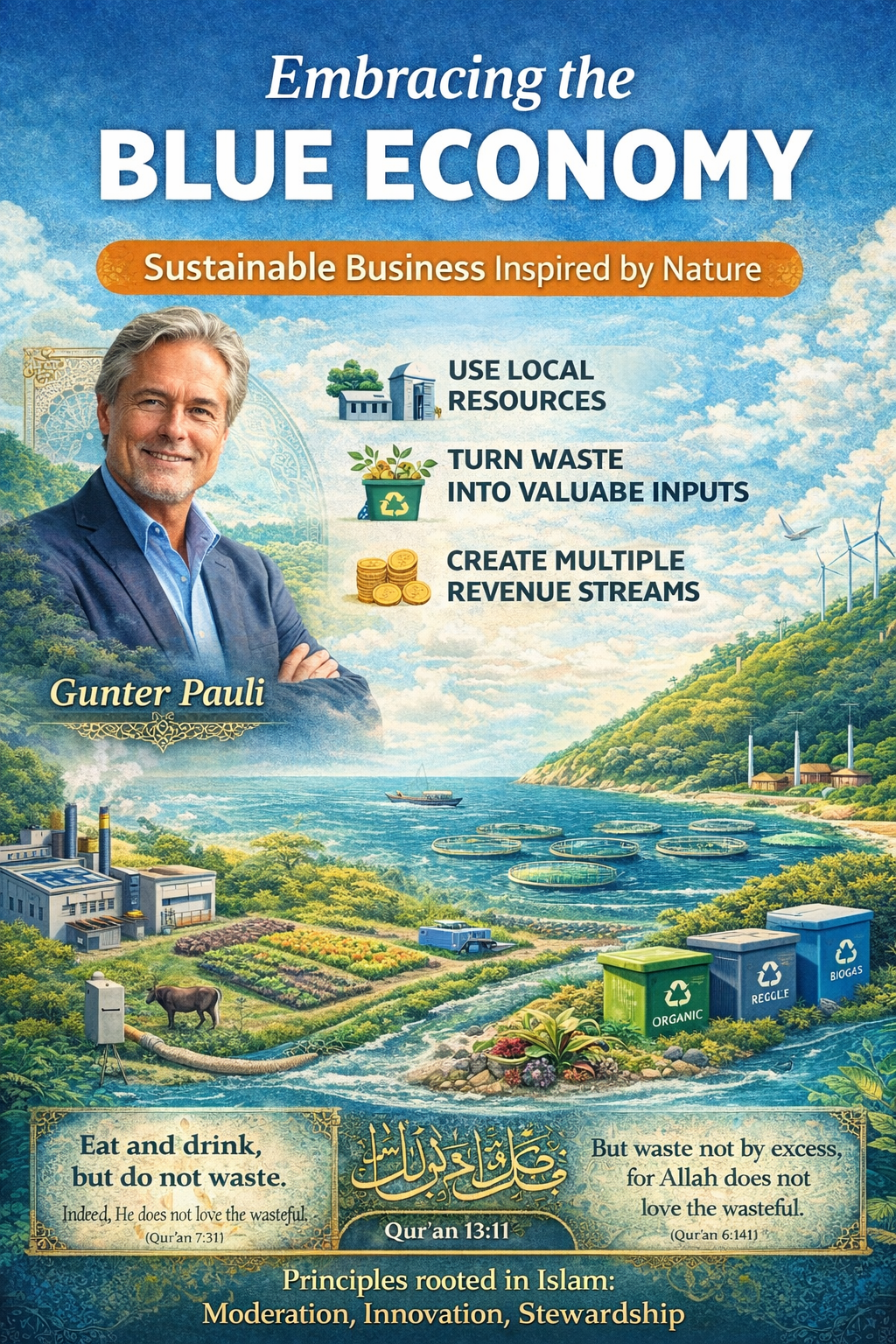
The Blue Economy and Islamic Principles: A Convergence of Sustainability, Ethics, and Opportunity
Today I had the honour of discussing the Blue Economy on Zoom with an amazing colleague from Slovenia, Goradz. I volunteer my time on a board focused on alternative economic models, and during our conversation we decided to work on a proposal—also incorporating the Islamic perspective—to present to the brilliant founder of the Blue Economy, Gunter Pauli. I will also try to arrange an interview with him about the Blue Economy.
This approach is deeply needed in today’s world, especially given the energy crisis, environmental challenges, and other global issues. Many of the principles he speaks about resonate strongly with Islamic teachings. Being able to interview a brilliant thinker like Gunter Pauli would truly put me on cloud nine.
I guess there is no dull moment in my life.
The Blue Economy and Islamic Principles: A Convergence of Sustainability, Ethics, and Opportunity
Introduction
In recent years, the concept of the Blue Economy, popularized by Gunter Pauli, has gained attention as a transformative model for sustainable development. The Blue Economy proposes a shift away from wasteful industrial systems toward regenerative economic models that mimic natural ecosystems. Rather than focusing solely on reducing harm, the Blue Economy seeks to create systems where resources circulate efficiently, waste becomes input for new production, and economic activity generates environmental and social benefits.
Interestingly, many of the principles underlying the Blue Economy resonate deeply with the ethical framework of Islam. Islamic teachings emphasize stewardship of the earth, responsible consumption, fairness in trade, and the avoidance of waste. When examined closely, the Blue Economy can be viewed not only as an economic innovation but also as a modern expression of values long embedded in Islamic tradition.
This article explores the relationship between the Blue Economy and Islamic principles, highlighting how both frameworks encourage sustainability, responsible resource management, and economic systems that benefit society while preserving the natural environment.
Understanding the Blue Economy
The Blue Economy was developed as an alternative to traditional industrial economic models that often rely on excessive resource extraction and generate large amounts of waste. According to this approach, economic systems should emulate natural ecosystems, where outputs from one process become inputs for another, creating closed-loop systems with minimal waste.
The Blue Economy focuses on several key principles:
Using locally available resources efficiently
Eliminating waste by turning by-products into valuable inputs
Creating multiple streams of revenue from a single resource
Supporting local economies and communities
Generating employment through sustainable innovation
Unlike conventional “green economy” models that sometimes focus on reducing environmental damage, the Blue Economy aims to redesign production systems so that environmental sustainability and economic growth reinforce one another.
Nature itself provides the model. In natural ecosystems, nothing is wasted. Leaves fall and become nutrients for soil. Organic matter decomposes and feeds microorganisms. Energy flows continuously through interconnected systems.
The Blue Economy seeks to replicate this efficiency in human economic systems.
Islamic Foundations of Environmental Stewardship
Islam provides a rich ethical framework for environmental responsibility and sustainable economic practices. The Qur’an repeatedly reminds humanity that the earth is a trust from God and that humans are appointed as stewards (khalifah) responsible for maintaining balance in creation.
Allah says:
“It is He who has appointed you stewards upon the earth.”
(Qur’an 6:165)
This concept of stewardship places a moral obligation on humans to protect the natural environment and manage resources responsibly. Economic activity should not disrupt the balance established within creation.
The Qur’an further emphasizes the importance of balance:
“And the heaven He raised and imposed the balance, so that you do not transgress within the balance.”
(Qur’an 55:7–8)
The idea of balance closely aligns with the ecological thinking behind the Blue Economy. Natural systems operate in balance, and sustainable economic systems must respect those natural limits.
The Prohibition of Waste
One of the most striking connections between Islamic teachings and the Blue Economy lies in the prohibition of waste.
The Qur’an states:
“Eat and drink, but do not waste. Indeed, He does not love the wasteful.”
(Qur’an 7:31)
Wastefulness is discouraged in all aspects of life, including food consumption, water use, and resource management. The Prophet Muhammad ﷺ also demonstrated strong environmental awareness and restraint in resource use.
Even when performing ritual washing, the Prophet advised moderation in water use, demonstrating that conservation should be practiced even when resources appear abundant.
The Blue Economy echoes this principle by designing systems where waste is eliminated entirely. Instead of disposing of by-products, they are repurposed into new resources.
For example, agricultural waste can be used to produce biofertilizers, energy, or animal feed. Coffee waste can be used to grow mushrooms. Organic waste can generate biogas.
These innovations reflect the same principle found in Islamic teachings: resources should be used responsibly and efficiently.
Ethical Trade and Responsible Production
Islam also places strong emphasis on ethical economic behavior. Trade and commerce are encouraged, but they must be conducted with fairness, honesty, and transparency.
The Prophet Muhammad ﷺ said:
“The truthful and trustworthy merchant will be with the prophets, the truthful, and the martyrs.”
This statement highlights the importance of ethical conduct in business and economic activity.
The Blue Economy similarly emphasizes responsible production and business practices. Instead of maximizing profits at the expense of environmental degradation, the Blue Economy encourages companies to design production systems that benefit communities and ecosystems.
Businesses operating within a Blue Economy model often create new industries from previously discarded materials, generating jobs and economic opportunities while reducing environmental harm.
This approach aligns closely with Islamic economic ethics, which encourage productive economic activity that benefits society.
Community-Centered Development
Another shared principle between the Blue Economy and Islamic economic thought is the importance of community welfare.
Islamic economic systems historically emphasized social justice, equitable wealth distribution, and community resilience. Institutions such as charitable giving (zakat) and voluntary charity (sadaqah) were designed to ensure that economic prosperity benefited the entire community.
The Blue Economy also prioritizes local development. Many Blue Economy innovations rely on locally available resources and encourage decentralized production systems that empower communities rather than concentrating economic power in large corporations.
By encouraging small-scale innovation and local entrepreneurship, the Blue Economy can support community development while reducing environmental impact.
Regenerative Agriculture and Islamic Land Ethics
Agriculture is another area where Blue Economy principles intersect with Islamic teachings.
The Prophet Muhammad ﷺ encouraged agricultural development and environmental care. One well-known teaching states:
“If a Muslim plants a tree or sows seeds, and then a bird, or a person, or an animal eats from it, it is regarded as charity.”
This teaching highlights the importance of cultivating the land in ways that benefit both humans and other living creatures.
The Blue Economy promotes regenerative agricultural practices that restore soil fertility, improve biodiversity, and enhance ecosystem health. Instead of relying heavily on chemical inputs, regenerative systems focus on natural cycles and ecological balance.
Such practices reflect the Islamic understanding that the earth should be cultivated responsibly and that human activity should contribute positively to the environment.
Innovation Within Natural Limits
Both Islamic ethics and the Blue Economy encourage innovation, but within the limits set by environmental and ethical considerations.
The Blue Economy promotes innovation that mimics nature’s efficiency. Rather than imposing artificial industrial systems onto ecosystems, the approach seeks to learn from natural processes.
Similarly, Islamic teachings encourage knowledge, discovery, and innovation, but emphasize that human activity should respect the balance of creation.
The Qur’an frequently invites reflection on nature:
“Indeed, in the creation of the heavens and the earth and the alternation of night and day are signs for those of understanding.”
(Qur’an 3:190)
This verse encourages observation and learning from the natural world—an approach that mirrors the Blue Economy’s emphasis on biomimicry and ecosystem-inspired innovation.
Opportunities for Muslim Economies
The integration of Blue Economy principles with Islamic ethical frameworks presents significant opportunities for Muslim-majority countries and halal industries.
Several sectors could benefit from this approach:
Sustainable agriculture
Using agricultural waste to create additional economic value.
Halal food production
Developing circular food systems that minimize waste.
Renewable energy
Using organic waste to generate bioenergy.
Sustainable fisheries and aquaculture
Managing marine resources responsibly.
Eco-friendly tourism
Developing tourism models that protect ecosystems while supporting local communities.
By integrating Blue Economy innovation with Islamic ethical principles, Muslim economies could develop sustainable industries that align with both environmental and religious values.
Conclusion
The Blue Economy represents an innovative approach to sustainable development, emphasizing efficient resource use, circular production systems, and community-centered economic growth. While this concept emerged from modern environmental economics, many of its underlying principles resonate strongly with the ethical teachings of Islam.
Islamic teachings emphasize stewardship of the earth, moderation in resource consumption, ethical trade, and responsibility toward future generations. These values align closely with the goals of the Blue Economy, which seeks to create economic systems that operate in harmony with natural ecosystems.
By drawing upon both modern sustainability innovations and the rich ethical traditions of Islam, societies can develop economic models that promote prosperity while protecting the environment.
In this sense, the Blue Economy can be viewed not only as an environmental strategy but also as a practical pathway toward fulfilling humanity’s responsibility as stewards of the earth.
Yours sister,
Dr. Thamina Anwar
CEO and Founder
Global Halal Shura Hub
please Join the Global Halal Shura Hub Community
📱 WhatsApp Community
👉 https://chat.whatsapp.com/CZJshg7AycWFJd3CyhSWj3
🌐 Website
https://globalhalalshurahub.com
📧 Email
thaminaanwar11@gmail.com; globalhalalshurahubsocialmedia@gmail.com
📘 Facebook
https://www.facebook.com/profile.php?id=61588247732733
https://www.facebook.com/profile.php?id=61588077462429
📷 Instagram
https://www.instagram.com/globalhalalshurahub/
🔗 LinkedIn
https://www.linkedin.com/in/dr-thamina-anwar-806124145/
https://www.linkedin.com/in/global-halal-shura-hub-dr-thamina-samina-anwar-05418b398/
📺 YouTube Channel
https://www.youtube.com/@GlobalHalalShuraHub