The Future of the Global Halal Economy: An Islamic Perspective on Growth, Governance, and Sustainable Development
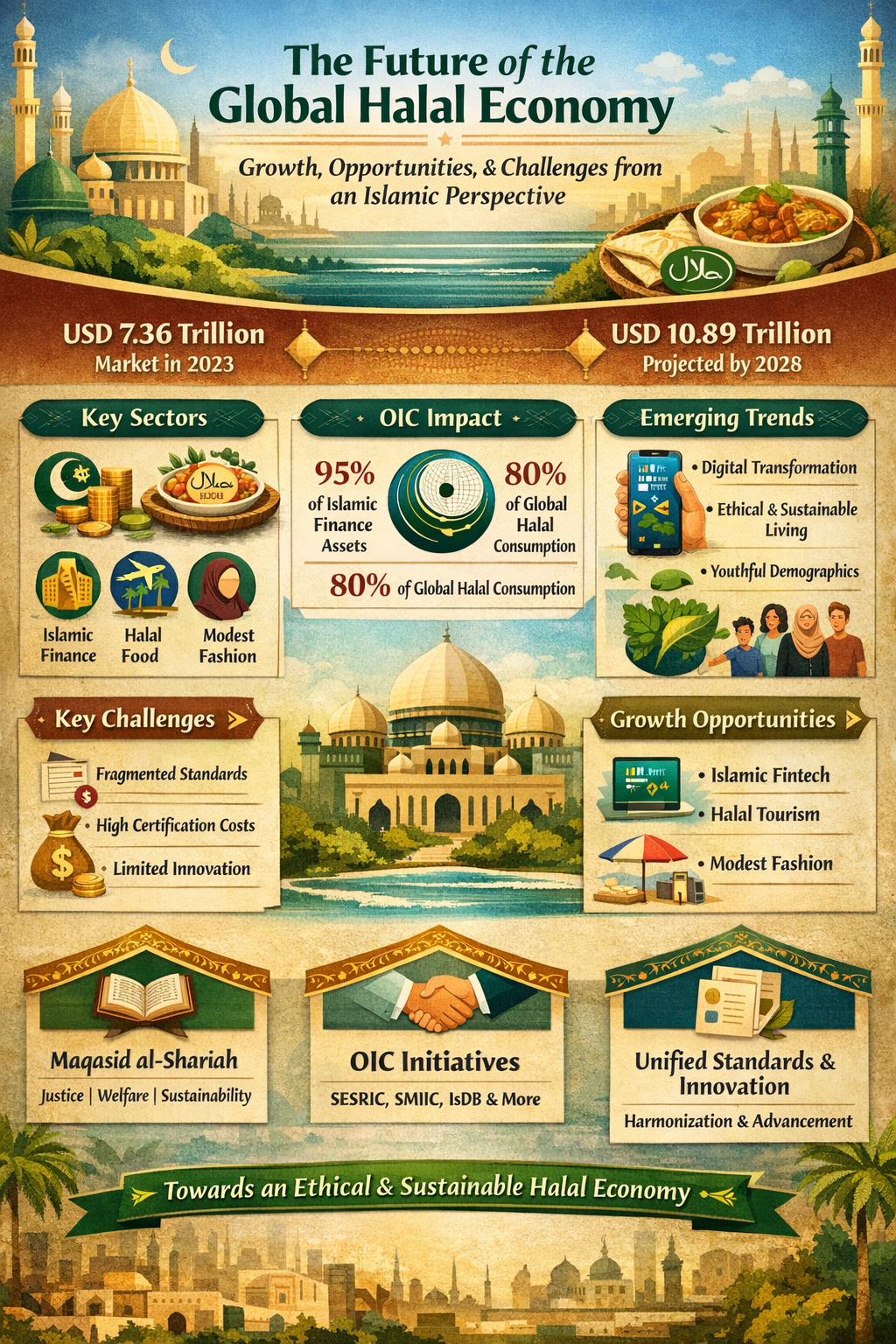
The global halal economy has undergone a profound transformation in recent decades, evolving from a niche market rooted in religious dietary laws into a dynamic, multi-sector global ecosystem. According to the latest Halal Industry Outlook Report published by the Statistical, Economic and Social Research and Training Centre for Islamic Countries (SESRIC), the halal economy was valued at USD 7.36 trillion in 2023 and is projected to reach USD 10.89 trillion by 2028. This rapid expansion reflects not only demographic and economic trends but also a deeper global shift toward ethical, sustainable, and value-based consumption.
From an Islamic perspective, the concept of halal extends far beyond permissibility; it represents a comprehensive ethical framework encompassing justice, transparency, sustainability, and social responsibility. This article examines the current state, emerging trends, key challenges, and future opportunities within the halal economy through the lens of Islamic teachings. It also explores the role of OIC institutions and policy initiatives in shaping a more integrated and resilient halal ecosystem.
The article argues that the future of the halal economy lies not merely in scaling production or expanding markets but in aligning economic activity with the higher objectives of Shariah (Maqasid al-Shariah), ensuring that growth is inclusive, ethical, and beneficial to humanity and the environment.
Introduction
The halal economy today represents one of the most significant and fastest-growing segments of the global economic landscape. What began as a system primarily concerned with food and dietary compliance has evolved into a comprehensive ecosystem that spans Islamic finance, halal food, pharmaceuticals, cosmetics, tourism, modest fashion, logistics, and digital services.
This transformation is not accidental. It reflects both the growing global Muslim population and a broader shift in consumer behavior toward ethical and sustainable consumption. Increasingly, consumers—Muslim and non-Muslim alike—are seeking products and services that align with their values, including transparency, environmental responsibility, and social justice.
From an Islamic perspective, this evolution represents a return to the true essence of halal. Islam does not view economic activity as separate from ethical responsibility. Rather, it integrates faith, commerce, and social welfare into a unified framework. The Qur’an repeatedly emphasizes that lawful (halal) must also be good (tayyib), highlighting that permissibility alone is not sufficient without ethical integrity.
The SESRIC Halal Industry Outlook Report provides valuable insights into the current state of the halal economy, identifying key trends, challenges, and opportunities. However, to fully understand the significance of these developments, it is necessary to examine them through the lens of Islamic principles.
This article seeks to do precisely that.
The State of the Global Halal Economy
A Multi-Sector Global Ecosystem
The halal economy has evolved into a complex, interconnected ecosystem that spans multiple industries. It is no longer confined to food production but includes:
Islamic finance
Halal food and beverages
Pharmaceuticals and cosmetics
Tourism and hospitality
Modest fashion
Logistics and supply chain services
Digital platforms and fintech
This diversification reflects the holistic nature of Islam itself. Halal is not merely a dietary guideline but a comprehensive system governing all aspects of life, including economic behavior.
The Qur’an states:
“O you who believe, eat from the good things We have provided for you…”
(Qur’an 2:172)
This verse emphasizes not only permissibility but also quality, ethics, and gratitude—principles that extend beyond food into all areas of economic activity.
Market Size and Growth
According to SESRIC, the global halal economy was valued at USD 7.36 trillion in 2023 and is projected to reach USD 10.89 trillion by 2028. This growth trajectory highlights the increasing importance of halal markets in global trade and development.
Several factors contribute to this growth:
Population expansion in Muslim-majority countries
Rising middle-class incomes
Increased awareness of halal standards
Expansion into non-traditional sectors
From an Islamic perspective, economic growth is encouraged, but it must be accompanied by justice and ethical conduct. Wealth is not an end in itself but a means to achieve social welfare and human development.
The Central Role of OIC Countries
OIC member states play a dominant role in the halal ecosystem:
Approximately 95% of global Islamic finance assets are held within OIC countries
Over 80% of global halal consumption originates from these countries
This concentration highlights both strength and responsibility. OIC countries are not merely participants in the halal economy; they are its custodians.
Islam teaches:
“You are the best nation produced [as an example] for mankind…”
(Qur’an 3:110)
This verse implies responsibility—not superiority—for ethical leadership in global economic systems.
Emerging Trends in the Halal Economy
Demographic Growth and Youth Influence
One of the most significant drivers of halal market expansion is demographic growth. The global Muslim population is young, dynamic, and rapidly expanding.
This demographic reality has several implications:
Increased demand for halal products and services
Greater digital engagement
Higher expectations for ethical and sustainable practices
Young Muslims are increasingly conscious of environmental issues, social justice, and ethical consumption. They are not satisfied with halal compliance alone; they seek alignment with broader values.
Digital Transformation
Digital technologies are reshaping the halal economy in profound ways:
Fintech solutions enabling Islamic finance
AI-driven supply chain management
E-commerce platforms expanding halal market access
Blockchain for traceability and transparency
From an Islamic perspective, technology is a tool that must be used responsibly. It should enhance transparency, reduce injustice, and promote efficiency.
Ethical and Sustainable Consumption
There is growing global interest in ethical consumption. Halal naturally aligns with this trend, as it emphasizes:
Cleanliness and purity
Ethical sourcing
Social responsibility
Non-Muslim consumers are increasingly drawn to halal products for these reasons, positioning halal as a global ethical standard.
Key Challenges Facing the Halal Industry
Fragmented Certification Systems
One of the most pressing challenges is the lack of harmonization in halal certification. Different countries and organizations apply varying standards, creating confusion and inefficiencies.
This fragmentation contradicts the Islamic principle of unity (ummah). Greater standardization is needed to ensure consistency and trust.
High Compliance Costs
Small and medium enterprises (SMEs) often struggle with the cost of certification and compliance. This creates barriers to entry and limits innovation.
Islam encourages ease and fairness:
“Allah intends for you ease and does not intend for you hardship…”
(Qur’an 2:185)
Reducing unnecessary burdens is therefore an ethical imperative.
Limited Innovation and Data Gaps
Many halal industries face challenges related to:
Weak research and development capacity
Lack of reliable data
Limited technological adoption
These gaps hinder competitiveness and growth.
Weak Intra-OIC Trade Integration
Despite shared values, trade among OIC countries remains below potential. Strengthening economic cooperation is essential for building a unified halal ecosystem.
Opportunities for Growth and Transformation
Expanding Muslim Population
The global Muslim population is projected to approach 3 billion by 2060. This represents a significant long-term growth driver for halal markets.
However, this growth must be managed responsibly to ensure sustainability.
Emerging Sectors
New opportunities are emerging in:
Islamic fintech
Halal tourism
Modest fashion
Digital halal platforms
These sectors offer significant potential for innovation and economic development.
Strengthening Value Chains
There is a growing need to move beyond raw material exports toward value-added production. Developing integrated halal supply chains will enhance competitiveness and economic resilience.
Policy Initiatives and Institutional Roles
OIC 2025 Programme of Action
The OIC 2025 Programme provides a strategic framework for advancing the halal industry. It emphasizes:
Economic cooperation
Trade integration
Capacity building
Role of Key Institutions
Several institutions play a critical role:
SESRIC (research and policy analysis)
SMIIC (standardization)
COMCEC (economic cooperation)
ICDT (trade development)
IsDB (financial support)
These organizations collectively contribute to building a cohesive halal ecosystem.
Islamic Perspective on Governance and Sustainability
Maqasid al-Shariah
The ultimate objective of Islamic economic systems is to achieve the Maqasid al-Shariah:
Protection of faith
Protection of life
Protection of intellect
Protection of wealth
Protection of lineage
Halal industry development must align with these objectives.
Justice and Accountability
Islam emphasizes justice and accountability in all economic activities. Governance frameworks must ensure transparency, fairness, and ethical conduct.
Environmental Stewardship
Islam teaches that humans are stewards of the earth. Sustainable practices are therefore a religious obligation.
The Future of the Halal Economy
The future of the halal economy lies in integration:
Integration of ethics and commerce
Integration of technology and transparency
Integration of sustainability and growth
Halal must evolve from compliance to a comprehensive ethical system.
Conclusion
The halal economy stands at a pivotal moment. Its rapid growth presents both opportunities and responsibilities.
From an Islamic perspective, the true success of the halal industry lies not in its size but in its alignment with divine principles. Economic growth must be accompanied by justice, sustainability, and social welfare.
The SESRIC report highlights the immense potential of the halal economy. However, realizing this potential requires:
Strong governance
Unified standards
Technological innovation
Ethical commitment
Ultimately, the halal economy has the potential to become a global model for ethical and sustainable development—one that reflects the timeless values of Islam while addressing the challenges of the modern world.
Yours sister,
Dr. Thamina Anwar
CEO and Founder
Global Halal Shura Hub
Please join the Global Halal Shura Hub Community
📱 WhatsApp Community
👉 https://chat.whatsapp.com/CZJshg7AycWFJd3CyhSWj3
🌐 Website
https://globalhalalshurahub.com
📧 Email
thaminaanwar11@gmail.com; globalhalalshurahubsocialmedia@gmail.com
📘 Facebook
https://www.facebook.com/profile.php?id=61588247732733
https://www.facebook.com/profile.php?id=61588077462429
📷 Instagram
https://www.instagram.com/globalhalalshurahub/
🔗 LinkedIn
https://www.linkedin.com/in/dr-thamina-anwar-806124145/
https://www.linkedin.com/in/global-halal-shura-hub-dr-thamina-samina-anwar-05418b398/
📺 YouTube Channel
https://www.youtube.com/@GlobalHalalShuraHub
#globalhalalshurahub