
The Justifying Framework : Sincerity, Structure, and the Unlearned Lessons of Islamic Finance
After more than five decades of institutional development, billions in assets under management, and the establishment of global regulatory frameworks, Islamic finance has arrived at a profound and uncomfortable standstill. The global Islamic finance industry surpassed $5 trillion in assets in 2025, with forward-looking projections suggesting total assets are on track to cross $6 trillion by the end of 2026. We have built an industry that looks like a bank, speaks like a bank, and creates debt like a bank, yet we continue to call it “Islamic.” When confronted with the empirical evidence of this failure—the persistent replication of Riba, the benchmarking against interest rates, and the avoidance of real-world risk—the industry unfailingly retreats into a singular, unassailable fortress: the “purity of intent.”
This is the justifying framework of our era. We operate under the comfortable shade of a collective excuse: that because our practitioners are sincere, because our scholars are pious, and because our community genuinely seeks a “Halal” alternative, the system must, by definition, be moving toward the truth. We treat sincerity (Niyyah) not as a private virtue for the afterlife, but as a structural variable that can somehow compensate for a broken architecture.
This is a delusion. Sincerity has been weaponized as a psychological buffer, a “Search Function” for comfort rather than truth. It allows the practitioner to live in the “Domain of Management” while pretending to remain in the “Domain of Obligation.” The hard truth is that sincerity is structurally irrelevant to systemic output. A sincere pilot cannot fly a plane whose wings are made of lead, and a sincere Muslim cannot operate a debt-logic architecture without producing Riba. We have traded the Command of Allah for the Comfort of Intent, and in doing so, we have built a graveyard of ethical aspirations.
1. The Corruption of Intention
1.1 The Quranic Foundation: Niyyah and Its Limits
The Quran and Sunnah place immense emphasis on intention. The Prophet Muhammad (peace be upon him) famously declared, “Verily, actions are judged by intentions.” This hadith, narrated by Umar ibn al-Khattab and recorded in Sahih al-Bukhari and Sahih Muslim, forms one of the cornerstones of Islamic ethics. Sincerity of purpose—Ikhlas—is the currency of the Hereafter. It distinguishes the righteous from the hypocrite, the worshipper from the show-off, the seeker of truth from the seeker of status.
But there is a profound and often overlooked corollary: sincerity does not transform falsehood into truth. A man who sincerely believes that wine is permissible and drinks it with pure intention remains in a state of sin. A merchant who sincerely intends to avoid deception but uses false scales remains a cheater. The Quran makes this distinction explicit. In Surah Al-Baqarah, Allah commands: “O you who have believed, do not consume usury (riba), doubled and multiplied, but fear Allah that you may be successful” (Quran 3:130). The prohibition is absolute, unconditional, and indifferent to the subjective state of the actor.
The Islamic legal tradition has always understood this distinction. The science of jurisprudence (usul al-fiqh) distinguishes between the inner state of the actor (niyyah) and the outer compliance of the act (hukm). A valid intention does not render a prohibited act permissible. It may mitigate culpability in the Hereafter, but it does not alter the objective legal status of the transaction in this world. This is not a minor technicality; it is a foundational principle of Islamic law.
1.2 The Industry’s Inversion: Sincerity as Structural Compensator
Yet the contemporary Islamic finance industry has quietly inverted this principle. In the current sector, sincerity acts as a structural lubricant for compromise. Because the actor wants to do the right thing, they believe that a “just-compliant-enough” structure is a stepping stone rather than a permanent trap. We frame our failures as “temporary accommodations” or “stages of transition,” ignoring the fact that these stages have no end date.
This creates a fundamental rupture between the person and the institution. The individual may be deeply sincere, but the institution is mechanical and cold (while generating wealth for shareholders). The institution’s “DNA”—yield parity, credit creation, liquidity requirements, and regulatory alignment—serves a master that does not recognise Niyyah. These systemic variables neutralise individual virtue with mathematical certainty.
Consider the empirical evidence. Data from the Islamic Financial Services Board (IFSB) reveals that 79% of Islamic banking financing assets are concentrated in low-risk Murabahah and Commodity Murabahah—debt-like sales structures. On the liability side, funding is anchored by non-remunerative deposits (40.7%) and Tawarruq deposits (39.1%). This is not a system of risk-sharing equity and partnership; it is a system of debt, dressed in Islamic terminology.
1.3 The Systemic Irrelevance of Individual Virtue
Sincerity does not change the gear ratio of a Riba-machine; it only makes the operator feel better while they pull the lever. When individual sincerity meets a system designed for guaranteed extraction, the system wins 100% of the time. The tragedy is not that the people are bad; it is that their goodness is being used to stabilise a system that is structurally antithetical to their values.
This is not merely an observation; it is a structural reality that can be demonstrated with mathematical certainty. In any financial system, the governing logic—the rules of the game—determines the outcomes. If the rules reward debt creation, debt will be created. If the rules require interest benchmarking, interest benchmarks will be used. If the rules prioritise yield parity, yield parity will be achieved—through whatever means necessary. The subjective virtue of individual actors cannot override the objective incentives built into the system. To believe otherwise is not faith; it is wishful thinking.
The Quran warns against precisely this form of self-deception. In Surah Al-Jathiya, Allah describes those who take their desires as their god (45:23). When we allow our desire for comfort, convenience, and competitive parity to override our obligation to obey Allah’s commands, we have effectively elevated our desires to the status of divinity. The industry’s reliance on sincerity as a structural compensator is nothing less than a form of shirk—associating human intention with divine authority to determine what is Halal and what is Haram.
2. The Scholar as a “Sanctifier of Substance”
2.1 From Governance to Sanction: The Historical Transformation
The most visible casualty in this pathology is the traditional role of the scholar. We have moved from a historical tradition where scholars governed the movement of capital to one where they merely sanctify the intent of the transaction.
In classical Islamic civilisation, the scholar (alim) occupied a position of moral and legal authority that extended into the commercial realm. Markets operated under the oversight of the muhtasib—a market inspector appointed by the state to ensure fair weights, honest transactions, and compliance with Islamic commercial law. Scholars did not merely certify contracts after the fact; they shaped the very architecture of commerce. The prohibition of Riba was not a technicality to be structured around but a fundamental constraint that defined the permissible boundaries of economic activity.
In the contemporary model, the Shariah Board has been repositioned at the end of the deal-making process. They are asked to validate the language of a contract after the economic substance has already been fixed by conventional optimisation metrics. This is not governance; it is a ritual purification of pre-determined outcomes.
2.2 The Fatwa as Certificate of Sincerity
The Fatwa has thus become a “Certificate of Sincerity.” It tells the customer:
“You do not need to look at the mechanics of this debt-based instrument, because a Sincere Man has signed it.”
This effectively kills the communal obligation of Hisbah (accountability) and replaces it with a procedural trust in a broken process.
Certification signals that the moral question has been resolved, even when the underlying structure preserves the very risk asymmetry and extraction that the prohibition of Riba was meant to restrain. When review does not interrogate outcomes, compliance reduces to hollow performance.
Critics have long identified this problem. As Jawad Ali, managing partner at Dubai-based law firm King & Spalding, noted in a Reuters interview, “40 to 50 percent of what’s being sent out is form over substance”. This assessment, made over a decade ago, remains tragically relevant. The issue is not the intention of the scholar; it is that their evaluative frame is now too narrow to address what the prohibition was actually designed to prevent.
2.3 Creative Shariah Compliance and the Form-versus-Substance Debate
The phenomenon of “creative Shariah compliance” has been extensively critiqued in the academic literature. Ahmad Alkhamees’s work, A Critique of Creative Sharīʿah Compliance in the Islamic Finance Industry, examines how Shariah supervisory board governance practices and inconsistent fatwas contribute to the problem of form over substance. The book critically appraises justifications of creative Shariah compliance practices and demonstrates how the industry has systematically prioritised legal form over economic substance.
This is not a marginal critique from the periphery of the industry. It goes to the heart of the legitimacy of the entire enterprise. If the substance of a transaction is indistinguishable from Riba—if the economic effect is identical to interest-based lending—then the fact that the contract has been certified by a scholar does not change its nature. The Prophet (peace be upon him) warned against legal stratagems (hiyal) that circumvent the spirit of the law while preserving its letter. He said: “Do not commit that which is akin to what the Jews did, making permissible that which Allah had made forbidden through trickery.”
2.4 The Quranic Mandate for Accountability
The Quran establishes a clear framework for accountability in commercial transactions. In Surah Al-Baqarah, Allah commands: “O you who have believed, when you contract a debt for a specified term, write it down. And let a scribe write [it] between you in justice” (Quran 2:282). The emphasis on writing, witnesses, and justice reflects the seriousness with which Islam treats financial obligations.
But the industry has inverted this framework. Instead of rigorous documentation and transparent accountability, we have procedural certification and trust in scholars. The scribe has been replaced by the signatory; the community of witnesses has been replaced by a small circle of experts; justice has been replaced by compliance.
The Quranic command to “write it down” is not merely a technical instruction; it is a demand for transparency and accountability. When Shariah boards operate behind closed doors, when their deliberations are opaque, and when their certifications are treated as final and unappealable, we have violated the spirit of this command. The community is entitled to know not merely that a transaction has been certified, but how that certification was reached and why the transaction is considered compliant.
3. The Illusion of Monetary Freedom
3.1 The Regulatory Excuse
We often blame the banking license for this failure. Critics and practitioners alike argue that the constraints of the fractional reserve system, the demands of central banks, and the necessity of capital adequacy force us into debt-logic. The narrative suggests that if we only had more regulatory freedom, the “Halal” nature of our finance would flourish. However, the data suggests a much darker reality.
Islamic banking assets comprise roughly 75% of the $5 trillion global industry. These are the assets under the strict “imprisonment” of the banking license. As noted, 79% of financing assets are concentrated in low-risk Murabahah and Commodity Murabahah—debt-like sales structures. But the problem is not confined to banking.
3.2 The Sukuk Evidence
Look at the remaining 25%—dominated by Sukuk, which reached approximately $1 trillion outstanding globally by the third quarter of 2025. Sukuk operate in the capital markets, largely outside the strict fractional reserve constraints of traditional banking. Yet, they revert unerringly to debt and Riba.
Sukuk, marketed as “asset-backed certificates” or “participation certificates,” are consistently engineered to function as fixed-income debt. They prioritise principal protection, guaranteed return of capital through “purchase undertakings,” and benchmark-linked yields. Research indicates that debt-based Sukuk, particularly Ijarah and Murabahah, have historically accounted for approximately 70–80% of the Sukuk market value.
Even with the freedom of the capital markets, the architects of Sukuk used that freedom not to innovate, but to IMITATE. Common features of conventional bonds are replicated in Sukuk via late penalty payment upon default, trading of debt-based Sukuk, purchase undertakings in equity-based structures, and ownership status in asset-based transactions. From a practitioner’s perspective, Sukuk—despite their unique characteristic of being Shariah-compliant—are commonly structured as debt-based instruments, with features similar to conventional bonds.
This illustrates, to my great living nightmare, that the banking license is not the cause of the behaviour; it is merely a convenient outlet for it. The toxicity is not regulatory; it is foundational. It is a refusal to accept the reality of loss and the “Refusal to Collapse Time.”
3.3 The Preference for Certainty Over Submission
The industry’s unwavering preference for fixed returns and principal protection reveals a deeper spiritual problem. The Quran repeatedly emphasises that risk and reward are inseparable. In Surah Al-Baqarah, Allah says: “And if someone is in hardship, then [let there be] postponement until [a time of] ease. But if you give [from your right as] charity, it is better for you, if you only knew” (Quran 2:280). The verse encourages lenders to forgive debts entirely, recognising that the creditor’s claim is not absolute and that mercy is superior to extraction.
But the modern Islamic finance industry has constructed an elaborate architecture designed to eliminate precisely this uncertainty. Purchase undertakings, collateral arrangements, and credit enhancements are deployed to ensure that the investor never bears real loss. This is not risk-sharing; it is risk-transfer disguised as partnership. It is the financial equivalent of having your cake and eating it too—participating in the upside of an enterprise while being insulated from its downside.
The Prophet (peace be upon him) said: “Profit is contingent upon liability.” This hadith, recorded by the companions, establishes a fundamental principle of Islamic commercial law: the right to profit is tied to the assumption of risk (al-kharaj bi al-daman). One cannot claim the rewards of ownership while disclaiming its burdens. Yet this is precisely what the contemporary Sukuk structure achieves—investors enjoy fixed returns comparable to conventional bonds while being structurally insulated from the risks that should accompany those returns.
4. The Dominance of Debt-Based Thinking
4.1 Debt-Logic as Civilisational Infection
The problem is not the “Bank”; it is a civilisational Debt-Logic that has infected the modern Muslim mind. The industry has built many different pipes—Banks, SPVs, Takaful, Sukuk, and Fintech platforms—but they all carry the same contaminated water. This is because the “Optimisation” hierarchy governs every move.
When the goal is market parity, every instrument must mirror the conventional world. The investors demand the same returns, the risk committees demand the same certainty, and the institutional leadership shares the same “Fear of Contraction.” The $1 trillion Sukuk market proves that the “Death of Sincerity” is not an accident of law. It is a structural choice made by people who refuse to allow capital to be truly exposed to the uncertainty of the future.
4.2 Tawarruq: The Legal Stratagem as Industry Standard
Perhaps the most damning evidence of the industry’s debt-logic is the widespread acceptance of Tawarruq—a controversial financial transaction that many scholars regard as a disguised form of Riba. Tawarruq involves a person buying a commodity on deferred payment terms and then selling it immediately to a third party for cash at a lower price, effectively generating a cash advance with an embedded interest charge.
The International Fiqh Academy and numerous fatwa bodies have issued resolutions prohibiting organised banking Tawarruq. Resolution No. 307, issued by the General Iftaa’ Department of Jordan, declared that “Organized Banking Tawarruq is Forbidden from the Perspective of the Higher Objectives of Sharia” because it has a negative impact on the Islamic economy—there is no real growth nor rotation of economic sectors.
Despite these scholarly warnings, Tawarruq remains a standard tool in the Islamic banking industry. As one observer notes, while practical, Tawarruq exposes practitioners to strong criticism as a disguised form of Riba. In some jurisdictions, particularly where Islamic banking is still developing, heavy reliance on Tawarruq may risk scholarly objections and credibility loss among the Muslim community.
The Quran anticipates precisely this form of legal manipulation. In Surah Al-Baqarah, Allah commands: “Do not consume one another’s wealth unjustly or send it [in bribery] to the rulers in order that [they might aid] you [to] consume a portion of the wealth of the people in sin, while you know [it is unlawful]” (Quran 2:188). The prohibition on consuming wealth unjustly is not limited to explicit interest charges; it extends to all forms of exploitation, trickery, and manipulation.
4.3 The Structure-Objective Mismatch
Academics have identified what they call the “structure-objective mismatch” in Islamic finance. The abolition of interest and promotion of growth with equity were goals of the conceived system, but the actual structures deployed have consistently prioritised debt-based instruments over equity-based partnerships.
This mismatch is not accidental. It reflects a fundamental tension between the objectives of Islamic finance and the operational requirements of modern financial markets. Equity-based contracts like Musharakah and Mudarabah—which embody the risk-sharing ideal—are complex, require ongoing monitoring, and expose financiers to real losses. Debt-based contracts like Murabahah and Ijarah are simpler, generate predictable returns, and align with conventional banking practices.
But the Quran does not promise that obedience will be easy or convenient. In Surah Al-Baqarah, Allah (SWT) says: “Fighting has been enjoined upon you while it is hateful to you. But perhaps you hate a thing and it is good for you; and perhaps you love a thing and it is bad for you. And Allah knows, while you know not” (Quran 2:216). The path of submission is not the path of least resistance. It is the path of obedience, regardless of cost, convenience, or competitive disadvantage.
4.4 The Economic Consequences of Debt-Logic
The preference for debt-based instruments has profound economic consequences. Tawarruq transactions, as one scholar observed, “do not represent any real economic activity and are simply a coverup”. The entire structure exists to generate a financial return without engaging in genuine trade, production, or partnership. This is finance for the sake of finance—precisely the phenomenon that the prohibition of Riba was meant to constrain.
The Quran’s critique of Riba is not merely a prohibition of a specific transaction type; it is a critique of a worldview that prioritises the accumulation of wealth through the exploitation of time and need. In Surah Ar-Rum, Allah says: “And whatever you give for interest to increase within the wealth of people will not increase with Allah. But what you give in zakah, desiring the countenance of Allah—those are the multipliers” (Quran 30:39). Interest-seeking finance may generate returns in this world, but it is barren in the sight of Allah.
5. The Axis Shift: Heart to Soul
5.1 The Necessity of Structural Reform
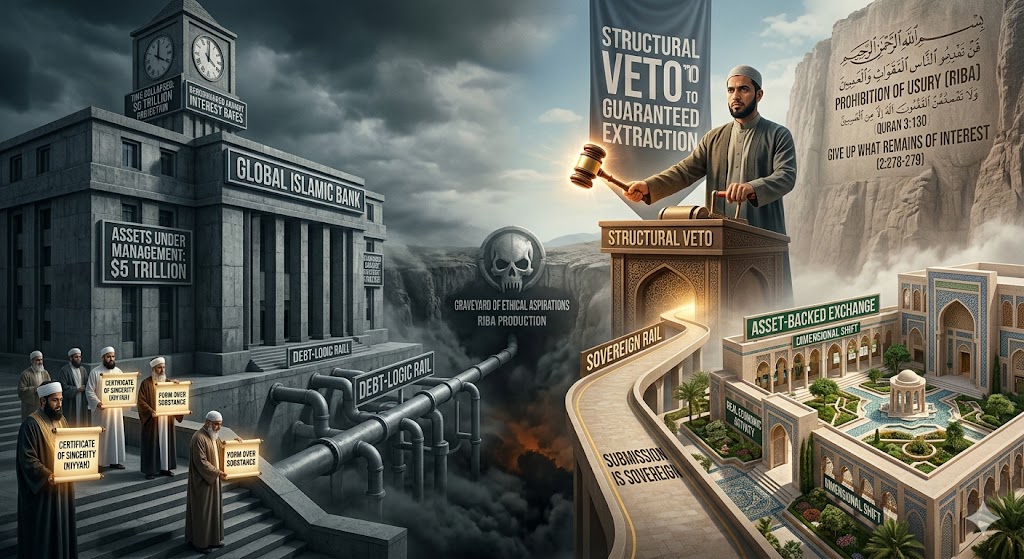
If sincerity is dead as a governing force, we must stop trying to “fix” the Muslims in the system and start fixing the system itself. We do not need better people in banking; we need a better Rail. We have spent five decades waiting for a change of heart to lead to a change of structure, and it has not happened. There is no hint of it even beginning. It is time to accept that the “System Is the Outcome.”
A true Islamic financial architecture must be so structurally sound that it produces Halal outcomes even if the operator is indifferent or even malevolent. We must move from a system that relies on “Sincere and Pious People” to a system that relies on Inviolable Mechanics—structures that are physically, legally, and mathematically incapable of creating Riba. This is the shift from the “Heart” to the “Soul.”
This is not a novel insight. Scholars have long called for a recalibration of Islamic finance to realign it with its ethical and developmental objectives. Professor Mehmet Asutay, a prominent critic of the industry, has argued that while Islamic finance has grown rapidly, it has lost its moral purpose and has instead become too similar to conventional finance. He has proposed a new model called the “Islamic Moral Economy,” which puts justice, equity, and human dignity at the centre.
5.2 The Structural Power Veto
This requires the Structural Power Veto—the presence of an architect of restraint who sits above the deal-making layer and says “No” to any structure that collapses time or guarantees extraction. The Structural Veto would have the authority to reject any transaction that fails to embody genuine risk-sharing, that relies on guaranteed returns, or that replicates the economic substance of Riba regardless of its legal form.
The concept of a Power veto is deeply rooted in Islamic governance traditions. The institution of hisbah—public accountability—gave the community the right to command good and forbid evil. The muhtasib had the authority to intervene in market transactions to ensure compliance with Islamic norms. The Structural Veto is a modern instantiation of this ancient principle—a mechanism for ensuring that the system’s outputs align with its stated values.
5.3 The Asset-Backed Exchange
This requires the Asset-Backed Exchange, where value is traded in reality rather than simulated in credit. An Asset-Backed Exchange would operate on the principle that financial instruments must be backed by tangible assets, that returns must derive from real economic activity, and that risk must be genuinely shared rather than transferred.
Some alternative models are emerging. Cash Waqf, for example, has been proposed as a sustainable funding mechanism for Qard Hasan (benevolent loans) that could provide a genuine alternative to interest-based financing. Other initiatives are exploring Shariah-compliant tokenised asset financing, bridging decentralised finance with Islamic principles to unlock new sources of capital through tokenized assets. These experiments, while still marginal, point toward a different financial imagination—one rooted in assets, equity, and partnership rather than debt, leverage, and extraction.
5.4 The Dimensional Shift
This requires the dimensional Shift—the courage to operate outside the incumbent institutions and their eternal optimisation loops. We must stop trying to sanctify the bank and start building the Sovereign Rail.
A dimensional shift means abandoning the assumption that Islamic finance must compete with conventional finance on its own terms. It means rejecting the benchmark of yield parity as irrelevant to the project of submission. It means building financial institutions that are structurally incapable of producing Riba, even if that means operating at a smaller scale, accepting lower returns, or remaining marginal to the global financial system.
The Quran provides a clear model for this kind of orthogonal thinking. In Surah Al-Baqarah, Allah (SWT) commands: “And do not mix the truth with falsehood or conceal the truth while you know [it]” (Quran 2:42). The command is to separate, to distinguish, to draw clear lines between the permissible and the prohibited. Mixing—even with good intentions—is prohibited. The industry’s attempt to blend Islamic forms with conventional substances is a violation of this command, regardless of the sincerity of those involved.
6. The Grounding of Truth
6.1 The Industry’s Hidden Success
Acknowledging the death of sincerity is not an act of cynicism; it is the ultimate act of honesty and the first step toward a genuine Exit. We must recognize that the industry is not failing despite its efforts; it is succeeding at its hidden goals of parity, scale, and optimisation. It has successfully preserved the substance of Riba while cleansing its form for a pious audience.
The industry has achieved remarkable growth. From a niche experiment in the 1970s, it has grown into a $5 trillion global industry. It has established regulatory frameworks, standard-setting bodies like AAOIFI, and a sophisticated infrastructure of Islamic banks, Takaful operators, and Sukuk issuers. By any conventional measure, Islamic finance is a success story.
But success at what? The industry has succeeded at replicating conventional finance in Islamic garb. It has succeeded at generating competitive returns for investors. It has succeeded at achieving scale and integration into global financial markets. What it has not succeeded at is submission to the command of Allah regarding Riba.
6.2 The Power of Submission
Submission does not require proof of competitive outperformance or the validation of a global benchmark. Its legitimacy derives from the Command of Allah, not from its ability to match the yield of a conventional competitor.
This is the fundamental theological error of the contemporary Islamic finance project. We have inverted the hierarchy. We treat the market as sovereign and submission as subordinate.
We ask: “How can we design Islamic products that compete with conventional products?” rather than “How can we design products that submit to Allah (SWT)’s commands, regardless of their competitive position?”
The Quran is explicit about the sovereignty of Allah’s commands. In Surah Al-Ahzab, Allah says: “It is not for a believing man or a believing woman, when Allah and His Messenger have decided a matter, that they should [thereafter] have any choice about their affair” (Quran 33:36). The command regarding Riba is clear and unequivocal. There is no room for reinterpretation, optimisation, or competitive benchmarking. The prohibition stands.
6.3 The Reversal of the Governing Hierarchy
Until we reverse the governing hierarchy—until obedience becomes sovereign and optimisation is correctly recognized as subordinate—we will remain structurally indistinguishable from the system we claim to critique.
The solution is the construction of a rail where the Veto sits above the deal, where time is not collapsed, and where Submission is the primary metric of success. We do not need a change of heart; we need an exit from dominant global debt and credit infrastructure. No other measure is appropriate for this endeavour of sincere Muslims.
This reversal requires a fundamental reorientation of the industry’s self-understanding. It requires abandoning the assumption that Islamic finance must be “banking” at all. It requires recognising that the modern banking model—with its fractional reserves, credit creation, and interest-based pricing—is fundamentally incompatible with the prohibition of Riba, regardless of how many scholars certify its products.
6.4 The Break Has Been Definitively Established
The fractural division is complete, and the foundation of truth is the only place left to stand.
The Quran offers a powerful image of this division – Loud and Clear: In Surah Al-Baqarah, Allah (SWT) commands the believers to abandon Riba entirely: “O you who have believed, fear Allah and give up what remains [due to you] of interest, if you should be believers. And if you do not, then be informed of a war [to be waged] from Allah and His Messenger” (Quran 2:278-279). The command is stark and unconditional. There is no middle ground, no transitional accommodation, no “just-compliant-enough” structure that can substitute for full compliance. It must be firmly acknowledged that the commands of Allah (SWT) are definitive, possessing a conclusive authority that admits no ambiguity or interpretive uncertainty. This issue is not subject to grey areas; it is clearly articulated and conclusively determined.
Therefore, the fractural division between the Islamic finance industry and the Quranic command is now complete. The industry has chosen optimisation over obedience, parity over purity, and sincerity over structure. It has built a pyramid to its own ingenuity while ignoring the clear command of Allah (SWT). The time for half-measures is over. The time for structural change is now.
Conclusion: The Next Phase
We have spent five decades building an industry that looks like a bank, speaks like a bank, and creates debt like a bank, while calling it “Islamic“. We have relied on “sincerity of the so-called scholars” as a structural compensator, treating good intentions as a substitute for sound architecture. We have transformed scholars from governors of capital into sanctifiers of substance. We have blamed the banking teller booth while ignoring the fact that even outside that banking booth, our instruments revert unerringly to debt and Riba. This is what Islamic banking has turned into. This urgently needs reform if we hope to face Allah (SWT) and attain Jannah (paradise).
The next phase forward requires courage—
- the courage to admit that the current model has failed,
- the courage to abandon the pursuit of competitive parity, and
- the courage to build something genuinely different.
- the courage to create the required Structural Power Veto, the Asset-Backed Exchange, and the Dimensional change.
- the courage to create the “moving from the Heart to the Soul” mindset.
- the courage to create a “Movement of Change” – We Muslims—and all those seeking ethical justice in finance—need to wake up and begin this movement of change. This is the time. Ultimately, we are answerable to Allah (SWT). Remember, one day we will all return to Allah (SWT)/God.
But most of all, it requires remembering that the legitimacy of Islamic finance derives from the Command of Allah (SWT), not from its ability to match the yield of a conventional competitor. The Quran asks of us not success, but submission. Not growth, but obedience. Not scale, but sincerity—sincerity not as a buffer against structural failure, but as the foundation for structural transformation.
Why is there a reluctance to critically examine those scholars who certify financial products as ‘Shariah-compliant’? In many cases, such certifications are shaped by financial incentives, while in others, interpretive ambiguities are employed to justify rulings that do not fully align with the spirit of what is genuinely halal. This raises broader concerns about the integrity of contemporary scholarly authority, where formal credentials from madrasas and Islamic universities do not necessarily reflect the levels of piousness and sincerity traditionally expected. Accordingly, there is a pressing need for rigorous inquiry, ethical reflection, and critical engagement. Ultimately, accountability rests with each individual, as every person will stand before Allah (SWT) and answer for their own deeds. So we need to do our own homework before making a decision to engage with a halal product or not as we cannot rely on the certification. In light of these concerns, personal due diligence becomes essential when evaluating whether a product is truly halal, as certification cannot be accepted uncritically.
The foundation of truth is the only place left to stand. From that ground, we can begin the long work of building something that is truly, structurally, irreducibly Islamic. May Allah (SWT) guide us to that work and accept it from us. And may Allah (SWT) forgive us for the decades we spent prioritising our own intellect and desires for wealth over Allah (SWT)’s command. Ameen.
Note: The picture above tells the whole story.
References
Quranic references cited from the Sahih International translation unless otherwise noted.
-
Islamic Financial Services Board (IFSB). Islamic Banking Prudential and Structural Indicators Data, Q1 2024.
-
ICD-LSEG Islamic Finance Development Report, 2023.
-
Alkhamees, Ahmad. A Critique of Creative Sharīʿah Compliance in the Islamic Finance Industry. Brill, 2017.
-
Asutay, Mehmet. “Islamic Moral Economy: A New Model for Islamic Finance.” UIII, 2025.
-
General Iftaa’ Department, Jordan. Resolution No. 307: “Organized Banking Tawarruq is Forbidden from the Perspective of the Higher Objectives of Sharia.” 2022.
-
Khan, Tariqullah. IFSB Data: Islamic Banking Balance Sheet Analysis, 2024.
-
Outer Temple Chambers. “The crisis Islamic finance was built to solve – and cannot.” Oliver Agha, Islamic Finance News, 2026.
-
Reuters. “Sharia boards face scrutiny amid financial crisis.” 2010.
-
Rudnyckyj, Daromir. Beyond Debt: Islamic Experiments in Global Finance. University of Chicago Press, 2019.
Yours Sister,
Dr. Thamina (Samina) Anwar
CEO & Founder
Global Halal Shura Hub
🌐 Connect With Us
📱 WhatsApp Community:👉 https://chat.whatsapp.com/KrWXFhHBuy6BkA3s4LYKQ2
🌐 Website: https://globalhalalshurahub.com
📧 Email: globalhalalshurahubsocialmedia@gmail.com
📷 Instagram:
https://www.instagram.com/globalhalalshurahub/
🔗 LinkedIn:
https://www.linkedin.com/in/dr-thamina-anwar-806124145/
https://www.linkedin.com/in/global-halal-shura-hub-dr-thamina-samina-anwar-05418b398/
📺 YouTube: https://www.youtube.com/@GlobalHalalShuraHub