
I’ve just completed this paper for the American non-Muslim community. I currently sit on the board of Mutual Aid, led by my wonderful friend Stephanie Rearick (President), based in Madison, Wisconsin.
https://mutualaidnetwork.org/team
Stephanie and I met 12–13 years ago in Aotearoa New Zealand. She had been invited by the government because of her exceptional work in community development through cooperative models—which, in many ways, are deeply aligned with Islamic principles. At the same time, I had been invited to speak in Christchurch. That’s where our paths crossed, and a lasting friendship began.
She often says that the highlight of her three weeks in Aotearoa New Zealand was learning about waqf from me. Ya Allah—what a truly sweet and generous soul she is.
When this girl (Stephanie) asks me to do something, I can never say no. This paper is my contribution to a larger work she will be presenting in Brazil later this year, and I’m grateful to be part of something that bridges communities, values, and shared visions of justice and cooperation.
Note: This paper is written for both Muslim and non-Muslim audiences; therefore, certain terminologies have been adapted to ensure clarity and accessibility for a diverse readership.
Here’s the unedited Abstract
—–
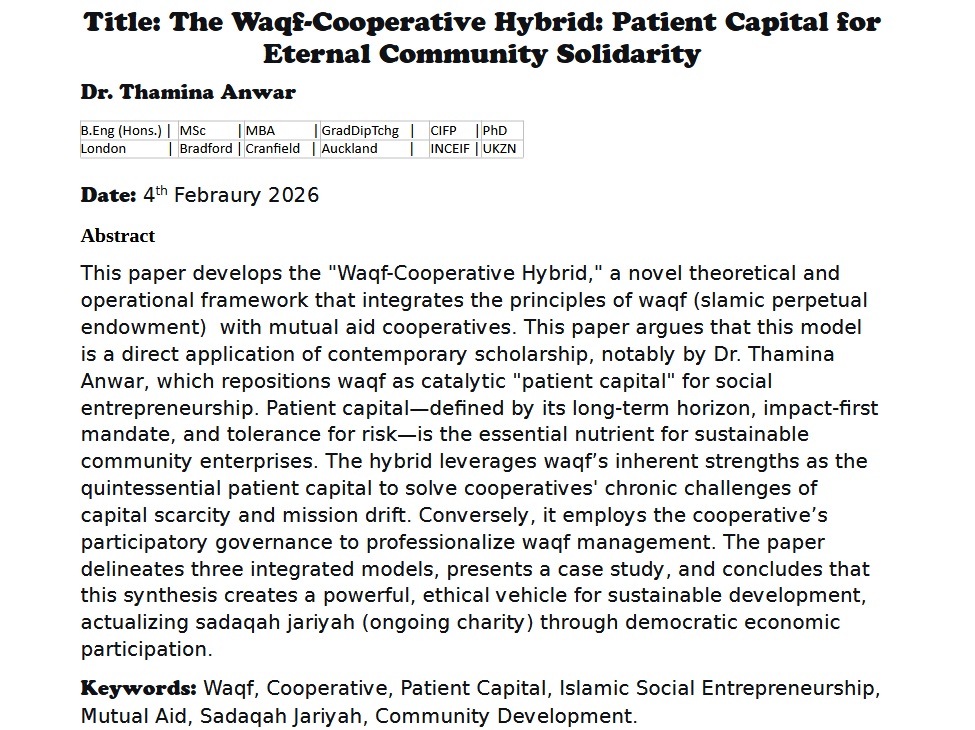
This paper develops the “Waqf-Cooperative Hybrid,” a novel theoretical and operational framework that integrates the principles of waqf (slamic perpetual endowment) with mutual aid cooperatives. This paper argues that this model is a direct application of contemporary scholarship, notably by Dr. Thamina Anwar, which repositions waqf as catalytic “patient capital” for social entrepreneurship. Patient capital—defined by its long-term horizon, impact-first mandate, and tolerance for risk—is the essential nutrient for sustainable community enterprises. The hybrid leverages waqf’s inherent strengths as the quintessential patient capital to solve cooperatives’ chronic challenges of capital scarcity and mission drift. Conversely, it employs the cooperative’s participatory governance to professionalize waqf management. The paper delineates three integrated models, presents a case study, and concludes that this synthesis creates a powerful, ethical vehicle for sustainable development, actualizing sadaqah jariyah (ongoing charity) through democratic economic participation.
Keywords: Waqf, Cooperative, Patient Capital, Islamic Social Entrepreneurship, Mutual Aid, Sadaqah Jariyah, Community Development.